
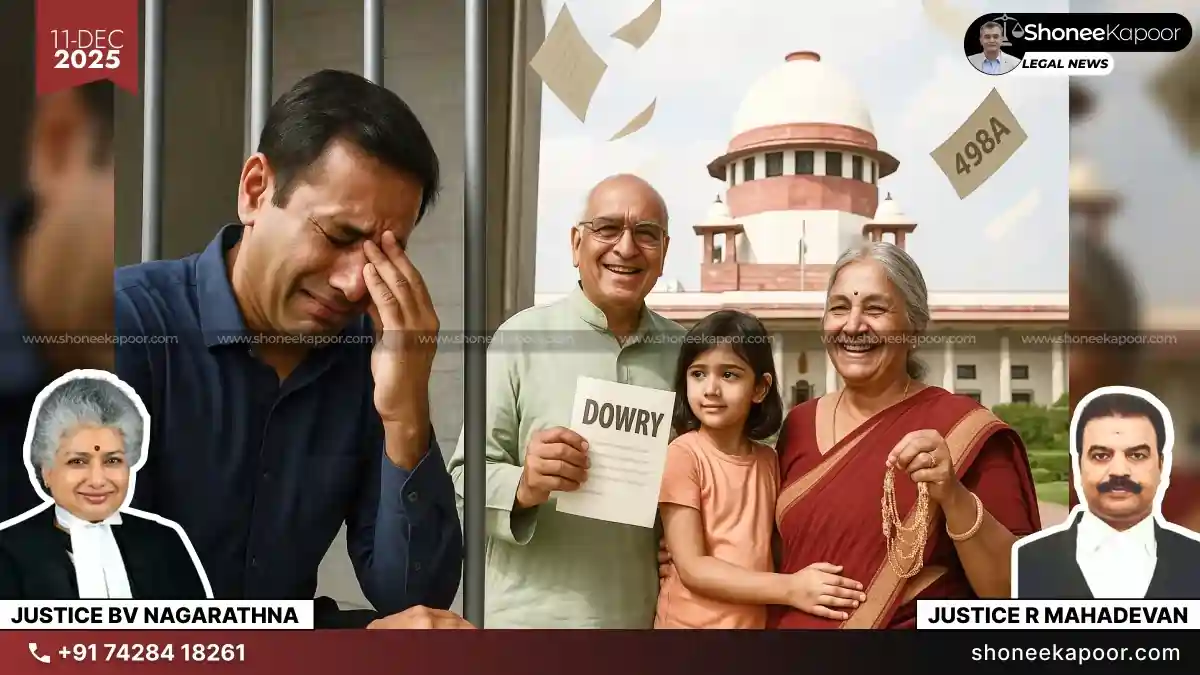
Man Fought Decades Against A Charge That Never Even Existed In Law | Demand Of Gold At Child’s Chhoochhak Ceremony Not Dowry Demand: Supreme Court

Written and analysed by Shonee Kapoor
Legal Consultant, Author & Men's Rights ActivistThe Supreme Court held that asking for gold during a child’s Chhoochhak ceremony is not a dowry demand under Section 304B IPC. The husband’s dowry-death conviction was cancelled, but his 498A conviction was kept because he had already completed more than the sentence.
NEW DELHI: The Supreme Court of India has cancelled the conviction of a man for dowry death after clearly holding that asking for gold ornaments during the Chhoochhak ceremony, which is performed after the birth of a child, cannot legally be considered a dowry demand.
The Court explained that Section 304B IPC applies only when the demand for property or security is made “in connection with the marriage”, and not when relatives ask for items during a child-birth ceremony or other customary rituals.
In the words of the Court:
“We find that the said demand made for gold ornaments at the time of the Chhoochhak ceremony cannot be considered to be a dowry demand. It could have been a demand which was made not in connection with the marriage of the said parties, but at the time of the birth of the child, whereas a dowry demand within the meaning and scope of 304B IPC should be any property or security given or agreed to be given in connection with the marriage”.
This reasoning was given by the bench of Justices BV Nagarathna and R Mahadevan.
For taking this view, the bench relied on an earlier Supreme Court judgment Satvir Singh v. State of Punjab (2001). In that decision, the Court had explained the true meaning of dowry and had observed:
“There are three occasions related to dowry. One is before the marriage, second is at the time of marriage and the third is at any time after the marriage. The third occasion may appear to be an unending period.
But the crucial words are in connection with the marriage of the said parties. This means that giving or agreeing to give any property or valuable security on any of the above three stages should have been in connection with the marriage of the parties.
There can be many other instances for payment of money or giving property as between the spouses. For example, some customary payments in connection with birth of a child or other ceremonies are prevalent in different societies. Such payments are not enveloped within the ambit of dowry. Hence the dowry mentioned in Section 304B should be any property or valuable security given or agreed to be given in connection with the marriage.”
Based on this legal principle, the Supreme Court concluded that the allegation of demanding a gold ring and chain at the time of Chhoochhak ceremony could not be treated as a dowry demand. Therefore, Section 304B IPC, which deals with dowry death, was wrongly applied to the accused.
The case goes back to 1986, when the appellant Baboo Khan married Khatoon. In May 1988, their male child was born and Chhoochhak ceremony was performed. On 24 November 1988, the wife and infant child were found dead in a well. The woman’s father later filed an FIR alleging harassment and torture linked to a demand for gold ornaments during Chhoochhak.
The police filed a chargesheet under Sections 498A and 304B IPC. The Trial Court convicted the husband and gave him seven years’ imprisonment under Section 304B and one year under Section 498A. In 2015, the Rajasthan High Court upheld the conviction. The husband then approached the Supreme Court.
The Supreme Court examined the evidence, the law on dowry, and the meaning of Section 304B. After applying the principles of the Satvir Singh judgment, the Court ruled that this case did not meet the legal requirement for dowry death. The conviction under Section 304B was therefore set aside completely.
However, the Court also looked at the ingredients of Section 498A IPC and the evidence led for cruelty. It found that the offence under Section 498A was proved. The conviction under Section 498A was upheld, but the Court noted that the man had already spent one year and five months in custody, which is more than the one-year sentence awarded under this section.
So the Court decided not to impose any further punishment. Since he had earlier been granted suspension of sentence and bail, his bail bonds were cancelled.
The order finally states that the appeal is allowed in part. The conviction under Section 304B is set aside, and the conviction under Section 498A is sustained.
Explanatory Table Of All Laws & Sections Mentioned
| Law / Section | What It Means (Simple Explanation) | How It Was Applied in This Case |
| Section 304B IPC (Dowry Death) | Applies when a woman dies within 7 years of marriage and there was a dowry demand in connection with the marriage soon before her death. | The Court held that the alleged demand for gold at the Chhoochhak ceremony was not a dowry demand. Therefore, Section 304B was wrongly used and the conviction was quashed. |
| Definition of Dowry (as interpreted in Satvir Singh Case) | Dowry is any property or valuable security demanded before, during, or after marriage, but it must have a clear link to the marriage itself. | The Court relied on this principle to say that gifts asked during child-birth rituals like Chhoochhak are not dowry, as they are customary and not linked to the marriage. |
| Section 498A IPC (Cruelty by Husband or Relatives) | Punishes cruelty by husband or his relatives; maximum punishment is 3 years + fine. | The Court upheld the 498A conviction but noted the man had already undergone more custody than the 1-year sentence, so no further jail was imposed. |
| Criminal Procedure / Sentencing Principles | Higher courts can reduce or set aside convictions if evidence does not satisfy legal requirements. | The Supreme Court removed the 304B conviction and sustained only the 498A conviction. |
| Precedent: Satvir Singh v. State of Punjab (2001) 8 SCC 633 | Clarifies what counts as dowry and what customary payments fall outside the legal definition. | The Court quoted and relied on this case to explain that Chhoochhak gifts cannot be labeled “dowry.” |
Case Summary
- Case Title: Baboo Khan vs. State of Rajasthan Criminal Appeal No. 1203 of 2016 (Supreme Court of India)
- Bench: Justice B.V. Nagarathna & Justice R. Mahadevan
Counsels
- For Appellant (Husband):
- Advocate Pratiksha Sharma
- Adv. Ankit Acharya
- Adv. Ayush Jain
- Adv. Mukesh Kumar
- Adv. Ritu Chaudhary
- For State of Rajasthan:
- AAG Shiv Mangal Sharma
- Standing Counsel Nidhi Jaswal
- Adv. Awanitika
Key Takeaways
- Supreme Court finally clarified that every demand inside a marriage is not “dowry” and customary Chhoochhak gifts cannot be misused to frame husbands.
- The judgment exposes how easily Section 304B is invoked without meeting the basic legal requirement of a demand “in connection with the marriage.”
- A man was forced to fight for decades because the system blindly accepted a dowry-death narrative without checking whether the demand even qualified as dowry.
- The Court’s reliance on earlier precedent shows that the law has always been clear, but misuse and over-application continue to ruin men’s lives.
- Even after proving misuse of 304B, the man still carried the burden of 498A, showing how men remain trapped in one-sided criminal provisions that presume guilt.
This Could Change Your Case-Get FREE Legal Advice-Click Here!
Disclaimer: The views and opinions expressed in this article are those of the Indian courts and do not necessarily reflect the official policy or position of “ShoneeKapoor.com” or its affiliates. This article is intended for informational and educational purposes only. The content provided is not legal advice, and viewers should not act upon this information without seeking professional counsel. Viewer discretion is advised.
Related Articles
Real Court Cases Where False Allegations Backfired On Wife
Real Indian court cases where false 498A, dowry, cruelty and defamatory allegations against husbands backfired, leadi...
The Law That Forgot Its Sons: How India’s Gender Laws Turn Protection into Persecution
India’s gender laws were designed to protect women — but today, countless innocent men are being destroyed by false c...
498A FIR in India While Husband Is in Canada: What an NRI Husband Must Do Immediately Before Police, LOC or NBW Pressure Begins
An NRI husband in Canada facing 498A IPC or Section 85 BNS FIR in India must preserve evidence, check jurisdiction, a...
Share Your Thoughts
Comments are moderated before publication.