
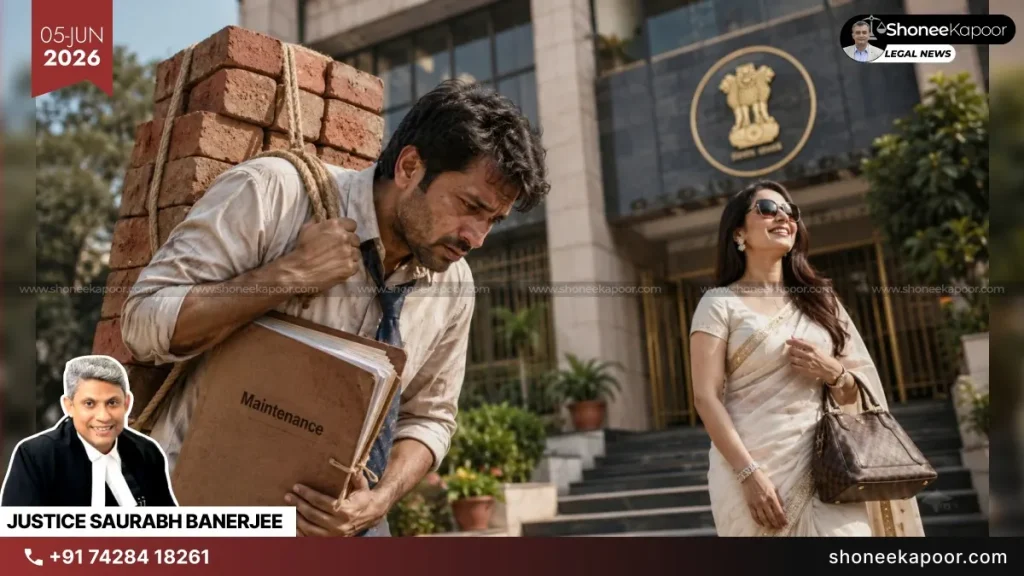
Can a husband avoid paying maintenance by claiming he has no regular income? Delhi High Court has given a clear answer—and it may surprise many readers.
NEW DELHI: The Delhi High Court refused to interfere with a Family Court order directing a husband to pay maintenance to his wife and two daughters. The Court held that a husband cannot escape his responsibility to maintain his wife and children merely by claiming that he does not have a regular source of income.
Justice Saurabh Banerjee was hearing a revision petition filed by the husband under Sections 438 and 442 read with Section 528 of the Bharatiya Nagarik Suraksha Sanhita, 2023, challenging the Family Court’s decision granting maintenance to the wife and daughters.
The Court observed:
“Be that as it may, on merits also, the records reveal that the petitioner failed to discharge his burden of proving that the respondent no.1 was capable of maintaining/ supporting herself and the two daughters residing with her. The case of the petitioner was based on bald assertions without any supporting document(s)/ evidence(s) thereto.
As held by the Hon’ble Supreme Court in Bhuwan Mohan Singh v. Meena : (2015) 6 SCC 353 and Anju Garg v. Deepak Kumar Garg, 2022 SCC OnLine SC 1314, the husband cannot escape from his liability to maintain his wife or children inasmuch as it is the legal and ethical duty of the husband to maintain them.
It is the sacrosanct duty of the husband to provide financial support to the wife and minor children, even by doing physical labour, and could not avoid his obligation. Therefore, the argument canvassed by the petitioner that he is unable to pay the maintenance on the ground that he has no regular source of income and, therefore, not in a position to pay the maintenance, is not acceptable.”
The Court further reminded the husband that a revision petition cannot be used as a second round of litigation to reopen issues already decided by the Family Court.
It stated:
“The petitioner is well aware that this is not an appeal. Therefore, under the garb of the present revision petition, the petitioner can neither reagitate the same issues, which this Court finds, have already been duly referred to and thence negated by the learned Family Court nor seek to agitate new facts which were never before the learned Family Court.
This Court cannot lose sight of the factum that for raising fresh issues, the petitioner has to take recourse to appropriate remedies as available to him under law by filing a fresh petition under Section 127 of the CrPC before the very same Court which has passed the impugned judgment based on the change of circumstances”.
The husband and wife were married in 2006 according to Hindu rites and customs. Two daughters were born from the marriage. Over time, disputes arose between the parties, and the wife returned to her parental home along with the children. She then filed a petition under Section 125 CrPC seeking maintenance for herself and the daughters. The Family Court allowed the claim, leading to the present challenge before the High Court.
While examining the record, the High Court found that the husband had not produced any convincing evidence to show that the wife was financially capable of maintaining herself and the children. The Court noted that his arguments were largely unsupported by documents or evidence.
The Court also examined the husband’s financial position. Salary slips placed on record showed that he was earning approximately ₹40,000 per month between February and April 2021.
The Court further recorded:
“Record also reveals that the petitioner had himself admittedly agreed to pay maintenance of Rs.25,000/- and Rs.30,000/- respectively to the respondents in two mediation settlements way back on 09.02.2016 and 12.10.2020, as also that he was offered employment wherein salary between Rs.80,000/- to Rs.1,00,000/- [Ex.PW1/7(colly)] was offered to him”.
The Family Court had awarded maintenance of ₹11,000 per month to each respondent. The High Court found this amount to be broadly consistent with the principles laid down in Annurita Vohra v. Sandeep Vohra (2004), which requires courts to assess the disposable income of the earning spouse while determining maintenance.
The Court ultimately concluded that the husband could not seek a fresh examination of the same issues before the High Court after having already contested them before the Family Court.
Dismissing the petition, it held:
“The petitioner is estopped from reopening his case de novo and seek to reagitate the very same facts and grounds before this Court once again”.
EXPLANATORY TABLE OF ALL LAWS AND SECTIONS MENTIONED
| LAW / SECTION | PURPOSE | HOW IT APPLIED IN THIS CASE |
| Section 438 BNSS, 2023 | Revisional jurisdiction provisions under Bharatiya Nagarik Suraksha Sanhita | Husband filed revision petition challenging Family Court order. |
| Section 442 BNSS, 2023 | Procedure relating to revision powers of higher courts | Invoked along with Section 438 BNSS. |
| Section 528 BNSS, 2023 | Saving/transition provisions connecting old CrPC proceedings with BNSS framework | Revision petition was filed under these provisions. |
| Section 125 CrPC, 1973 | Maintenance to wife, children and parents unable to maintain themselves | Wife and daughters sought maintenance under this provision. |
| Section 127 CrPC, 1973 | Alteration or modification of maintenance due to change in circumstances | Court said husband could seek remedy under Section 127 if circumstances genuinely changed. |
IMPORTANT CASES RELIED UPON BY THE COURT
| CASE | PRINCIPLE |
| Amit Kapoor v. Ramesh Chander & Anr. (2012) 9 SCC 460 | Scope of revisional jurisdiction is very limited. |
| Pyla Mutyalamma v. Pyla Suri Demudu (2011) 12 SCC 189 | High Court should interfere only where there is illegality or perversity. |
| Bhuwan Mohan Singh v. Meena (2015) 6 SCC 353 | Husband cannot avoid maintenance responsibility towards wife. |
| Anju Garg v. Deepak Kumar Garg, 2022 SCC OnLine SC 1314 | Reaffirmed maintenance obligations of husband. |
| Annurita Vohra v. Sandeep Vohra, 2004 SCC OnLine Del 192 | Introduced “Family Resource Cake” principle for calculating maintenance. |
CASE DETAILS
| PARTICULARS | DETAILS |
| Case Title | ABC v. XYZ |
| Case Number | CRL.REV.P.(MAT.) 177/2024 |
| Connected Applications | CRL.M.A. 38813/2024 & CRL.M.A. 10432/2025 |
| Court | Delhi High Court |
| Bench | Justice Saurabh Banerjee |
| Reserved On | 28 April 2026 |
| Pronounced On | 20 May 2026 |
| Neutral Citation | 2026:DHC:4517 |
| Family Court Case | MT Case No. 181/2016 |
| Impugned Judgment Date | 05 October 2024 |
| Petitioner | Husband (Name Withheld) |
| Respondents | Wife and Two Daughters (Names Withheld) |
COUNSELS
| SIDE | COUNSEL |
| Petitioner/Husband | Mr. Vijay Kinger, Ms. Roopa Nagpal, Mr. Hemant Kumar, Mr. Himanshu Kinger and Mr. Ashwani Gehlot, Advocates |
| Respondents/Wife & Daughters | Mr. Gurinder Pal Singh and Mr. Satyam Upadhyay, Advocates |
KEY TAKEAWAYS
- Courts continue to place a very high burden on husbands to prove genuine financial inability before reducing or avoiding maintenance.
- A man’s past earnings, previous job offers, and earning capacity can be used against him even when he claims present financial difficulties.
- Health problems, loan liabilities, and responsibility towards elderly parents may not automatically reduce maintenance obligations.
- Once a maintenance order is passed, reopening the same issues becomes extremely difficult unless there is strong evidence of changed circumstances.
- The case highlights the importance for men to maintain complete financial records and documentary proof, because courts are unlikely to accept unsupported claims of financial hardship.
This Could Change Your Case-Get FREE Legal Advice-Click Here!
Disclaimer: The views and opinions expressed in this article are those of the Indian courts and do not necessarily reflect the official policy or position of “ShoneeKapoor.com” or its affiliates. This article is intended for informational and educational purposes only. The content provided is not legal advice, and viewers should not act upon this information without seeking professional counsel. Viewer discretion is advised.