
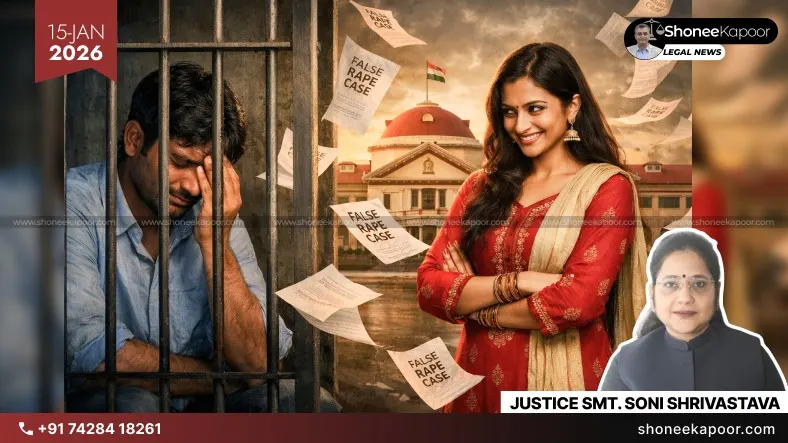
The Patna High Court has ruled that a failed consensual relationship cannot be converted into a rape case merely because marriage did not happen. Quashing the prosecution, the Court reaffirmed that criminal law cannot be misused to punish men for relationship breakdowns.
Patna: The Patna High Court has quashed a rape case registered under Section 376 IPC against the petitioner and set aside the entire prosecution holding that a consensual relationship between two adults cannot be converted into a rape case merely because the relationship did not culminate in marriage.
The case arose from an FIR lodged by a 25-year-old woman, who alleged that the accused had sexually exploited her on the promise of marriage. She claimed that she remained in a relationship with him for nearly one year and later accompanied him with cash and jewellery when he allegedly assured marriage. According to her, the marriage did not happen due to objections raised by the accused’s family members. After investigation, the police filed a charge sheet and the trial court rejected the discharge application under Section 227 CrPC. The accused then approached the High Court seeking quashing of the proceedings.
The High Court carefully examined the FIR, the statement recorded under Section 164 CrPC, and the medical evidence. The Court noted that the woman was an adult and there was no allegation of force, threat, or coercion. The medical report did not corroborate allegations of sexual assault. The Court found that the relationship was voluntary and continued for a considerable period, indicating conscious and informed consent by both parties.
The High Court further examined the overall circumstances and observed that even in the statement recorded before the Magistrate, the complainant had not clearly alleged any sexual assault. There was no material to show immediate deception at the beginning of the relationship or any dishonest intention on the part of the accused from inception. The facts indicated that the relationship failed due to family interference and changing circumstances, not because of any fraudulent inducement.
The Court emphasized that every failed relationship or broken promise of marriage cannot automatically become a criminal case of rape. For a sexual offence based on promise of marriage to survive, there must be clear material showing that the promise was false from the very beginning and that the woman consented only because of such deception.
In this context, the Court relied on Naim Ahmed vs State (NCT of Delhi) (2023) 15 SCC 385, which draws a clear distinction between a false promise to marry and a mere breach of promise due to later circumstances. The Supreme Court held that not every breach of promise amounts to rape and that criminal liability arises only when the promise was dishonest at inception.
The Court also referred to Pramod Suryabhan Pawar vs State of Maharashtra (2019) 9 SCC 608, which explains that consent must be an informed and conscious choice, and that a false promise must be shown to be dishonest at the inception and directly linked to the decision to engage in the sexual act.
The Court further relied on Prashant vs State (NCT of Delhi) (2025) 5 SCC 764, where the Supreme Court held that a breakup of a consensual relationship cannot be converted into a criminal case and that what begins as a consensual relationship cannot be given a colour of criminality merely because it does not end in marriage.
The High Court also cited Samadhan vs State of Maharashtra (2025 SCC Online SC 2528), holding that continuation of prosecution in purely consensual relationships, absent coercion, fraud, or misrepresentation, amounts to abuse of the court process.
On the issue of discharge and protection against false prosecution, the Court relied on Kanchan Kumar vs State of Bihar (2022) 9 SCC 577, holding that courts must not act like a post office and must meaningfully examine whether sufficient material exists to justify a criminal trial.
The Court further applied the principles laid down in State of Haryana vs Bhajan Lal (1992 Supp (1) SCC 335), which empowers courts to quash proceedings where allegations do not disclose any offence or where prosecution is manifestly malicious and vexatious.
The High Court held that a mature adult is capable of making informed personal decisions, including entering into relationships. When such a relationship is voluntary and consensual, criminal prosecution cannot be permitted merely because the relationship later collapses. Turning personal disappointments into criminal allegations damages the credibility of genuine victims and misuses the criminal justice system.
The Court also criticised the trial court for mechanically refusing discharge without properly examining whether the basic ingredients of the alleged offence were even made out.
Considering the entire factual background and settled legal principles, the Patna High Court concluded that the prosecution was frivolous, vexatious, and legally unsustainable. The necessary ingredients of rape under Section 375 IPC were clearly absent. Continuing the case would amount to abuse of the judicial process. Accordingly, the impugned order rejecting discharge was quashed and the entire criminal proceedings were set aside.
This judgment once again reinforces a crucial principle that consensual relationships between adults cannot be criminalised simply because emotions change, families interfere, or marriages fail to happen. Law must protect real victims, not become a tool for post-breakup revenge or legal harassment.
Explanatory table – laws and sections involved
| Law & Section | Purpose / Explanation | How Applied in This Case |
| Indian Penal Code – Section 376 | Punishment for rape | Court held ingredients of rape not made out as the relationship was consensual and not based on false promise at inception |
| Indian Penal Code – Section 375 | Definition of rape and consent | Court examined whether consent was vitiated by misconception of fact and found it voluntary |
| Indian Penal Code – Section 341 | Wrongful restraint | Alleged in FIR but not substantiated during prosecution |
| Indian Penal Code – Section 379 | Theft | Mentioned in FIR but not central to prosecution |
| Indian Penal Code – Section 34 | Common intention | Applied mechanically along with other IPC sections |
| Code of Criminal Procedure – Section 227 | Discharge of accused | Trial court wrongly refused discharge; High Court corrected this error |
| Code of Criminal Procedure – Section 482 | Inherent powers of High Court | Used to quash abusive criminal proceedings |
| Code of Criminal Procedure – Section 164 | Statement before Magistrate | Statement did not clearly disclose any sexual assault |
| Bharatiya Nagarik Suraksha Sanhita – Section 528 | Quashing jurisdiction | Referenced through Supreme Court precedent |
| Indian Contract Act, 1872 – Section 19 | Consent obtained by coercion, fraud or misrepresentation | Court held no fraud or misrepresentation existed |
Case Details
- Case Title: Md. Saif Ali Ansari vs State of Bihar & Anr.
- Court: High Court of Judicature at Patna
- Case Number: Criminal Miscellaneous No. 3303 of 2022
- Date of Judgment: 12 January 2026
- Bench: Hon’ble Justice Smt. Soni Shrivastava
- Counsels:
- For Petitioner: Mr. Syed Masleh Uddin Ashraf, Senior Advocate
- Assisted by: Mr. Shehan Ashraf, Advocate
- For State: Mr. Bhanu Pratap Singh, APP
Key Takeaways
- Consensual relationships between two adults cannot be converted into rape cases merely because marriage did not happen or the relationship failed later.
- A false promise to marry becomes criminal only when it is proved that the intention was dishonest from the very beginning, not when circumstances change or families interfere.
- Courts must protect innocent men from mechanical prosecutions based on emotional allegations without medical proof, coercion, or clear deception.
- Trial courts cannot act as rubber stamps; they have a duty to scrutinize evidence at the discharge stage and stop legally weak cases early.
- Misuse of criminal law in failed relationships damages genuine victims and turns the justice system into a tool of harassment against men.
This Could Change Your Case-Get FREE Legal Advice-Click Here!
Disclaimer: The views and opinions expressed in this article are those of the Indian courts and do not necessarily reflect the official policy or position of “ShoneeKapoor.com” or its affiliates. This article is intended for informational and educational purposes only. The content provided is not legal advice, and viewers should not act upon this information without seeking professional counsel. Viewer discretion is advised.
