
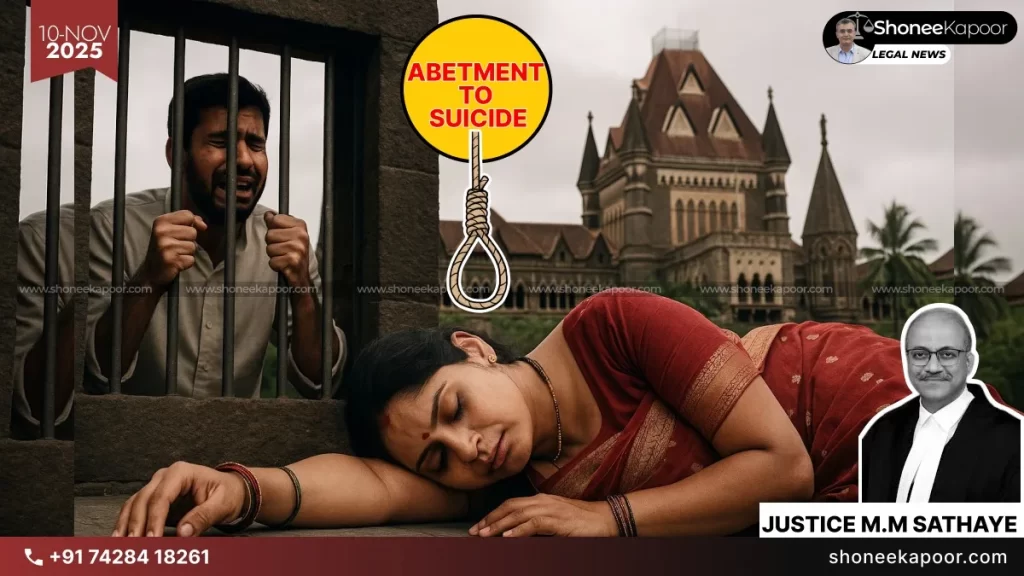
The Bombay High Court ruled that just saying a woman was unhappy or used to cry is not enough to prove harassment or abetment to suicide. Justice M.M. Sathaye set aside a husband’s conviction under Sections 306 and 498-A IPC, giving him the benefit of doubt.
MAHARASHTRA: The Bombay High Court has acquitted a husband accused of abetting his wife’s suicide, holding that mere statements from her parents that she was “unhappy” and “used to weep” cannot, by themselves, prove cruelty or abetment beyond reasonable doubt.
The case—Ramprakash @ Popat Govind Manohar v. State of Maharashtra (Criminal Appeal No. 885 of 1998)—was decided by Justice M.M. Sathaye on 4 November 2025.
The appellant had been convicted by the trial court under Sections 306 and 498-A IPC, sentenced to three years of rigorous imprisonment and fined ₹ 1,000. His mother, the co-accused, was already acquitted.
Background of the Case
Ramprakash married Rekha in May 1997. According to the prosecution, Rekha was subjected to cruelty and pressure to bring money from her parents and buy a sewing machine. On 13 November 1997, Rekha left her marital home and was later found dead in a river on 17 November 1997. Her father then lodged an FIR accusing the husband and mother-in-law of harassment leading to suicide.
Both accused pleaded not guilty. The defence contended that Rekha had married against her wishes and might have fallen into the river accidentally while answering nature’s call.
Court’s Observations
Justice Sathaye examined the entire evidence and found no credible proof of continuous cruelty or instigation. The father and mother had made general allegations but could not give specific instances of harassment or illegal demands.
“Mere statements that the deceased daughter used to be unhappy and used to weep is not sufficient to conclude beyond reasonable doubt that there was harassment or conduct of such nature and degree that it will drive a woman to commit suicide.”
The Court noted that the only specific allegation was a payment of ₹ 1,000 during Diwali and the giving of a sewing machine—facts insufficient to prove cruelty or illegal demand. The alleged panch witness turned hostile, and the investigation failed to gather statements from neighbours.
“In such circumstances, the necessary ingredient of cruelty in the form of conduct of such nature as is likely to drive a woman to commit suicide or harassment of a woman with a view to coercing her or a person related to her to meet unlawful demand for any property or valuable security is not clearly spelt out, much less proved.”
Justice Sathaye further remarked that the husband himself had lodged a missing report the day Rekha disappeared, stating she had left her ornaments at home—a detail that supported his innocence.
“There is nothing on record to indicate that the Appellant had instigated deceased-Rekha to commit suicide or had engaged in any conspiracy to push the deceased mentally or physically in committing suicide.”
“There is also nothing to indicate any mental torture as held by the Trial Court.”
Legal Reasoning and Precedents
Relying on earlier Supreme Court rulings such as M. Mohan v. State (2011) and Sanju @ Sanjay Singh Sengar v. State of M.P. (2002), the Court reiterated that abetment involves a mental process of instigation or intentional aid, which must be proved through a direct or active act linked to the suicide.
“In the present case, no instance of instigation is attributable to the Appellant and there is also no proximate link between the event of suicide and the alleged demand of money and sewing machine.”
Justice Sathaye also cited Ramesh Kumar v. State of Chhattisgarh (2001) 9 SCC 618, quoting:
“Instigation is to goad, urge forward, provoke, incite or encourage to do an act… A word uttered in the fit of anger or emotion without intending the consequences to actually follow cannot be said to be instigation.”
Final Order
Finding serious doubts in the prosecution’s case, the Court allowed the appeal, setting aside the conviction and granting full acquittal:
“The Appellant is acquitted of all the charges.”
Justice Sathaye directed him to furnish a personal bond of ₹ 15,000 under Section 481 of the Bharatiya Nagarik Suraksha Sanhita (2023) (equivalent to Section 437A CrPC) to ensure appearance in any further proceedings.
The ruling reinforces that criminal convictions cannot rest on emotional statements alone. In the absence of specific evidence of cruelty or instigation, the benefit of doubt must go to the accused. The Bombay High Court’s clear message: “Tears alone cannot prove torture.”
ALSO READ: Child Custody | Maternal Grandparents Cannot Have Better Claim Than Father: Supreme Court
Explanatory Table of All Laws & Cases Mentioned
| Provision / Case | Law / Citation | Explanation (Simple English) |
|---|---|---|
| Section 306, IPC | Abetment of Suicide | This section punishes anyone who abets or encourages another person to commit suicide. To convict, prosecution must prove direct involvement or instigation. |
| Section 498-A, IPC | Cruelty by Husband or Relatives | Deals with cruelty (mental or physical) by husband or his relatives towards a wife. Cruelty must be of such severity that it can drive the woman to suicide or force her to meet unlawful demands. |
| Section 107, IPC | Definition of Abetment | Explains what amounts to “abetment” — i.e., instigating, engaging in conspiracy, or aiding the act. |
| Section 313, CrPC (now Section 324 BNSS) | Examination of Accused | Allows the court to question the accused to explain circumstances appearing against them in evidence. |
| Section 437A, CrPC (now Section 481 BNSS, 2023) | Bond for Appearance After Acquittal | Even after acquittal, the accused must furnish a bond to appear in higher court if the State files an appeal. |
| M. Mohan v. State (2011) 3 SCC 626 | Supreme Court | Held that abetment involves a mental process of instigating or aiding someone to commit suicide, requiring clear proof of mens rea (intent). |
| Sanju @ Sanjay Singh Sengar v. State of M.P. (2002) 5 SCC 371 | Supreme Court | Even saying “go and die” during a quarrel does not amount to abetment if there is no direct link or intention leading to suicide. |
| Madan Mohan Singh v. State of Gujarat (2010) 8 SCC 628 | Supreme Court | Clarified that the accused must have played a direct or active role leading the victim to suicide. |
| Dnyandeo Pandurang Yadav v. State of Maharashtra (2024 NCBHC-AUG 16532) | Bombay High Court | Held that general and vague allegations of demand do not satisfy the ingredients of Section 498-A or 306 IPC. |
| Ramesh Kumar v. State of Chhattisgarh (2001) 9 SCC 618 | Supreme Court | Defined “instigation” as to goad, urge, or provoke; mere words in anger without intent do not constitute abetment. |
Case Summary
| Parameter | Details |
|---|---|
| Case Title | Ramprakash @ Popat Govind Manohar v. State of Maharashtra |
| Court | High Court of Judicature at Bombay, Criminal Appellate Jurisdiction |
| Case No. | Criminal Appeal No. 885 of 1998 |
| Bench / Judge | Hon’ble Justice M. M. Sathaye |
| Date of Judgment Reserved | 12th September 2025 |
| Date of Judgment Pronounced | 4th November 2025 |
| Appellant | Ramprakash @ Popat Govind Manohar (husband) |
| Respondent | State of Maharashtra (through Khadki Police Station, Pune) |
| Counsel for Appellant | Mr. Pawan Mali, i/b Mr. Deepak More |
| Counsel for Respondent-State | Mr. Vinit Kulkarni, APP |
| Trial Court Judgment Challenged | Sessions Case No. 67 of 1998, decided on 17 November 1998 by Additional Sessions Judge, Pune |
| Verdict | Appeal allowed. Conviction set aside. Appellant acquitted of all charges under Sections 306 & 498-A IPC. Directed to furnish PR bond of ₹15,000 under Section 481 BNSS (corresponding to Section 437A CrPC). |
Key Takeaways
- Tears Don’t Equal Torture:
The Bombay High Court has made it loud and clear — a woman’s unhappiness or emotional breakdown cannot be treated as cruelty. Courts need proof, not emotion. - Mere Allegations ≠ Conviction:
Vague and general statements from parents about “demands” or “crying” don’t make a husband a criminal. Every accusation must be backed by solid, independent evidence. - 498A Misuse Once Again Exposed:
Another case where a young man spent years fighting false dowry and cruelty charges — only to be acquitted decades later. The law meant to protect women is too often being used as a weapon. - Emotional Narratives Cannot Replace Legal Proof:
“She was unhappy” or “used to weep” can’t be the basis for sending men to jail. Emotions are not evidence — and the Court has upheld that principle. - Abetment Requires Intent, Not Guesswork:
To prove Section 306 IPC (abetment of suicide), prosecution must show clear instigation or direct link — not just assumptions or family suspicions after death. - Investigative Bias Questioned:
No neighbours examined, no suicide note, no independent witness — yet a man was convicted. This shows how men often face biased investigations when marital disputes turn tragic. - BNSS 2023 Reminder:
Even after acquittal, the Court followed new Section 481 BNSS (replacing old 437A CrPC) — showing how procedural changes continue, but fairness must remain central. - Every Acquittal Is a Precedent for Justice:
This judgment isn’t just about one man. It’s a statement — that men too deserve fairness, proof, and presumption of innocence. - Systemic Reform Needed:
False 498A and suicide-abetment cases destroy families, careers, and mental health. We need gender-neutral laws that punish false accusers the same way as real offenders. - Voice for the Voiceless Men:
For every “Rekha” who cries, there’s a “Ramprakash” who bleeds silently. This verdict gives hope that truth still matters, even in a biased system.
Would You Like Assistance In Drafting A Legal Notice Or Complaint?
CLICK HERE
FOLLOW US ON YOUTUBE FOR MORE LEGAL UPDATES

Disclaimer: The views and opinions expressed in this article are those of the Indian courts and do not necessarily reflect the official policy or position of “ShoneeKapoor.com” or its affiliates. This article is intended for informational and educational purposes only. The content provided is not legal advice, and viewers should not act upon this information without seeking professional counsel. Viewer discretion is advised.