
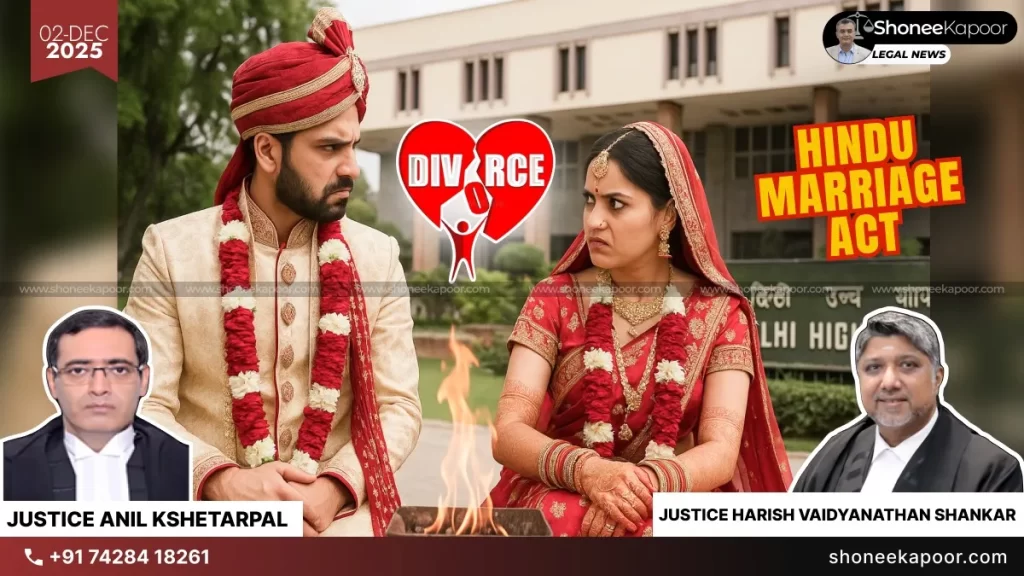
The Delhi High Court ruled that a Hindu marriage can be dissolved through custom only when the person proves the custom with strict, reliable evidence. A woman’s second marriage was declared void after she failed to prove her alleged “panchayati divorce.”
Fake Divorce: The Delhi High Court clearly held that a Hindu marriage cannot be treated as dissolved on the basis of an unverified “customary divorce” unless the party proves the custom with strict, solid and believable evidence.
The Court said that customs which go against the Hindu Marriage Act (HMA) cannot be accepted casually, and the burden of proof is very heavy on the person who claims such a custom.
This ruling came from a Division Bench of Justice Anil Kshetarpal and Justice Harish Vaidyanathan Shankar, while hearing an appeal filed by a woman whose second marriage had been declared void by the Family Court. The Family Court had annulled her marriage because she was still legally married to her first husband at the time of the second marriage.
The woman argued that she belonged to the Jat community and that her earlier marriage was already dissolved through a “panchayati divorce” before she married the present husband. She also claimed that her second husband and his family were fully aware of this before the marriage. But the Court held that such claims must be backed with strong, historical and community-recognised evidence.
The High Court emphasised that when anyone claims a custom that contradicts the written law, the court expects strict proof.
The Court said:
“It is expected from the parties to prove the prevalence of customary divorce in their area/community by producing judgments that recognise their custom and show past instances of customary divorce in the community. One of the ways to prove the custom is reference to any text or interpretation of Hindu law or usage for long period of time. Once the Court is called upon to declare that there exists a custom which is contrary to the codified law, the burden of proof is heavy upon the party asserting custom. Custom cannot be extended by analogy and it cannot be established by a priori method.”
Court Rejects Photocopy Divorce Deed
The only document produced by the woman was a photocopy of a so-called divorce deed, marked as “X”. The Court found that it was simply a mutual settlement between her and her previous husband. No panchayat members, no scribe, and no witnesses were examined. The Court said that such a private agreement cannot amount to customary divorce under Hindu law.
The Court also noted that even the alleged panchayat witnesses (RW-4 and RW-5) did not attend any such panchayat meeting. The woman also failed to produce any record, text, community decision, or earlier court ruling to show that such divorces were actually recognised in the Jat community.
Legal Provisions Highlighted
The Court analysed the Hindu Marriage Act extensively. It noted that Section 29(2) allows customary divorce, but only when the custom is clearly proven. Otherwise, Section 5(1) applies, which strictly says that a Hindu marriage is not valid if either party already has a living spouse.
The Court explained that a marriage in violation of Section 5(1) is “null and void” under Section 11.
Because the woman failed to prove that she was actually divorced, the High Court upheld the Family Court’s decision to declare the second marriage void.
Supreme Court Precedents
The Court relied on several Supreme Court judgments and included the following precedent in its decision:
From Bhimashya v. Janabi:
“A custom is a particular rule which has existed either actually or presumptively from time immemorial and has obtained the force of law in a particular locality, although contrary to or not consistent with the general common law of the realm. A custom to be valid must have four essential attributes. First, it must be immemorial; secondly, it must be reasonable; thirdly, it must have continued without interruption since its immemorial origin, and fourthly, it must be certain in respect of its nature generally as well as in respect of the locality where it is alleged to obtain and the persons whom it is alleged to affect.”
From Gokal Chand v. Parvin Kumari:
“A custom, in order to be binding, must derive its force from the fact that by long usage it has obtained the force of law, but the English rule that ‘a custom, in order that it may be legal and binding, must have been used so long that the memory of man runneth not to the contrary’ should not be strictly applied to Indian conditions.”
From Saraswathi Ammal v. Jagadambal:
“…it is incumbent on a party setting up a custom to allege and prove the custom on which he relies and it is not any theory of custom or deductions from other customs which can be made a rule of decision but only any custom applicable to the parties concerned that can be the rule of decision in a particular case. It is well settled that custom cannot be extended by analogy. It must be estabished inductively, not deductively and it cannot be established by a priori methods. Theory and custom are antitheses, custom cannot be a matter of mere theory but must always be a matter of fact and one custom cannot be deduced from another.
A community living in one particular district may have evolved a particular custom but from that it does not follow that the community living in another district is necessarily following the same-custom.”
From Yamanaji H. Jadhav v. Nirmala:
“As per the Hindu Law administered by courts in India, divorce was not recognised as a means to put an end to marriage, which was always considered to be a sacrament, with only exception where it is recognised by custom… this consensus on the part of the counsel or lack of sufficient pleading in the plaint or in the written statement would not, in our opinion, permit the court to countenance the plea of customary divorce unless and until such customary divorce is properly established in a court of law.”
Final Decision
After reviewing the entire evidence, the High Court held that:
- The woman could NOT prove the existence of a valid customary divorce.
- The photocopy of the deed was only a private agreement.
- No panchayat record, no original document, and no credible testimony was produced.
- Therefore, her second marriage was in violation of Section 5(1) of the HMA.
- Hence, the marriage was void under Section 11.
The High Court dismissed the appeal and confirmed that the woman’s second marriage was invalid in law.
Explanatory Table Of All Laws & Sections Mentioned
| Law / Section | What It Says (Simple English) | Why It Matters in This Case |
| Section 4 – Hindu Marriage Act (HMA) | Says that the HMA overrides all old customs, traditions, or Hindu law rules, unless the Act itself saves them. | Court said you cannot escape HMA rules unless you prove a strong, established custom. |
| Section 5(i) – HMA (Conditions of marriage) | A Hindu marriage is valid only if neither person already has a living spouse. | Woman was still legally married (no valid divorce), so second marriage violated this section. |
| Section 11 – HMA (Void marriages) | A marriage is null and void if it violates Section 5(i), 5(iv), or 5(v). | Court declared her second marriage void because she had not dissolved her first marriage legally. |
| Section 29(2) – HMA (Customary divorce saved) | Recognises the right to get a divorce through custom, if such custom actually exists and is proven. | Court said customary divorce is allowed only when proved with strict, solid evidence. She failed. |
| Section 13(1)(ia) – HMA (Divorce on cruelty) | Allows divorce if one spouse treats the other with cruelty. | Husband had earlier filed a petition under this but withdrew it; not central to the decision. |
| Section 57 – Indian Evidence Act | Customs must be proven with clear, longstanding evidence like judgments, records, or texts. | Court explained that custom cannot be proved just by 2-3 witnesses; heavy burden on claimant. |
| Order XLI Rule 22 CPC | Allows a respondent to support a judgment even without filing cross-objections. | Court used this to correct the Family Court’s earlier incorrect finding on existence of custom. |
| Order XLI Rule 3 CPC | Procedural rule on hearing appeals. | Court relied on combined reading to justify examining the family court’s findings. |
Case Details
Case Title: SS vs SRD
Case Number: MAT.APP.(F.C.) 281/2024 & CM APPL. 48706/2024
Court: High Court of Delhi, New Delhi
Judgment Reserved: 06.11.2025
Judgment Pronounced: 28.11.2025
Family Court Judgment Challenged: 07.06.2024
Appeal: Filed by the wife (Appellant)
Result: Appeal dismissed, second marriage declared void
Reason: Appellant failed to prove valid customary divorce; only produced a private agreement, not a panchayat divorce.
Bench (Judges):
- Justice Anil Kshetarpal
- Justice Harish Vaidyanathan Shankar
Counsels:
- For Appellant (Wife):
- SC Singhal
- Parth Mahajan
- Garvita Bansal
- Ritvik Madan
- For Respondent (Husband):
- Mrinal Singh
- Priya Rani Jha
Parties’ Background
- Appellant (wife) earlier married to Sanjay.
- Respondent (husband) earlier married, divorced by court.
- Appellant claims she got “customary Jat community panchayat divorce” on 23.05.2009.
- Appellant and respondent married on 16.05.2010.
- Child born: Daksh (15.03.2011).
- Appellant left matrimonial home on 12.10.2012.
- Husband learnt in 2013 that she was never actually divorced earlier.
Evidence Produced by the Wife
- Only a photocopy of a “divorce deed” → not original
- No scribe examined
- No witnesses examined
- No panchayat record
- No community judgment
- No historical proof of custom
Why the Court Rejected Customary Divorce Claim
Because:
- No proof of long-standing community custom
- No panchayat names, dates, signatures
- No original document
- Witnesses never attended any panchayat
- Private agreement ≠ Panchayati divorce
- Custom cannot contradict law without clear proof
Final Outcome
- Second marriage = void
- Appeal dismissed
- Family Court judgment upheld
Key Takeaways
- Delhi High Court made it clear that no woman can use a vague “customary divorce” excuse unless she proves it with strict, undeniable evidence.
- Private agreements or self-made panchayat stories cannot be used to trap men in bigamy or void marriage complications.
- The burden to prove a customary divorce lies entirely on the person claiming it, and not on the husband.
- A second marriage becomes void if the woman hides her existing marriage or fails to show a legally valid divorce.
- This judgment protects men from false claims of panchayat divorces and reinforces that Hindu marriages cannot be dissolved casually or secretly.
This Could Change Your Case-Get FREE Legal Advice-Click Here!
Disclaimer: The views and opinions expressed in this article are those of the Indian courts and do not necessarily reflect the official policy or position of “ShoneeKapoor.com” or its affiliates. This article is intended for informational and educational purposes only. The content provided is not legal advice, and viewers should not act upon this information without seeking professional counsel. Viewer discretion is advised.