
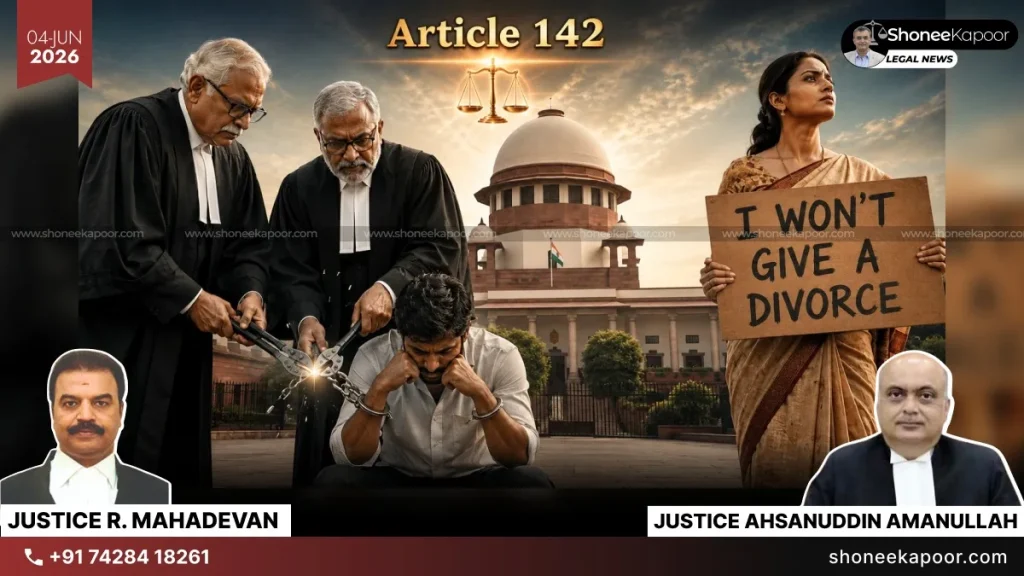
Living separately for over two decades, but divorce was still denied? The Supreme Court stepped in and made an important observation on dead marriages and individual freedom.
NEW DELHI: The Supreme Court has held that a husband-wife relationship cannot be forced to continue through judicial proceedings when the marriage has completely broken down and there is no possibility of reconciliation.
In a judgment delivered by a Bench of Justice Ahsanuddin Amanullah and Justice R. Mahadevan, the Court granted divorce to a husband by exercising its extraordinary powers under Article 142 of the Constitution.
The husband had approached the Supreme Court after the High Court upheld the Family Court’s decision dismissing his divorce petition.
The dispute had remained unresolved for several years. According to the husband, the parties had been living separately since 2003 and all attempts to reunite had failed. He submitted that due to constant harassment, the family had shifted to Andhra Pradesh after selling their house in Hyderabad. He further stated that he saw no future in the marriage and wanted peace in the remaining years of his life.
The wife opposed the divorce and argued that the allegations made by the husband were frivolous and fictitious. She requested the Court not to dissolve the marriage.
After considering the facts, the Supreme Court observed that it was dealing with a peculiar situation where the positions of both parties had become completely rigid and inflexible. The Court noted that it was required to take a difficult decision even if it was not acceptable to either side.
The Bench observed:
“The Court may indicate here that in such matters and at a juncture where the stance of the parties are absolutely hard and totally inflexible, the Court has to take a hard decision which may not be acceptable to both the parties. However, the Court has to look at the matter objectively, more so, for the reason that both the parties have a life ahead which it is for them to choose how they want to spend and forcing a relationship, that too of husband and wife, cannot be done by judicial proceedings.”
The Court emphasized that when a marriage has ceased to exist in substance and the parties have remained apart for decades, the legal bond should not be allowed to continue merely on paper. The judgment reflects the growing judicial recognition that prolonged matrimonial disputes often leave both parties trapped in a relationship that no longer serves any purpose.
Taking a practical view of the matter, the Bench further held:
“The Court thus has taken a very realistic view in the matter and going by what has been stated above, has come to the conclusion that the marriage between the parties being dead for all practical purposes has to be nullified.”
Accordingly, the Supreme Court granted a decree of divorce on the ground of irretrievable breakdown of marriage by invoking Article 142 of the Constitution.
However, the Court made the divorce conditional upon financial settlement in favour of the wife. The Bench ordered:
“However, the said grant of divorce is subject to the appellant paying/transferring an amount of Rs. 60,00,000/- (Rupees Sixty Lakhs) in favour of the respondent-wife within two months from today, as has been undertaken before the Court and proof thereof be filed before this Court. The amount lying with the Registry of Rs. 68,00,000/- (Rupees Sixty Eight Lakhs) along with whatever interest may have accrued in the interregnum be paid to the respondent by the Registry upon completion of the required formalities within two weeks from today.”
The Court also recorded the husband’s undertaking that he would contribute his share towards the marriage expenses of his daughter.
EXPLANATORY TABLE OF LAWS AND LEGAL PROVISIONS MENTIONED
| LAW / PROVISION | PURPOSE | HOW IT WAS APPLIED IN THIS CASE |
| Article 142, Constitution of India | Gives the Supreme Court extraordinary power to pass any order necessary to do complete justice between parties. | The Supreme Court directly granted divorce despite lower courts refusing it and dissolved the marriage on the ground of irretrievable breakdown. |
| Doctrine of Irretrievable Breakdown of Marriage | Recognizes situations where a marriage has completely failed and there is no possibility of reconciliation. | The Court found that the parties had lived separately since 2003 and the marriage was “dead for all practical purposes.” |
| Divorce Decree | Legally dissolves the marital relationship between spouses. | The Court directed the Registry to prepare a decree of divorce. |
| Permanent Settlement / One-Time Financial Settlement | Ensures financial protection of the spouse after dissolution of marriage. | Divorce was made conditional upon payment of ₹60 lakh to the wife and release of deposited amounts from the Registry. |
| Rights of Child Against Father | Protects legal and inheritance rights of children irrespective of divorce between parents. | The Court specifically preserved the daughter’s rights against her father and his estate. |
CASE DETAILS
| PARTICULARS | DETAILS |
| Case Title | XYZ v. ABC |
| Original Case | Civil Appeal No. 8212-8213 of 2026 (Arising out of SLP (C) No. 34898-34899 of 2014) |
| Neutral Citation | 2026 INSC 623 |
| Court | Supreme Court of India |
| Date of Judgment | 27 May 2026 |
| Bench | Justice Ahsanuddin Amanullah and Justice R. Mahadevan |
| Appellant Counsel | Mr. Balaji Srinivasan, AOR; Ms. Kanishka Singh, Advocate |
| Respondent Counsel | Respondent-in-Person |
| Result | Appeal Allowed; Divorce Granted |
| Ground | Irretrievable Breakdown of Marriage |
| Constitutional Provision Invoked | Article 142 of the Constitution of India |
KEY TAKEAWAYS
- A man cannot be forced to remain trapped in a dead marriage merely because one spouse refuses to let go.
- The Supreme Court recognized that prolonged separation and complete breakdown of marital relations cannot be ignored indefinitely.
- Courts exist to deliver justice, not to preserve marriages that have already collapsed in reality.
- Even after living separately for more than two decades, the husband had to continue fighting litigation before finally obtaining relief.
- The judgment acknowledges an important reality: men too deserve peace, dignity, and freedom from marriages that have become emotional prisons.
This Could Change Your Case-Get FREE Legal Advice-Click Here!
Disclaimer: The views and opinions expressed in this article are those of the Indian courts and do not necessarily reflect the official policy or position of “ShoneeKapoor.com” or its affiliates. This article is intended for informational and educational purposes only. The content provided is not legal advice, and viewers should not act upon this information without seeking professional counsel. Viewer discretion is advised.