
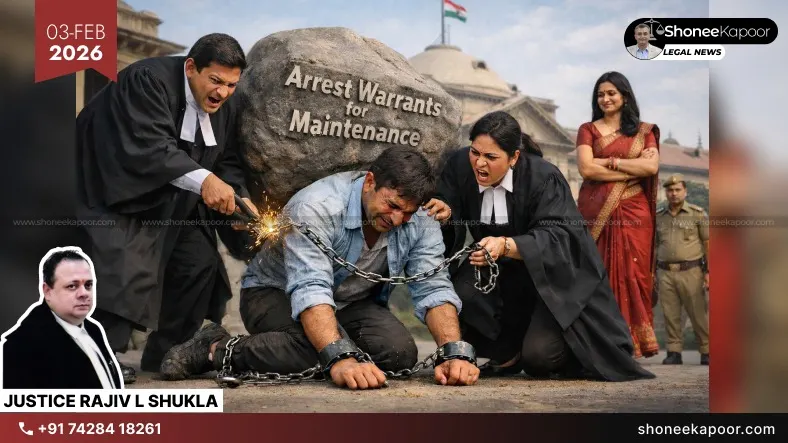
The Allahabad High Court has ruled that Family Courts cannot issue recovery and arrest warrants together for maintenance arrears. Treating a husband like a criminal for non-payment violates law, dignity, and personal liberty.
PRAYAGRAJ: The Allahabad High Court has delivered a strong and much-needed judgment putting an end to a routine but illegal practice followed by many Family Courts across the State. The Court held that issuing recovery warrants and arrest warrants at the same time for maintenance arrears is not only unlawful but also inhumane, and this practice must stop immediately.
The Bench of Justice Rajiv Lochan Shukla made it clear that a husband directed to pay maintenance cannot be treated like a criminal. Courts cannot sacrifice a citizen’s dignity and liberty just to enforce maintenance orders, even where there is an allegation of deliberate non-payment.
The Court categorically observed:
“His personal dignity and liberty cannot be trampled with by the Courts in their excessive enthusiasm in enforcement of orders of maintenance, even if they come to a finding that there has been a deliberate non-payment of arrears of maintenance pursuant to an order of Court”.
The case arose when the Family Court at Aligarh issued both recovery and arrest warrants against Mohammad Shahzad to recover alleged arrears of maintenance. Challenging this order under Section 528 BNSS, the petitioner argued that while maintenance orders can be enforced, the law does not permit arrest as the first step.
Before the High Court, even the State’s counsel fairly admitted that arrest warrants cannot be issued for recovery of maintenance arrears without first following the procedure prescribed under Sections 125(3) and 128 CrPC. The State, however, pointed out that the applicant had defaulted earlier instalments.
After examining the law in detail, the High Court explained that Section 125(3) CrPC clearly lays down a step-by-step process. Recovery must first be attempted in the same manner as recovery of fines under Section 421 CrPC. This includes attachment and sale of movable property or recovery as arrears of land revenue. Importantly, the proviso to Section 421 explicitly states:
“No such warrant shall be executed by the arrest or detention in prison of the offender.”
The Court further clarified that imprisonment can be considered only after recovery warrants are executed and the amount still remains unpaid. Arrest is not the starting point.
The Bench emphatically held:
“Section 125(3) Cr.P.C. clearly indicates that efforts are to be made, first, to recover the arrears of maintenance/enforce the order of maintenance in the manner provided for levying fines, and if the warrant is not executed or is partially executed, the Court may sentence the person, directed to pay the maintenance amount, to imprisonment… Thus, the simultaneous issuance of warrants for recovery and arrest is not contemplated under the Code of Criminal Procedure. Even the directions given by the Supreme Court do not contemplate any such practice”.
Taking serious note, the Court said it has repeatedly seen Family Courts issuing arrest warrants and even non-bailable warrants as if the husband were an accused in a criminal case.
The Court stated in clear terms:
“This is clearly against specific statutory provisions and the directions given by the Supreme Court in the case of Rajnesh”.
The judgment also addressed arguments that maintenance should be enforced strictly like a civil money decree under the CPC. The Court rejected this blanket approach and clarified that orders under Chapter IX CrPC must be executed strictly as per CrPC, as mandated by Section 18(2) of the Family Courts Act. CPC provisions apply only in a limited manner, such as attachment of salary, and cannot override the CrPC framework.
The High Court laid down the correct and lawful procedure:
- First, issue notice to the person directed to pay maintenance;
- Second, if no sufficient cause is shown, issue recovery warrants under Section 421 CrPC;
- And only thereafter, if recovery fails, consider imprisonment.
Holding that the Family Court had overstepped its jurisdiction, the High Court allowed the application, set aside the impugned order, and sent the matter back to the Family Court with strict directions to follow the law.
This judgment is a powerful reminder that maintenance enforcement cannot become a tool of coercion that crushes personal liberty. A husband may be a defaulter, but he is not a criminal by default. Courts are duty-bound to enforce orders within the limits of law, not through shortcuts that humiliate and punish men without due process.
Explanatory Table: Laws & Sections Involved In This Case
| Law / Statute | Section | Simple Explanation | How It Was Misused / Clarified |
| Bharatiya Nagarik Suraksha Sanhita (BNSS) | Section 528 | Allows High Court to quash illegal orders of subordinate courts | Used to challenge illegal arrest and recovery warrants |
| Code of Criminal Procedure (CrPC) | Section 125 | Provides for maintenance to wife, children, parents | Maintenance is civil in nature, not criminal punishment |
| CrPC | Section 125(3) | Lays down how maintenance arrears can be recovered | Recovery first, jail only after failure, not simultaneously |
| CrPC | Section 128 | Enforcement of maintenance orders | Does not permit automatic arrest |
| CrPC | Section 421 | Mode of recovery of fines (attachment, land revenue) | Clearly bars arrest for recovery |
| CrPC | Proviso to Section 421 | Protection against arrest for recovery of money | Court quoted this to stop coercive arrests |
| Family Courts Act, 1984 | Section 10 | Procedure to be followed by Family Courts | Cannot override liberty protections |
| Family Courts Act, 1984 | Section 18(2) | Execution of CrPC maintenance orders | Must follow CrPC, not CPC |
| Code of Civil Procedure (CPC) | Sections 51, 55, 58, 60 | Execution of money decrees | Applicable only in limited salary attachment cases |
| CPC | Order XXI | Process for execution of decrees | Cannot replace CrPC procedure |
| U.P. Family Courts Rules, 2006 | Rule 36 | Salary attachment in maintenance cases | Additional method, not substitute |
| Constitution of India | Article 21 | Right to life and personal liberty | Arrest without procedure violates fundamental rights |
| Supreme Court Judgment | Rajnesh vs. Neha (2021) | Guidelines on maintenance enforcement | Does not permit arrest-first approach |
Case Details
- Case Title: Mohammad Shahzad vs. State of U.P. and 2 Others
- Court: Allahabad High Court
- Bench: Justice Rajiv Lochan Shukla
- Case Number: Application U/S 528 BNSS No. 39747 of 2025
- Impugned Order Date: 25.09.2025
- Family Court Case Details: Misc. Case No. 548 of 2024 (Smt. Shajiya Khan & Another vs. Mohammad Shahzad) Court No. 2, Family Court, Aligarh
- Date of High Court Judgment: 16 January 2026
- Neutral Citation: 2026:AHC:10500
- Police Station & District: P.S. Banna Devi, District Aligarh
- Counsel for Applicant: Kuldeep Kumar
- Counsel for State: G.A. (Government Advocate)
Key Takeaways
- Non-payment of maintenance is not a criminal offence and cannot justify treating a husband like an accused.
- Arrest warrants cannot be issued as the first step for maintenance recovery; law mandates recovery before coercion.
- Simultaneous recovery and arrest warrants are illegal and amount to judicial overreach.
- Personal liberty and dignity of men cannot be sacrificed in the name of maintenance enforcement.
- Family Courts must strictly follow CrPC procedure, not invent shortcuts that punish men without due process.
This Could Change Your Case-Get FREE Legal Advice-Click Here!
Disclaimer: The views and opinions expressed in this article are those of the Indian courts and do not necessarily reflect the official policy or position of “ShoneeKapoor.com” or its affiliates. This article is intended for informational and educational purposes only. The content provided is not legal advice, and viewers should not act upon this information without seeking professional counsel. Viewer discretion is advised.

My lawyer in civil court,alipur,Kolkata ,does bot recognise these orders and he tild me that these orders will be implemented after 10 years
That advice is wrong.
Maintenance orders under Section 125/128 CrPC are enforceable immediately unless stayed by a higher court.
There is no rule of “implementation after 10 years.”
What is illegal is issuing arrest warrants as a first step or along with recovery, not enforcement itself.
Change the lawyer who is misguiding you.
You can contact my office +917428418261 for correct and proper legal guidance.