
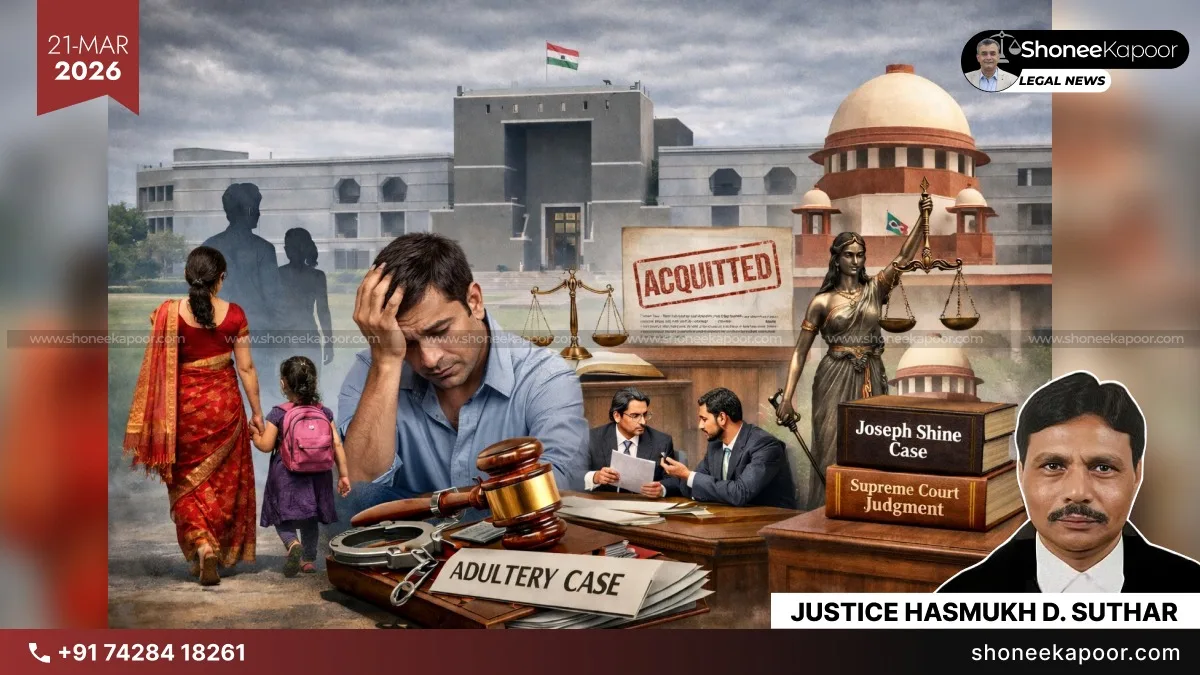
Man Discharged In Adultery Case Citing SC Judgment Striking Down 497 IPC As Unconstitutional: Gujrat High Court Rejects Husband’s Argument Against Wife’s Lover

Written and analysed by Shonee Kapoor
Legal Consultant, Author & Men's Rights ActivistA husband fought a decade-long legal battle after discovering his wife living with another man—only to be told the law no longer recognises the offence itself. If betrayal has no legal consequence, what remains for the one who suffers it?
Adultery Case: In a judgment dated 16.03.2026, the Gujarat High Court led by Justice Hasmukh D. Suthar dealt with a case where a husband tried to seek justice after his wife left him and started living with another man.
The marriage took place in 1994 and a daughter was born from the relationship. As per the case, in 1999, the wife left the matrimonial home and did not return despite repeated efforts made by the husband to reconcile and bring her back. Years later, in 2010, the husband allegedly saw his wife with another man, which came as a serious emotional shock to him and triggered the legal dispute.
The husband claimed that his wife was living with that man without a valid legal marriage. He even stated that the other man showed photographs suggesting a marriage. Feeling cheated and humiliated, the husband filed a criminal complaint, accusing the man of adultery and other offences under IPC sections including 497.
The trial court later discharged the accused, and this decision was upheld by the sessions court. The husband then approached the High Court, arguing that since his complaint was filed before the law on adultery was struck down, the case should still continue.
However, the High Court rejected this argument and made it clear that once the Supreme Court removed adultery as a criminal offence, no such prosecution can continue. The Court relied on the landmark judgment in Joseph Shine v Union of India (2018) and observed that continuing such a case is legally not possible.
The Court clearly held:
“The constitutional validity of Section 497 of the IPC has been struck down by the Hon’ble Supreme Court as being unconstitutional and violative of Articles 14, 15 and 21 of the Constitution of India.”
It further noted:
“Except for the allegation of adultery, no other consequence or independent offence—such as abetment of suicide or any other criminal offence—has been alleged.”
The Court also made its position clear by stating:
“Once the very provision under which the accused were sought to be prosecuted has been declared unconstitutional, the question of continuing the criminal prosecution on the basis of such allegation does not arise.”
On the husband’s argument that the law should apply prospectively, the Court rejected it and said:
“The contention that the judgment of the Hon’ble Supreme Court has only prospective application cannot be accepted in the facts of the present case.”
Finally, the Court dismissed the case and upheld the earlier decisions, stating that there was no legal error in discharging the accused.
This case reflects a harsh reality—while adultery may no longer be a crime, the emotional, financial, and social damage suffered by husbands finds no recognition in criminal law. The system closes the door completely, leaving men with no legal remedy, even in situations where the breakdown of marriage is caused by clear acts of betrayal.
Explanatory Table: Laws & Sections Involved
| Section / Law | What It Means (Simple Explanation) | Role in This Case |
| Section 497 IPC (Adultery) | Earlier made it a crime if a man had relations with a married woman without husband’s consent | Main allegation by husband, but now struck down |
| Section 114 IPC | If a person is present when a crime is committed, they are treated as equally responsible | Added along with adultery allegation |
| Section 495 IPC | Hiding previous marriage and marrying again | Alleged but not substantiated independently |
| Section 496 IPC | Fake or illegal marriage ceremony | Invoked based on alleged second relationship |
| Section 294B IPC | Obscene acts or abusive language in public | Allegation of abuse |
| Section 504 IPC | Intentional insult to provoke breach of peace | Alleged verbal misconduct |
| Section 506 IPC | Criminal intimidation or threats | Husband alleged he was threatened |
| Section 245 CrPC | Discharge of accused if no case is made out | Used by accused to get discharged |
| Joseph Shine v. Union of India (2019) | Supreme Court judgment striking down adultery law (Section 497 IPC) | Basis for dismissal of entire case |
Case Details
- Case Title: Mansukhbhai Dhanjibhai Makwana vs State of Gujarat & Ors.
- Court: High Court of Gujarat at Ahmedabad
- Case Number: Criminal Revision Application No. 425 of 2020
- Bench: Hon’ble Mr. Justice Hasmukh D. Suthar
- Date of Judgment: 16/03/2026
- Neutral Citation: 2026:GUJHC:19326
- Counsels:
- For Applicant (Husband): HCLS Committee, and Mr. Neeraj Soni
- For Respondents (Wife & Others): Mr. Mehul A. Surati
- For State: Ms. Shruti Pathak, APP
Key Takeaways
- Even clear marital betrayal has zero criminal consequence for the husband after adultery law was struck down.
- The system completely ignores the emotional and social damage suffered by men in such situations.
- Courts have made it clear that no case can survive if based only on adultery, no matter when it was filed.
- Legal remedies for husbands are now limited to civil disputes, while criminal law offers no protection.
- This creates a one-sided reality where breakdown of marriage due to infidelity leaves men legally helpless.
This Could Change Your Case-Get FREE Legal Advice-Click Here!
Disclaimer: The views and opinions expressed in this article are those of the Indian courts and do not necessarily reflect the official policy or position of “ShoneeKapoor.com” or its affiliates. This article is intended for informational and educational purposes only. The content provided is not legal advice, and viewers should not act upon this information without seeking professional counsel. Viewer discretion is advised.
Related Articles
498A FIR in India While Husband Is in Canada: What an NRI Husband Must Do Immediately Before Police, LOC or NBW Pressure Begins
An NRI husband in Canada facing 498A IPC or Section 85 BNS FIR in India must preserve evidence, check jurisdiction, a...

Myth: NRI Husband Must Attend Every Court Hearing in India – Legal Reality Under Criminal Procedure & Constitutional Jurisprudence
Do NRI husbands really have to travel to India for every hearing in matrimonial cases? Indian courts have repeatedly ...
Share Your Thoughts
Comments are moderated before publication.