
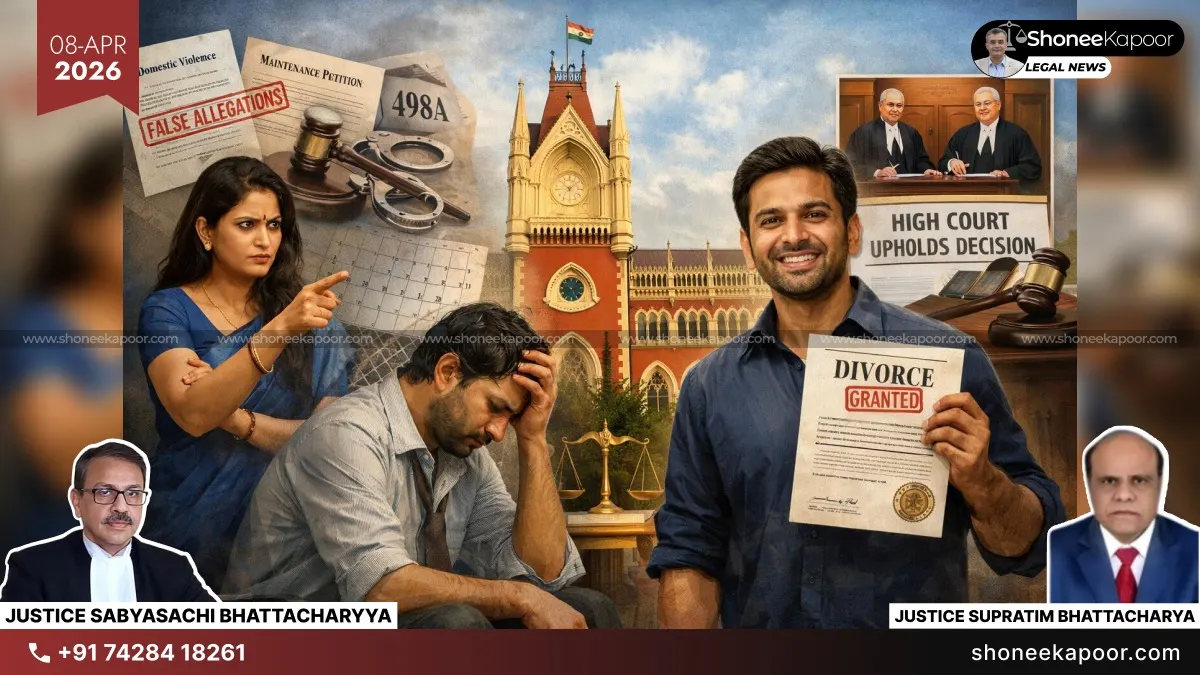
A man faces arrest, criminal trials, and years of separation—only for every allegation to collapse in court. The High Court examines the pattern and delivers a ruling that raises serious questions on misuse of legal process.
KOLKATA: In a judgment by the Calcutta High Court, Justice Sabyasachi Bhattacharyya and Justice Supratim Bhattacharya dismissed the wife’s appeal and upheld the divorce granted to the husband, holding that he was subjected to mental cruelty.
The case started when the husband filed a divorce petition in January 2010 after the wife left the matrimonial home in November 2009. Soon after, the wife filed criminal complaints against him, including one under Section 498A IPC, which the Court later found unsupported and ultimately resulted in his acquittal.
On the issue of cruelty, the Court made it clear that repeated false allegations and legal harassment cannot be taken lightly. The Court treated this as a serious factor showing misuse of the legal process.
The judges specifically held that: “The allegations against the husband were baseless and amount to cruelty.”
The Court further emphasized that making serious allegations without proof, especially about a person’s character, directly damages dignity and reputation.
The Court also highlighted that:
“The nature of the allegations made against the respondent-husband was grave, but those could not be substantiated in evidence.”
This clearly showed that the accusations were not only false but also reckless.
In another crucial observation, the Court said that:
“Such baseless assassination of the husband’s character itself has the cumulative effect of perpetrating mental cruelty.””Such baseless assassination of the husband’s character itself has the cumulative effect of perpetrating mental cruelty.”
This reinforces the legal position that false allegations are not just defensive claims—they can themselves become grounds for divorce.
The judgment also pointed out that the wife repeatedly used criminal proceedings as a tool of pressure. It recorded that:
“The consistent efforts of the appellant-wife and her family was to malign the husband and his family by lodging one false complaint after the other,”
Which caused mental agony and social humiliation.
The Court further noted that even after filing of the divorce case, the wife continued filing complaints, which showed a pattern rather than isolated incidents. It observed that:
“The cumulative effect of the said attempts was sufficient to make it impossible for the parties to live together as spouses.”
On long separation, the Court clarified that even though irretrievable breakdown is not a direct statutory ground, it can amount to cruelty. It observed that:
“The rift between the parties has reached a point of no-return and their marriage has spent its shelf-life long back.”
It further held that:
“Irretrievable breakdown of marriage, although by itself not a ground for divorce, comes within the purview of cruelty.”
The Court also denied permanent alimony at this stage, stating that without a proper application under Section 25 of the Hindu Marriage Act, such relief cannot be granted, while allowing the wife liberty to apply later.
In conclusion, the appeal was dismissed, and the divorce upheld, with the Court finding no illegality given the pattern of false allegations, criminal cases, and prolonged separation. The ruling recognises that sustained false accusations and legal harassment can themselves amount to mental cruelty.
Explanatory Table: Laws & Sections Involved
| Law / Section | Purpose | How Applied In This Case |
| Section 13(1)(ia), Hindu Marriage Act | Divorce on ground of cruelty | Court held false allegations, criminal cases, and conduct of wife amounted to mental cruelty |
| Section 25, Hindu Marriage Act | Permanent alimony | Court denied alimony as no application was filed, but allowed liberty to apply later |
| Section 498A IPC | Cruelty by husband | Wife filed case; husband acquitted due to lack of evidence, which supported cruelty claim against wife |
| Sections 403, 406, 120B IPC | Criminal breach of trust, misappropriation, conspiracy | Additional cases filed by wife; acquittal showed allegations were baseless |
| Article 141, Constitution of India | Binding nature of Supreme Court law | Court relied on Supreme Court rulings to treat irretrievable breakdown as cruelty |
| Judicial Precedents (Rakesh Raman v. Kavita) | Irretrievable breakdown interpretation | Used to hold that long separation can fall within cruelty |
Case Details
- Case Title: Saranjit Kaur (Hura) vs. Inder Singh Hura
- Court: Calcutta High Court
- Case Number: FA No. 185 of 2022
- Date Of Judgment: 06.04.2026
- Bench: Justice Sabyasachi Bhattacharyya & Justice Supratim Bhattacharya
- Counsels:
- For Appellant (Wife): Mr. Uday Sankar Chattopadhyay, Mr. Suman Sankar Chatterjee, Mr. Pronay Basak, Ms. Rajashree Tah, Ms. Trisha Rakshit, Ms. Aishwarya Datta, Ms. Bidisha Chakraborty, and Ms. Sadia Parveen
- For Respondent (Husband): Mr. Kallol Basu, and Mr. Atreya Chakraborty
Key Takeaways
- False criminal cases and baseless allegations against a man can legally amount to mental cruelty and justify divorce.
- Acquittal due to lack of evidence exposes misuse of law and strengthens the husband’s case.
- Character assassination without proof is treated as serious cruelty, not a minor marital issue.
- Long separation is not ignored—courts now treat irretrievable breakdown as a form of cruelty.
- Legal process cannot be used as a weapon; repeated litigation and harassment will backfire in court.
This Could Change Your Case-Get FREE Legal Advice-Click Here!
Disclaimer: The views and opinions expressed in this article are those of the Indian courts and do not necessarily reflect the official policy or position of “ShoneeKapoor.com” or its affiliates. This article is intended for informational and educational purposes only. The content provided is not legal advice, and viewers should not act upon this information without seeking professional counsel. Viewer discretion is advised.
