
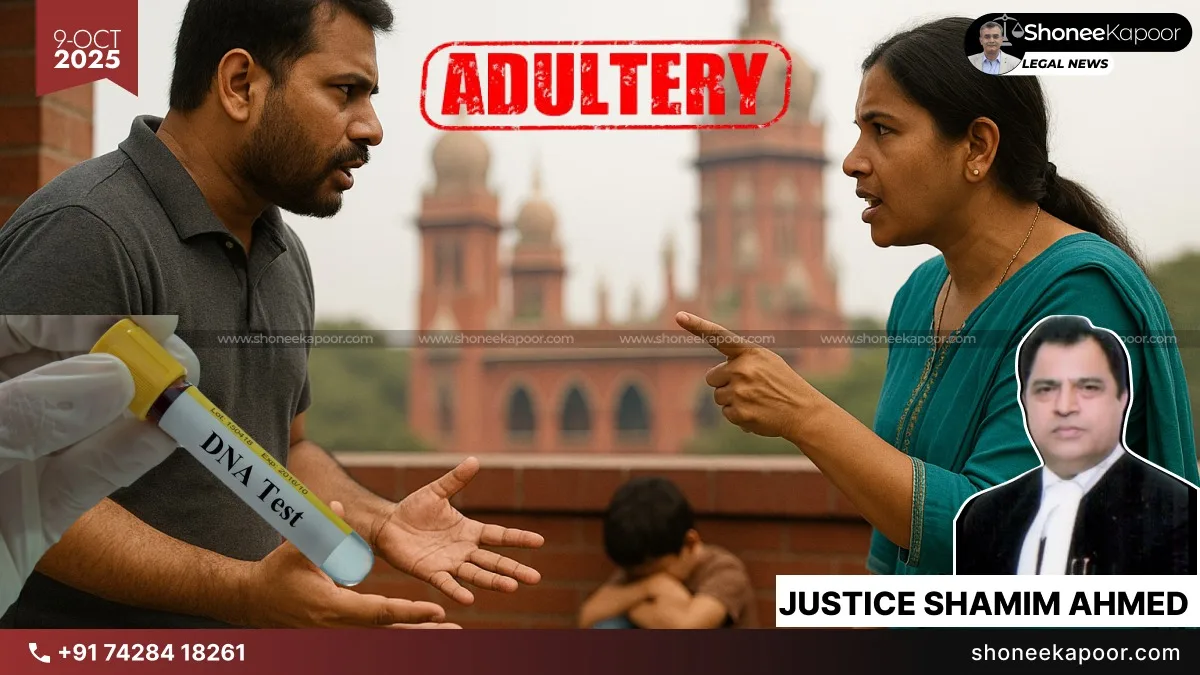
Madras High Court refuses ex-husband’s plea for a DNA test to disprove paternity, calling it a delayed and humiliating move against his ex-wife. The Court stressed that DNA tests can’t be used as shortcuts to prove infidelity or adultery.
Chennai: In a strong judgment protecting the privacy and dignity of women and children, the Madras High Court (Madurai Bench) Rejects Plea filed by a man seeking a DNA test to challenge the paternity of his daughter — nearly 12 years after divorce.
Justice Shamim Ahmed observed that such a plea was both belated and intended to humiliate the former wife, especially as the man offered no satisfactory reason for the delay. The Court made it clear that DNA testing cannot be used as a shortcut method to establish infidelity, saying —
“The DNA Testing cannot be used as a short cut method to establish infidelity… The child cannot be used as a pawn to show that the mother of the child was living in adultery.”
The couple married in March 2007, and their daughter was born in December 2009. Following marital disputes, they obtained a mutual divorce in March 2012. After almost a decade, the wife filed a maintenance case in 2021 before the Palani Judicial Magistrate. During those proceedings, the husband applied for a DNA test, claiming that the child was not biologically his.
However, the Trial Court dismissed the plea in June 2025, ruling that there was no need to order a DNA test. Challenging this, the man filed a Criminal Revision Petition (Crl.R.C(MD) No.842 of 2025) under Sections 438 and 442 of the Bharatiya Nagarik Suraksha Sanhita (BNSS), 2023.
Rejecting the revision, Justice Ahmed said the husband failed to explain the 12-year delay, remarking —
“No satisfactory explanation has been given by the revision petitioner for such an inordinate delay.”
The Court also noted that the petitioner appeared to have moved the plea “only with a view to humiliate his wife and to protract the maintenance case.”
Presumption of Legitimacy under Law
Referring to Section 116 of the Bharatiya Sakshya Adhiniyam, 2023, the Court said that a child born during a valid marriage is conclusively presumed legitimate, unless it is proven that the husband and wife had no access to each other during the relevant time.
“The revision petitioner has failed to establish non-access. No material has been placed before this Court to disprove access between them in the relevant period.”
Supreme Court Precedents on DNA Testing
The Court relied on several Supreme Court rulings to explain that DNA tests must not be ordered routinely:
In Ivan Rathinam v. Milan Joseph (2025), the apex court held that DNA tests should not be used unless there is a strong prima facie case, and that such orders may have “far-reaching effects on the dignity and privacy of individuals.”
Similarly, in Selvi v. State of Karnataka (2010), the Supreme Court ruled that forcing a person to undergo tests like DNA, narco-analysis, or brain mapping violates Article 20(3) (right against self-incrimination) and Article 21 (right to privacy) of the Constitution.
“The compulsory administration of the impugned techniques violates the ‘right against self-incrimination’… It would also amount to ‘cruel, inhuman or degrading treatment’.”
Further, in Aparna Ajinkya Firodia v. Ajinkya Arun Firodia (2023), the top court clarified that:
“DNA testing cannot be used as a short cut to establish infidelity that might have occurred over a decade ago… The child cannot be used as a pawn to show that the mother was living in adultery.”
Justice Ahmed cited this precedent to underline that ordering a DNA test years after divorce would violate both the wife’s and the child’s rights.
Court’s Final Observation
The Madras High Court concluded that the husband had not made out any legal justification for a DNA test and that the petition was frivolous and motivated.
“This Court finds that the Revision Petitioner, only with a view to humiliate his wife and to defame her name and to protract the maintenance case, has come forward with this frivolous Criminal Revision Case.”
Reiterating that privacy and identity rights of the child must be protected, the Court emphasized:
“The question whether a DNA Test should be permitted on the child is to be analysed through the prism of the child and not through the prism of the parents… The child cannot be used as a pawn to show that the mother of the child was living in adultery.”
Holding that there was no prima facie case, and that the delay, lack of evidence, and legal presumptions all went against the husband, the Court dismissed the revision petition on September 25, 2025, and upheld the trial court’s order refusing the DNA test

Explanatory Table of Laws, Sections & Precedents Mentioned
| Law / Case / Section | Full Citation / Description | Explanation / Relevance in Judgment |
|---|---|---|
| Bharatiya Nagarik Suraksha Sanhita (BNSS), 2023 | Sections 438 & 442 | The revision petition was filed under these provisions, replacing the old CrPC sections. These deal with the High Court’s powers to revise or call for records and set aside lower court orders. |
| Bharatiya Sakshya Adhiniyam, 2023 (BSA) | Section 116 | Replaces Section 112 of the Indian Evidence Act, 1872. It presumes that a child born during a valid marriage is legitimate, unless the husband proves “non-access.” The husband here failed to prove non-access. |
| Constitution of India | Article 20(3) – Right against self-incrimination Article 21 – Right to privacy and life | The court said forcing DNA or similar tests violates these rights, referring to Selvi v. State of Karnataka (2010). |
| Supreme Court – Ivan Rathinam v. Milan Joseph, (2025 INSC 115) | Crl.A.No.413 of 2024 | The SC held DNA tests can’t be ordered as routine; only if a strong prima facie case is made out, and courts must avoid infringing privacy or dignity. Justice Ahmed directly relied on this precedent. |
| Supreme Court – Selvi & Ors. v. State of Karnataka, (2010) 7 SCC 263 | Criminal Appeal No.1267 of 2004 | Landmark ruling holding that compulsory administration of DNA, narco, or brain mapping tests violates Articles 20(3) and 21. Quoted at length by the HC. |
| Supreme Court – Aparna Ajinkya Firodia v. Ajinkya Arun Firodia (2023) | SLP(C) No. 9855 of 2022 | The Court held DNA testing can’t be used as a shortcut to prove adultery years later; a child’s legitimacy must not be questioned casually. Cited to reinforce the HC’s stand. |
| Kerala High Court – Abdurahiman v. State of Kerala (2013) | Crl.Rev.Pet. No. 2329 of 2012 | Discussed the limited necessity of DNA testing and stated that paternity tests are not always relevant in proving rape or sexual assault; quoted to show restraint in ordering DNA tests. |
| Section 39 of Bharatiya Sakshya Adhiniyam (BSA), 2023 | Related to admissibility of scientific evidence | The HC noted that the petitioner’s request under this section (to allow scientific tests) lacked legal justification as no prima facie case was made. |
| Goutam Kundu v. State of West Bengal (1993) 3 SCC 418 | Supreme Court | Established that courts in India cannot order blood or DNA tests as a matter of course; a strong prima facie case and non-access proof are mandatory before ordering such tests. Quoted within Ivan Rathinam case passage. |
| Latin Maxim | Jura publica anteferenda privatis juribus | Meaning: “Public rights are to be preferred to private rights.” Used by Justice Ahmed to emphasize that while privacy is important, frivolous misuse of court process must not override public interest. |
| Maintenance Proceedings | Section 125 of the old CrPC (now BNSS equivalent) | The wife filed maintenance case (M.C. No. 4/2021). The husband’s DNA plea arose during this proceeding, allegedly to avoid paying maintenance. |
| Right to Identity (Child’s Rights) | Constitutional + Jurisprudential principle | The HC stressed that forcing a child into paternity disputes violates the child’s right to identity and dignity, reinforcing the modern approach of protecting children from parental conflicts. |
Case Details
- Court: Madras High Court (Madurai Bench)
- Case Title: Kandhasamy v. Magudeeshwari & Minor Akshya (represented by mother Magudeeshwari)
- Case Number: Crl.R.C. (MD) No. 842 of 2025 with Crl.M.P. (MD) No. 8958 of 2025
- Date of Judgment: 25 September 2025
- Bench: Hon’ble Justice Shamim Ahmed
- Petitione: Kandhasamy, S/o Velan, K. Vallakundapuram, Udumalaipettai, Tiruppur District
- Respondents:
- Magudeeshwari, W/o Kandhasamy
- Minor Akshya, D/o Kandhasamy (represented by R1)
- Counsel for Petitioner: Mr. A.K. Manikkam
- Counsel for Respondents: Ms. Kayal Vizhi, for Mr. T. Thirumurugan
- Lower Court Order Challenged: Order dated 12.06.2025 in Cr.M.P.No.504 of 2025 in M.C.No.4 of 2021 by Judicial Magistrate, Palani
- Relief Sought: Petition under Sections 438 & 442 of the Bharatiya Nagarik Suraksha Sanhita, 2023 (BNSS) seeking to set aside the Magistrate’s refusal to order a DNA test
- Outcome: Criminal Revision Dismissed — No merit found; court upheld trial court’s order rejecting DNA test request
Key Takeaways From the Judgment
- DNA Test Not Routine: Courts cannot order DNA testing casually; only when a clear prima facie case exists proving non-access during conception.
- Delay Fatal to Claim: The husband waited 12 years after divorce and 3 years after maintenance filing — showing intent to harass and delay proceedings.
- Presumption of Legitimacy: Section 116 of BSA, 2023 creates a strong legal presumption that a child born in wedlock is legitimate.
- Privacy and Dignity: The Court reaffirmed that DNA tests invade privacy and can brand a child illegitimate and a mother “unchaste.”
- Child’s Rights Paramount: The High Court stated that any analysis on DNA must be done “through the prism of the child, not the parents.”
- Frivolous Litigation Discouraged: The Court called the husband’s revision a “frivolous attempt to humiliate his wife and delay maintenance.”
Final Disposition
- Criminal Revision Case (Crl.R.C.(MD) No.842 of 2025): Dismissed
- Connected Crl.M.P.(MD) No.8958 of 2025: Closed
- Costs: No order as to costs
- Date: 25.09.2025
- Judge: Justice Shamim Ahmed
Disclaimer: The views and opinions expressed in this article are those of the Indian courts and do not necessarily reflect the official policy or position of “ShoneeKapoor.com” or its affiliates. This article is intended for informational and educational purposes only. The content provided is not legal advice, and viewers should not act upon this information without seeking professional counsel. Viewer discretion is advised
