
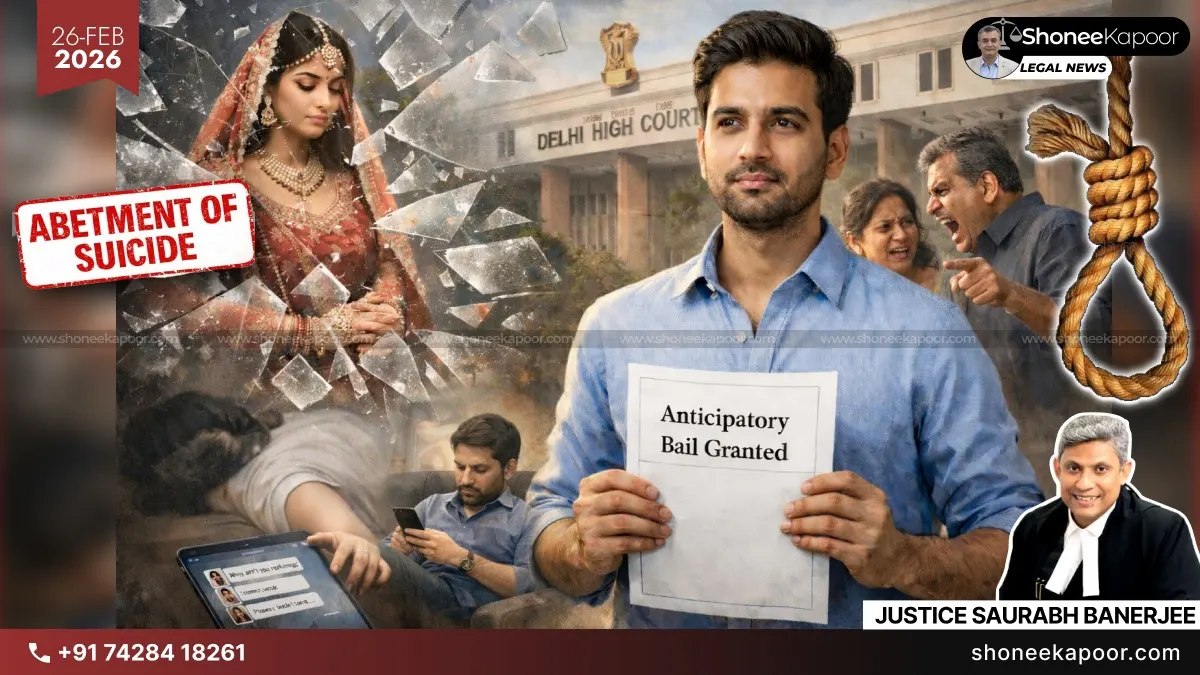
Can a suicide note alone put a man behind bars? The Delhi High Court says criminal law demands proof of an active and direct act, not emotional allegations.
Refusal to Marry Not Suicide Abetment: In a recent order, the Delhi High Court, through Justice Saurabh Banerjee, granted anticipatory bail to applicant Ujjwal in an FIR registered under Sections 306/34 IPC at PS Punjabi Bagh. The case arose after a young woman died by hanging on 09.05.2023, following which her parents approached the court seeking registration of an FIR alleging abetment of suicide.
As per the FIR, the deceased left behind two suicide notes blaming the applicant for misleading her for two years, promising marriage and later withdrawing. The post-mortem confirmed death due to asphyxia from antemortem hanging. The forensic report confirmed that the suicide notes were written by the deceased.
The applicant argued that even if there was a refusal to marry, that by itself does not amount to abetment of suicide. It was also submitted that there was no active or direct act from his side that could have led to the extreme step.
After examining the record, Justice Saurabh Banerjee made important observations that go to the root of criminal liability in such cases.
The Court clearly stated:
“Though the case of the prosecution rests upon the contents of the alleged suicide notes of the deceased, there is nothing credible enough for substantiating the same. It is at the end of the day a singular version of the deceased.”
Most importantly, the Court underlined the legal requirement under Section 306 IPC by holding:
“There are thus no active/ clear act of instigation/ abetment having a direct and proximate link to the commission of suicide.”
This line makes it clear that criminal law requires a direct connection and clear intention, not mere emotional fallout from a failed relationship.
Considering the safeguards applicable in anticipatory bail matters, the Court concluded:
“This Court is of the opinion that the applicant has prima facie made out a case for grant of anticipatory bail.”
Accordingly, anticipatory bail was granted subject to standard conditions including cooperation with investigation, surrender of passport, and non-tampering with evidence.
Explanatory Table: Laws & Sections Involved
| Law / Section | Purpose | How applied in this case |
| Section 482 BNSS, 2023 | Gives inherent powers to High Court to secure justice and prevent abuse of legal process | Used by applicant to seek anticipatory bail protection |
| Section 306 IPC | Punishes abetment of suicide requiring instigation or active role | FIR alleged applicant’s conduct led to suicide; Court found no direct instigation |
| Section 34 IPC | Establishes joint liability when offence done with common intention | Invoked in FIR to attribute shared responsibility with family members |
| Section 156(3) CrPC | Allows Magistrate to direct police to register FIR and investigate | FIR registered based on parents’ application under this provision |
Case Details
- Case Title: Ujjwal vs State (Govt. of NCT of Delhi)
- Court: High Court of Delhi at New Delhi
- Bench: Hon’ble Mr. Justice Saurabh Banerjee
- Neutral Citation: 2026:DHC:1623
- FIR Details:
- FIR No.: 503/2025 dated 13.08.2025
- Police Station: Punjabi Bagh, Delhi
- Dates:
- Order Reserved On: February 16, 2026
- Order Pronounced On: February 24, 2026
- Counsels:
- For Applicant: Mr. Sarthak Tomar, Advocate
- For Respondent: Mr. Satish Kumar, APP with Ms. Upasna Bakshi and Ms. Divya Bakshi, Advocates with SI Naresh Kumar, PS Punjabi Bagh
Key Takeaways
- A failed relationship or refusal to marry cannot automatically be treated as abetment of suicide; criminal law requires clear mens rea and a direct act of instigation.
- A suicide note naming someone is not conclusive proof; there must be credible material showing active involvement and a proximate link to the tragic act.
- Not replying to messages or ending communication does not amount to a criminal offence unless there is clear evidence of coercion or provocation.
- Arrest cannot become a default reaction in emotional relationship disputes; personal liberty must be protected unless strong legal ingredients are made out.
- Section 306 IPC demands strict proof of intentional instigation; without an active and direct role, criminal prosecution becomes misuse rather than justice.
This Could Change Your Case-Get FREE Legal Advice-Click Here!
Disclaimer: The views and opinions expressed in this article are those of the Indian courts and do not necessarily reflect the official policy or position of “ShoneeKapoor.com” or its affiliates. This article is intended for informational and educational purposes only. The content provided is not legal advice, and viewers should not act upon this information without seeking professional counsel. Viewer discretion is advised.
