
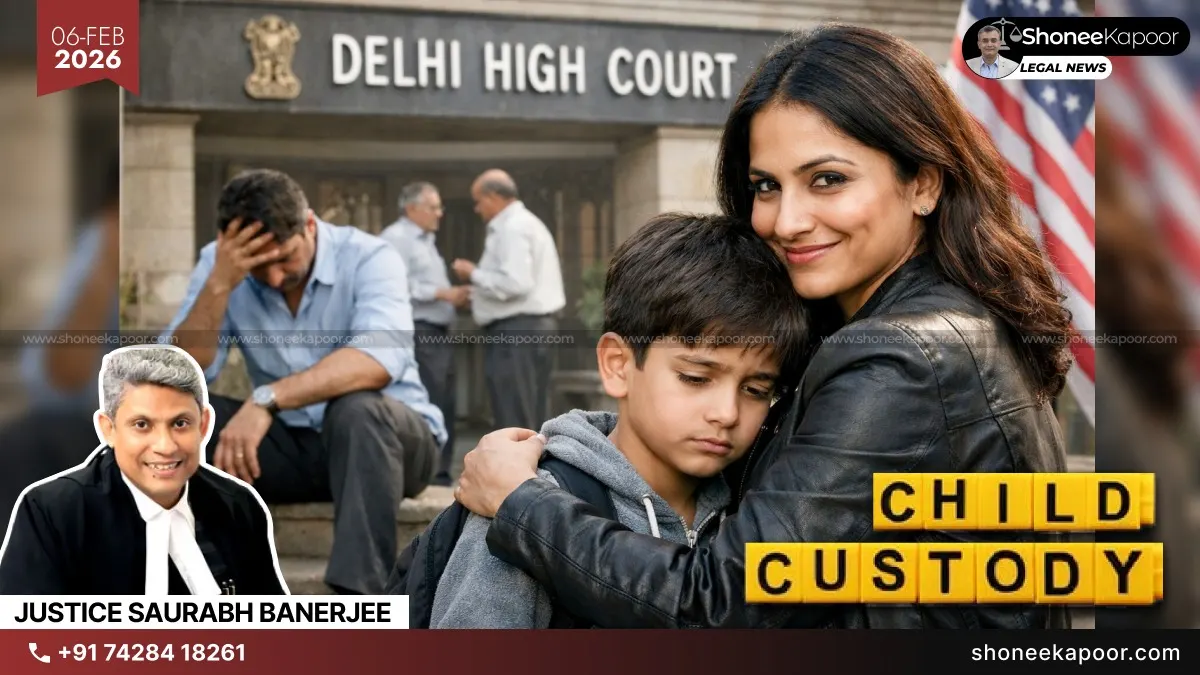
The Delhi High Court held that a mother’s right to higher education and personal development under Article 21 cannot be stopped due to pending custody disputes. The Court allowed her to relocate abroad with the child while modifying the father’s visitation rights.
NEW DELHI: Justice Saurabh Banerjee of the Delhi High Court delivered a detailed judgment allowing a mother to travel to the United States with her minor son for completion of her post-graduate studies.
The Court repeatedly relied on constitutional rights and motherhood while restructuring the father’s visitation rights, raising serious concerns about fairness to fathers in custody disputes.
The case arose from prolonged matrimonial conflict between the parents. The couple married in 2014 and had a son in 2017. Due to disputes, the mother left the matrimonial home in 2019 with the child.
Since then, multiple cases were filed by both sides. A Family Court had granted the father visitation rights, which later led to further litigation and even contempt proceedings when visitation was not followed.
Despite ongoing court proceedings and existing visitation orders, the mother left India with the child in July 2024 without court permission and travelled to the USA after securing admission to a post-graduate program.
This forced the father to file a habeas corpus petition. Even then, the child was not immediately restored to India permanently, and the matter continued through different courts, including the Supreme Court.
The mother argued that she had secured admission in a recognised foreign university and had already completed part of the course with good academic performance. She claimed that denying permission would ruin her career, financial future, and indirectly affect the child.
The Court accepted this argument, repeatedly linking the mother’s education and personal development to the welfare of the child.
Justice Saurabh Banerjee emphasised constitutional liberty and personal autonomy, observing:
“Denial or unreasonable restriction on exercise of such a choice, in the considered opinion of this Court, would tantamount to an impermissible intrusion into the very spirit of the right to personal liberty and development enshrined and protected under Article 21 of the Constitution.”
The Court further held that motherhood strengthens the claim to such liberty and stated,
“The fact that a mother is the primary caregiver and responsible for the upbringing of a child cannot be a ground to compel her to surrender her right to education, personal growth, and/or self-advancement.”
While recognising that the welfare of the child is paramount, the Court clarified that it must be read along with the mother’s rights and said:
“The welfare of the minor child is undoubtedly the paramount consideration, however, the same has to be taken cumulatively and harmoniously with various relevant factors.”
The father strongly opposed the application, arguing that allowing the child to move abroad would destroy his relationship with his son, make Indian court orders unenforceable, and permanently alienate him. He pointed out that the child was settled in Delhi and that the mother had earlier violated court directions.
However, the Court dismissed these concerns as speculative and held:
“Penalizing the mother for speculative apprehensions would be unjust.”
The judgment repeatedly stressed that a mother cannot be forced to choose between her child and her career. Relying on earlier Supreme Court precedents, the Court stated:
“A mother cannot be compelled to make an invidious choice between her child and her career.”
In one of the strongest observations, the Court concluded:
“Separating the minor child from his mother can prove fatal for his welfare.”
Ultimately, the Court permitted the mother to take the child to the USA, subject to strict undertakings. These included providing address details, allowing regular video calls, bringing the child to India during vacations, and returning permanently after completing the course.
Even then, the father’s physical access was reduced to limited vacation periods and virtual interactions.
This judgment highlights a recurring pattern in Indian custody litigation, where a father’s fundamental role is acknowledged in theory but diluted in practice. Despite proven violations, pending litigation, and clear loss of day-to-day parenting, the father is expected to adjust, wait, and accept reduced access in the name of welfare and constitutional balance.
The case once again raises a serious question: when courts speak of equality and parental rights, why does the burden of compromise almost always fall on the father?
Explanatory Table: Laws & Sections Involved
| Law & Section | Purpose | How Applied in This Case |
| Constitution of India – Article 21 | Right to life, liberty, dignity, personal development | Used to protect mother’s right to education and career abroad |
| Code of Civil Procedure, 1908 – Section 151 | Inherent powers of court | Allowed filing of applications and additional documents |
| Guardians and Wards Act, 1890 – Welfare Principle | Child’s welfare is paramount | Interpreted to favour custody remaining with mother |
| Family Law – Paramount Welfare Doctrine | Welfare above parental rights | Welfare read along with mother’s autonomy, not father’s access |
| Criminal Jurisdiction – Habeas Corpus | Remedy against illegal custody | Invoked by father after child taken abroad without permission |
| Vivek Singh v. Romani Singh (SC) | Role of mother in child’s upbringing | Relied upon to justify child staying with mother |
| Vikram Vir Vohra v. Shalini Bhalla (SC) | Mother’s career autonomy | Used to allow relocation with child |
| Shilpa Aggarwal v. Aviral Mittal (SC) | Limits on relocation affecting visitation | Distinguished; not strictly followed |
| FRRO / MEA / Bureau of Immigration Directions | Control over foreign travel | Earlier restraint lifted after court permission |
Case Details
- Case Title: Smt. Twinkle Vinayak vs. Sh. Vishal Verma
- Case Number: CM(M) 159/2023 with CM Appl. 4739/2023
- Court: High Court of Delhi, New Delhi
- Bench: Hon’ble Mr. Justice Saurabh Banerjee
- Neutral Citation: 2026:DHC:945
- Dates:
- Judgment Reserved on: 04 December 2025
- Judgment Pronounced on: 05 February 2026
- Counsels:
- For Petitioner (Mother): Dr. Swati Jindal Garg, Advocate
- For Respondent (Father): Mr. Udit Gupta, Advocate, and Ms. Nidhi Malhotra, Advocate
Key Takeaways
- A father’s right to daily parenting can be diluted even when court orders are violated, while the system still places trust in the mother’s assurances.
- “Child welfare” is repeatedly interpreted through the lens of the mother’s convenience, autonomy, and career growth, not the father’s emotional loss or bonding rights.
- Fathers are expected to accept long-distance parenting through video calls as an adequate substitute for physical presence.
- Past non-compliance by the mother does not automatically weigh against her, whereas fathers must continuously prove their intentions and conduct.
- Indian custody law still lacks true gender neutrality, where a father’s role is acknowledged in words but compromised in outcomes.
This Could Change Your Case-Get FREE Legal Advice-Click Here!
Disclaimer: The views and opinions expressed in this article are those of the Indian courts and do not necessarily reflect the official policy or position of “ShoneeKapoor.com” or its affiliates. This article is intended for informational and educational purposes only. The content provided is not legal advice, and viewers should not act upon this information without seeking professional counsel. Viewer discretion is advised.
