
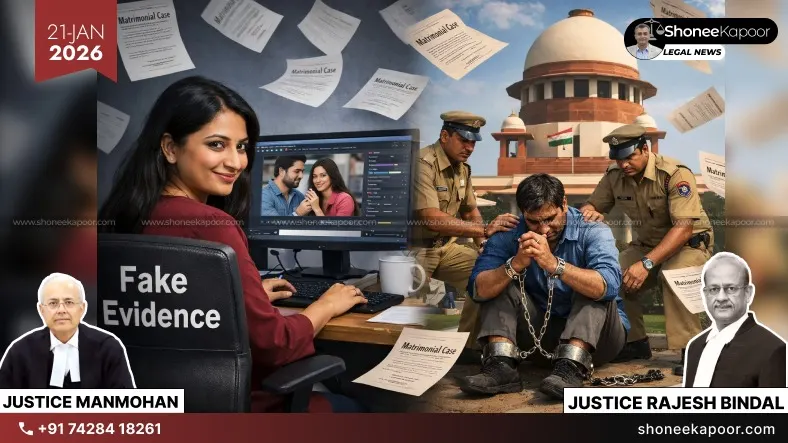
The Supreme Court has raised serious alarm over fake and AI-generated evidence in matrimonial disputes. The Court warned that false allegations and criminal cases are destroying marriages and lives beyond repair.
NEW DELHI: The Supreme Court has openly expressed deep concern over the growing misuse of technology in matrimonial disputes, especially the creation of fake and AI-generated evidence to strengthen false cases. The Court observed that instead of resolving marital issues, many disputes are now being turned into legal battles where the intention is not justice, but punishment of the other side at any cost.
While dissolving a marriage on the ground of irretrievable breakdown, the Bench comprising Justices Rajesh Bindal and Manmohan clearly highlighted how modern technology is being weaponised inside family disputes. The Court noted that once differences arise, preparation begins to trap the other party rather than to save the marriage.
The Bench observed:
“Whenever the parties in matrimonial dispute have differences, the preparation starts as to how to teach lesson to the other side. Evidence is collected and, in some cases, even created, which is more often in the era of artificial intelligence. False allegations are rampant.”
The Court further pointed out that such practices not only damage the institution of marriage but also ruin lives, reputations, careers, and families, especially when criminal law is invoked without restraint. The Judges emphasised that rushing to the police for every marital disagreement has become a dangerous trend and often leads to irreversible consequences.
The Supreme Court strongly advised that mediation should be the first step in matrimonial disputes, not criminal complaints. It observed that even courts must prioritise reconciliation over confrontation.
The Court stated:
“First and the foremost, earnest effort should be made by the parties and to be guided by the advocates, whensoever consulted in the process, is to convince them for a pre-litigation mediation. Rather in some cases, their counselling may be required.”
The Bench further clarified that even when cases related to maintenance or domestic violence are filed, courts must attempt mediation before allowing the exchange of allegations that escalate hostility.
The Court observed:
“Even if a case is filed in a Court on a trivial issue such as maintenance under Section 144 of BNSS, 2023 (earlier Section 125 of CrPC, 1973) or Section 12 of the Protection of Women from Domestic Violence Act, 2005, the first effort required to be made by the Court is to explore mediation instead of calling upon the parties for filing replies as allegations and counter allegations sometimes aggravate the dispute.”
The Supreme Court also expressed concern over the immediate involvement of police in matrimonial disputes, warning that arrests often become a point of no return for any chance of reconciliation.
The Court clearly cautioned:
“Even when a complaint is sought to be registered with the police of simple matrimonial dispute, first and the foremost effort has to be for re-conciliation, that too, if possible, through the mediation centers in the Courts, instead of calling the parties to the police stations. This sometimes becomes a point of no return specially when any of the parties is arrested, may it be even for a day.”
These observations were made in a case where the marriage had effectively collapsed within just 65 days of cohabitation, but litigation continued for more than 13 years. During this period, the husband and wife filed over 40 cases against each other, including divorce petitions, maintenance proceedings, domestic violence cases, criminal complaints under Section 498A IPC, perjury applications, execution petitions, writ petitions, and multiple transfer pleas across different courts.
The Supreme Court noted that courts cannot be allowed to become battlefields where broken relationships are converted into endless legal warfare. It stressed that prolonged litigation only deepens bitterness and causes permanent damage to both parties.
The judgment, authored by Justice Rajesh Bindal, ultimately dissolved the marriage using the Court’s extraordinary powers under Article 142 of the Constitution, while also allowing perjury proceedings to continue. The Court made it clear that while dead marriages should not be kept alive artificially, false statements, fabricated evidence, and abuse of the legal system cannot be ignored or protected.
The ruling sends a strong message that matrimonial laws are meant to deliver justice, not to be used as tools for harassment, revenge, or character assassination, and that misuse of criminal law has serious consequences for society as a whole.
Explanatory Table – Laws & Sections Involved In The Case
| Law / Statute | Section | Simple Explanation |
| Constitution of India | Article 142 | Gives the Supreme Court special power to do complete justice, even beyond existing laws, including dissolving marriages where continuation serves no purpose. |
| Bharatiya Nagarik Suraksha Sanhita, 2023 (BNSS) | Section 144 | Provision relating to maintenance, replacing old Section 125 CrPC, often invoked in matrimonial disputes. |
| Bharatiya Nagarik Suraksha Sanhita, 2023 (BNSS) | Section 379 read with 215 | Deals with proceedings related to perjury and false statements under oath, continuation allowed even after divorce. |
| Code of Criminal Procedure, 1973 | Section 125 (earlier law) | Maintenance provision for wife, now replaced by Section 144 BNSS. |
| Code of Criminal Procedure, 1973 | Section 340 | Allows court to initiate perjury proceedings for false affidavits, fabricated evidence, or misleading statements. |
| Hindu Marriage Act, 1955 | Section 13 | Provision for divorce through regular matrimonial courts. |
| Protection of Women from Domestic Violence Act, 2005 | Section 12 | Allows filing of domestic violence complaints; court stressed mediation even in such cases. |
| Indian Penal Code, 1860 | Section 498A | Criminal offence for cruelty by husband or relatives; highlighted as frequently invoked in matrimonial conflicts. |
| Indian Penal Code, 1860 | Section 406 | Criminal breach of trust, often added in matrimonial FIRs. |
| Indian Penal Code, 1860 | Sections 323, 504, 506 | Commonly added sections alleging hurt, insult, and criminal intimidation in family disputes. |
| Indian Penal Code, 1860 | Sections 191–195, 211, 471, 120B | Sections related to false evidence, false charges, forged documents, and criminal conspiracy. |
Case Details
- Case Title: Neha Lal vs Abhishek Kumar
- Neutral Citation: 2026 INSC 73
- Court: Supreme Court of India
- Jurisdiction: Criminal Original Jurisdiction
- Case Number: Transfer Petition (Crl.) No. 338 of 2025. Along with I.A. No. 200539 of 2025 (Application under Article 142 of the Constitution of India)
- Date of Judgment: 20 January 2026
- Bench: Justice Rajesh Bindal & Justice Manmohan
- Counsels / Appearances
- Petitioner (Wife): Represented through Counsel
- Respondent (Husband): Appeared in Person
Key Takeaways
- The Supreme Court has officially recognised that false allegations and fabricated evidence are rampant in matrimonial cases, validating what accused husbands have been saying for years.
- The Court admitted that criminal cases are frequently filed not to seek justice but to “teach a lesson,” turning husbands into easy targets of legal harassment.
- Arrests in matrimonial disputes were acknowledged as a point of no return, often destroying any chance of reconciliation and permanently damaging a man’s life, reputation, and career.
- The judgment makes it clear that divorce cannot be used as an escape route from perjury and false affidavits, holding accountable those who misuse the legal system.
- By urging mediation over police action, the Court indirectly exposed how criminal law is routinely weaponised against men instead of being used as a last resort.
This Could Change Your Case-Get FREE Legal Advice-Click Here!
Disclaimer: The views and opinions expressed in this article are those of the Indian courts and do not necessarily reflect the official policy or position of “ShoneeKapoor.com” or its affiliates. This article is intended for informational and educational purposes only. The content provided is not legal advice, and viewers should not act upon this information without seeking professional counsel. Viewer discretion is advised.
