
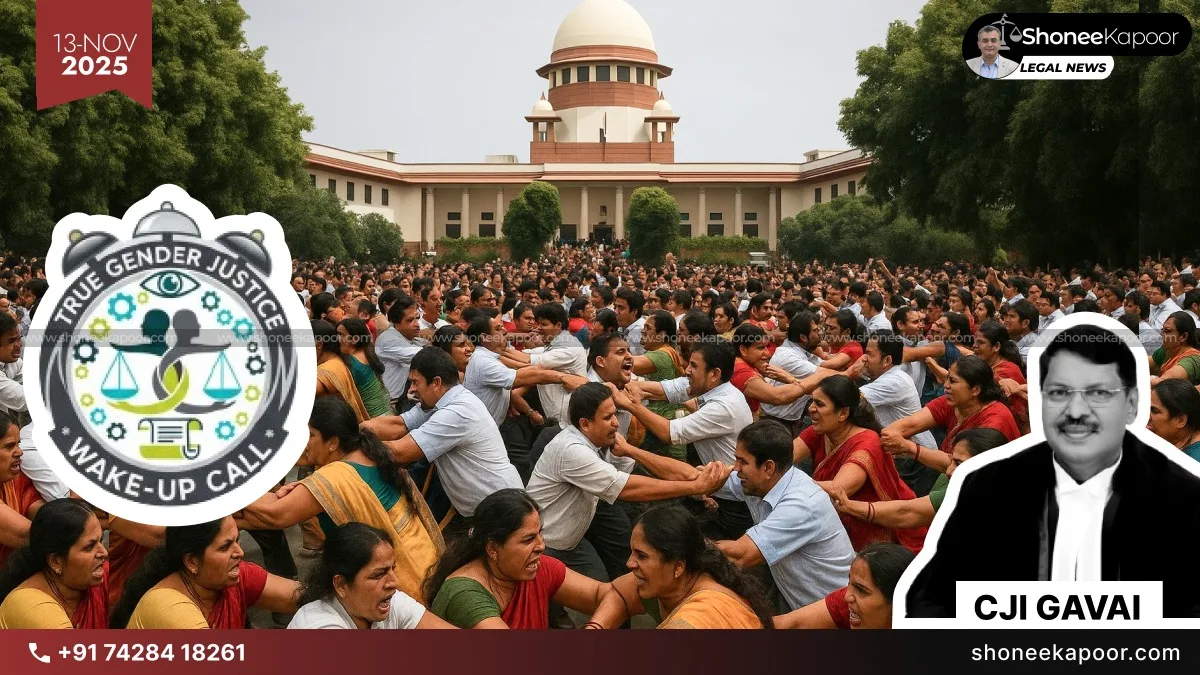
CJI B.R. Gavai said gender Justice cannot be achieved by women alone; men must also take responsibility, share power and work in collaboration. He reminded that real progress comes when both genders rebuild institutions together — not through confrontation but cooperation.
NEW DELHI: Chief Justice of India B.R. Gavai spoke about the real meaning of gender justice and how both men and women must work together to make equality a living reality. Speaking at the 30th Justice Sunanda Bhandare Memorial Lecture on the theme “Justice for all: Building a gender equal and inclusive India,” he said the journey toward gender equality will succeed only if men contribute equally.
According to CJI Gavai, gender justice cannot be achieved if men continue to hold all the power and expect women alone to fight for change. He emphasized that the real progress will come when men understand that sharing power is not losing control, but freeing society from its old chains.
He said:
“Achieving gender justice is not the responsibility of women alone. It requires an active reimagining of power by men, especially those who occupy positions of authority in our institutions, workplaces, and political systems. Real progress will come only when men recognize that sharing power is not an act of loss, but of liberation of society. The path to a gender equal India, therefore, lies not in confrontation, but in collaboration, where men and women together rebuild the moral and institutional architecture of equality envisioned by our Constitution.”
CJI Gavai explained how India’s journey toward equality has moved through three stages since independence. The first stage began in 1950 when the Constitution came into force. The second phase started around 1975 when the idea of gender equality went beyond legal rights and began to include dignity, autonomy, and social realities.
The third and current phase, he said, focuses on empowerment, protection, and inclusion of women, transgender, and queer individuals.
He noted:
“After 1975, the national discourse on gender equality began to evolve beyond questions of formal rights, turning instead towards the deeper idea of dignity as an inseparable component of equality. The conversation shifted from a mere legal parity to the recognition of the woman’s autonomy, bodily integrity and the social realities that shape their lived experiences.”
The Chief Justice also pointed out that laws like the Protection of Women from Domestic Violence Act, the recognition of reproductive rights, and inclusion of transgender and queer rights are steps toward comprehensive protection and empowerment. However, he also accepted that the judiciary has made mistakes.
CJI Gavai mentioned the Mathura case, calling it an “embarrassing” moment in judicial history. In that case, two policemen accused of raping a tribal girl were acquitted because the court felt she had not fought back strongly.
He said:
“The judgment reflected a deeply regressive and patriarchal understanding of consent, effectively denying the social context of power, coercion and vulnerability in which sexual violence often occurs. In my view, this decision remains one of the most troubling moments in India’s constitutional and judicial history. And it could be called as a moment of institutional embarrassment, where the legal system failed to protect the dignity of the very person it was meant to safeguard.”
But this failure, he said, also sparked a people’s movement that reshaped gender justice in India. Public outrage and nationwide protests led by women’s groups, students and activists became the foundation of modern women’s rights campaigns.
He added:
“The vigilance of civil society, the persistence of women’s movements, and the courage of ordinary citizens have together kept the judiciary accountable to the constitutional promise of equality. Therefore, it is important to acknowledge that the progress in gender justice has never been the achievement of courts alone. The collective voice of the citizens has ensured that regressive precedents were questioned, debated and ultimately corrected through reform, reinterpretation or legislative intervention.”
In his concluding remarks, CJI Gavai said the journey toward equality is far from complete. Symbolic gestures are not enough — women must have a real and equal share in power, decision-making, and opportunities.
“The task before us is not merely to celebrate symbolic achievements or token representations but to ensure that women have a real and equal share in spaces of power, decision-making and opportunity.”
As a men’s-rights perspective, this message holds an even deeper meaning. Equality cannot exist if it becomes a one-sided narrative. True gender justice must include men’s participation, men’s empathy, and men’s accountability — not as villains or oppressors, but as equal partners in reform. Sharing power does not weaken men; it strengthens the fabric of justice itself.
Men must realise that fighting for fairness in family laws, in custody battles, and against misuse of legal provisions is not against women — it is for building a gender-neutral society where every human being is protected equally under the law.
Explanatory Table – Laws and Articles Mentioned
| Law / Article / Case | Description | Relevance |
| Protection of Women from Domestic Violence Act, 2005 | Provides protection and civil remedies to women facing physical, emotional, or economic violence within family or relationships. | Cited by CJI Gavai as a key step in the third phase of gender-justice evolution. |
| Article 14 – Equality Before Law | Ensures every citizen is treated equally under the law. | Forms the constitutional foundation of gender equality. |
| Article 15 – Prohibition of Discrimination | Prohibits discrimination by the State on grounds of religion, race, caste, sex, or place of birth. | Underlines that gender-based inequality violates the Constitution. |
| Article 16 – Equal Opportunity in Public Employment | Guarantees equal access to public employment and prohibits gender-based bias. | Reflects gender parity in institutions and employment. |
| Article 21 – Right to Life and Personal Liberty | Includes the right to dignity, privacy, and bodily integrity. | Referred to while discussing reproductive and bodily rights of women. |
| Criminal Law (Amendment) Act, 2013 | Strengthened rape and sexual-assault laws following the Nirbhaya case. | Symbol of reform born out of public activism and legal introspection. |
| Mathura Rape Case (1979) | Supreme Court acquitted two policemen accused of raping a young tribal girl, sparking nationwide protests. | Mentioned by CJI Gavai as an “institutional embarrassment” and turning point in gender-rights movement. |
Event Summary
| Category | Details |
| Event Title | 30th Justice Sunanda Bhandare Memorial Lecture |
| Theme | Justice for all: Building a gender equal and inclusive India |
| Speaker | Chief Justice of India – B.R. Gavai |
| Date | 12 November 2025 |
| Bench / Counsels | Not applicable (Public lecture, not judicial hearing) |
| Key Case Mentioned | Mathura Rape Case (1979) – criticised as regressive and patriarchal |
| Key Message | Gender justice requires active participation of men, shared power, and a collaborative approach to equality |
| Focus Points | Power sharing, dignity, autonomy, institutional reform, accountability of judiciary, and inclusion of all genders |
| Closing Line Essence | Men and women must rebuild equality together — not through confrontation, but collaboration. |
Key Takeaways
- Gender Justice is NOT Women’s Job Alone
Finally, a sitting Chief Justice has said it clearly — men too must take responsibility for gender equality. It’s not a “feminist issue”; it’s a human issue. When laws and systems are fair to both genders, society becomes stronger. - “Sharing Power is Liberation, Not Loss”
CJI Gavai’s quote hits hard — men sharing power doesn’t mean surrendering it. It means ending the old system of blame and control. In a truly fair India, men and women must both have dignity and voice — not one dominating the other. - True Equality Needs Collaboration, Not Confrontation
The CJI rightly said that the future lies in cooperation. For decades, gender debates in India have been confrontational — men vs. women. It’s time to rebuild institutions that treat everyone equally, whether it’s in courts, workplaces, or families. - Constitution Protects All Genders — Not Only Women
Articles 14, 15 and 16 ensure equality for every citizen. Men also have the right to protection from discrimination — including bias in family courts, false 498A cases, and maintenance abuse. Equality cannot mean “justice for one, punishment for another.” - “Institutional Embarrassment” Should Never Repeat
By calling the Mathura case a national embarrassment, CJI Gavai reminded us that justice systems can fail victims — whether they’re women or men. Men too face institutional bias — false accusations, custodial torture, one-sided laws. These failures deserve the same outrage. - Courts Alone Didn’t Achieve Gender Justice
He admitted it — real reform came from people’s voices. Men’s rights activists, social reformers, and honest citizens must continue raising awareness. Only public pressure can make laws gender-neutral and fair. - No More Symbolic Equality — Demand Real Parity
CJI Gavai warned against “token” equality. Men’s rights activists echo this — stop celebrating symbolic wins while men continue to suffer in silence. Equality means shared responsibility, shared power, and shared accountability. - Time for Men to Be Stakeholders, Not Spectators
Men can’t stay silent while being blamed for systemic inequality. True progress demands male participation — from policy making to parenting, from social reform to law reform. - Reproductive & Bodily Autonomy Must Apply Equally
If bodily autonomy is a human right, it should apply to men too — whether in cases of paternity fraud, forced parenthood, or reproductive decisions. Equality is incomplete without equal bodily rights. - “The Journey is Not Complete Yet”
The CJI closed by saying the journey continues. As men’s rights advocates, we say — yes, and the next step must be gender-neutral laws, equal accountability, and balanced representation in every field.
Disclaimer: The views and opinions expressed in this article are those of the Indian courts and do not necessarily reflect the official policy or position of “ShoneeKapoor.com” or its affiliates. This article is intended for informational and educational purposes only. The content provided is not legal advice, and viewers should not act upon this information without seeking professional counsel. Viewer discretion is advised.

What does forced parenthood mean? For example If a lady does not want a child and the man wants then it is forced parenting on the lady, but it violates the reproductive decision of the mansimilarly if a man doesnot want a child and the lady wants then it will be forced parenting of the man, and violate the reproductive decision of the lady
Excellent observation. This goes to the heart of reproductive equality. Today, a woman’s reproductive choice is legally recognized, but a man’s isn’t. If he doesn’t want fatherhood, the system still forces financial and emotional responsibility on him, even when he had no say in the decision.
That imbalance is what many call forced parenthood for men. A serious blind spot in our justice system. True equality means recognizing that consent and choice must exist for both genders, not just one.
But then it will lead to forced termination ,then what could be that will be in favour of both and will protect reproductive choice of both , means it will be he said she said what are you implying should there be a ground of divorce in case a man donot want to take responsibility and the mother be single parent ??
I am just curious how will it play out as I donot think neither you are anyone else support forced abortion either
all these I beleive before the child is born
Also if it mean termination then consent of the other party is needed that too upto a particular term
Or does it mean that for abortion under normal condition(no threat to life and mental challage) in case the couple is married , both consent is required for abortion, where at present only woman consent is required?
I too think that it is about changes in the abortion law where in married and in normal condition consent of both is needed
else
in case the lady life in danger then as in the MTP, the lady should be saved
else donot know how will they navigate the forced parenthood point keep rights of both spouses
Sir,
will it affect the forced termination law
and the pcpndt act??
Violet, this is exactly why men must start speaking up. Every time laws around MTP or PCPNDT are discussed, the conversation magically forgets that forced parenthood is a lived reality for men in India. A woman can terminate without the husband’s consent, but a man has zero say even when he is trapped into unwanted fatherhood, financial exploitation, or weaponized pregnancies. Any reform that doesn’t recognize misuse, false accusations, and the absolute power imbalance in reproductive laws will only deepen the injustice men already face. Gender justice cannot mean rights for one gender and responsibilities for the other – consent, accountability and protection must be equal for both spouses.
This changes will come under MTP(Medical termination of pregnancy ),by adding a clause of leagally opting out as you suggested.
Forced abortion is wrong – just like forced parenthood is wrong. Today only a woman’s reproductive choice is recognized, while a man is still bound for 18+ years even if he never consented to fatherhood. Equality means her body, her choice and his life, his choice. The solution is not forcing termination, but allowing men a legal opt-out before birth so both adults retain autonomy without harming each other. True justice requires reproductive rights for both genders, not just one.
ok understood
Means a legal opt out option before birth , like how women have that option of abortion till a certain weeks ,
It will make sense , the child can easily get the mother surename as the father has given up on him / her before birth.
and lead a normal life ,
Thanks for explaining in detail and bringing such a win win situation for all
Also sir I understand your point but when I search about it there are MRAs who want this to happen and your thoughts seems to be progressive
” Single Parenting के मामले में पिता का नाम PAN CARD पर अनिवार्य किया जायेगा (किसी विवाद या गैंग रेप के मामले में DNA टेस्ट के आधार पर)”
how will it work ( if you want can provide screen shot too)
Why are some MRAs so against single mothers
Now if law like these come into picture then although the man legally opt out would his name be in the pan card still or will you campaign against it(I support the legal opt out one)
just like for abortion it is only upto certain weeks will for this also upto certain weeks ?? that the man can go and opt out??
Rupali, very important question.
Right now, Indian law gives a time-bound choice to the woman under the MTP Act, but there is no similar “opt-out window” for men. A man cannot legally sign out of fatherhood the way a woman can decide on abortion within certain weeks.
Once a child is born, courts treat maintenance as the child’s right, not as a contract between the parents – so even if a man says he didn’t want the pregnancy, he is still bound to provide for the child.
This is exactly the imbalance we keep pointing out: women have reproductive choice backed by statute, men don’t. The article is a call for men to be part of the gender-justice conversation, not an announcement of any existing legal right for men to opt out.
Thank you for the information , and knowing that after a child is born noone has choice to opt out and abandon the child
Rupali, Indian law is clear: after a child is born, neither parent can opt out of responsibility. Under Section 125 CrPC, both parents are legally bound to maintain the child. Abandonment by either parent is a legal wrong and affects custody and guardianship under the Guardians and Wards Act. What the law does not permit is one parent denying access or walking away emotionally while demanding financial control. Responsibility is mandatory, privilege is not.
Also as you are a veteran lawyer , when do you thinks divorce will become no fault and easier than it is now , young couples are very particular when they once decide of divorce but some courts feet like they want to keep it hanging
You’ve raised a very valid point. The idea of no-fault divorce has been long due in India, but unfortunately, our matrimonial system still clings to the outdated concept of “finding fault”. Courts often drag proceedings, believing reconciliation is possible. Even when both parties are mentally done with the marriage.
True gender justice means giving equal exit rights in marriage, without forcing couples into years of courtroom trauma. The law must evolve from “marriage preservation” to “individual dignity.”
Most divorce among young couple starts at the pretext that the man doesnot want to leave his parents after marriage and the woman doesnot want to stay and destroy herself emotionally , but our outdated system doesnot consider forced to stay with inlaws as ground of divorce , in case the man lives in a lala land of that he will force her to continue the marriage by not agreeing for mutual or use RCR , cases drag for 2-3 years lakhs spent then at times convert to mutual
The above is the example of a scenario which doesnot make sense of delaying and wasting time
You’re absolutely right – our divorce system traps couples in dead marriages, and men suffer the worst because outdated laws allow wives to weaponize allegations, delay mutual consent, and extort settlements. Most young couples split due to incompatibility or living-arrangement issues, yet courts drag cases for years while men face RCR traps, false cases, and financial bleedings. Forcing a man to continue marriage or litigation isn’t reconciliation – it’s legalized harassment. India urgently needs no-fault, time-bound divorce so that dignity and justice aren’t held hostage by misuse of law.
Agree
As you advocate for shared parenting
how will it actually play out
1.same city
2.different city
3. different country
Meeting 50% time is impossible and not financially feasible