
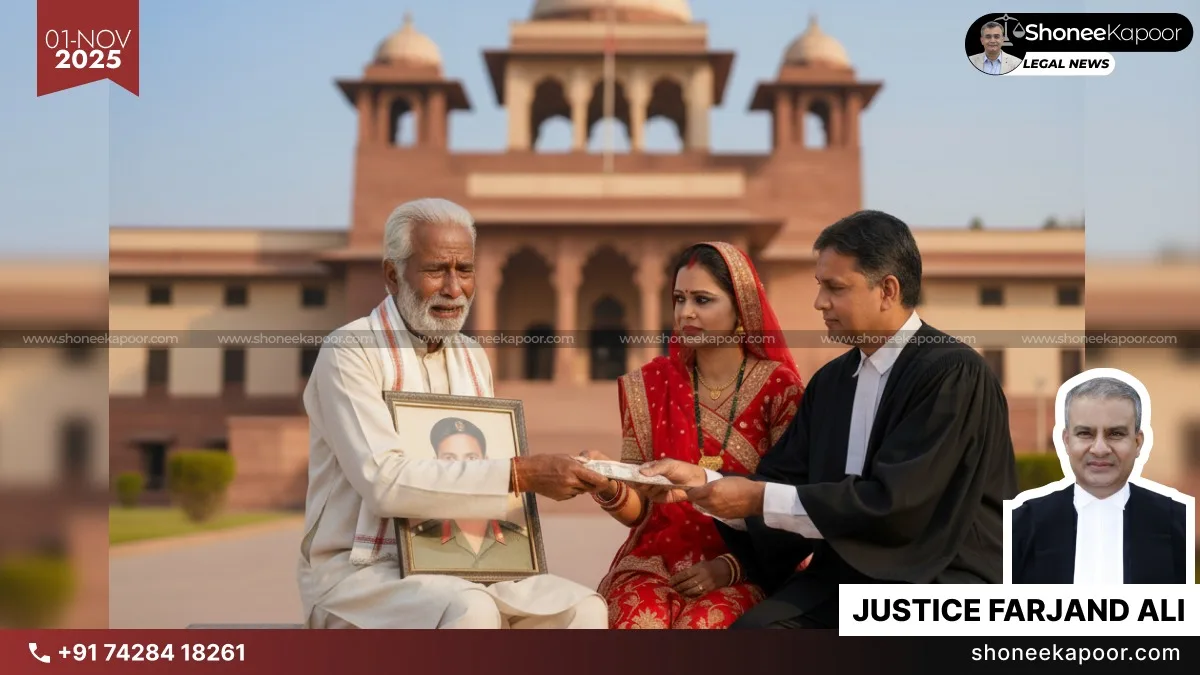
After an elderly man gave up his job opportunity to help his widowed daughter-in-law, she left and remarried. The High Court restored justice, directing salary deduction to maintenance and support the father-in-law she abandoned.
JODHPUR: In a landmark decision rendered by Justice Farzand Ali on October 29, 2025, the Rajasthan High Court’s Jodhpur Bench ordered Ajmer DISCOM to take ₹20,000 a month maintenance out of the salary of Shashi Kumari, the daughter-in-law of Bhagwan Singh Saini of Kherli, Alwar, and deposit it into his account starting on November 1, 2025, for the duration of his life. The decision was made after Bhagwan Singh, an elderly father who lost his only son in the military, was left powerless when his daughter-in-law left the home and got married again after landing a government job on his own recommendation on compassionategrounds.
Facts of the case
On September 15, 2015, Rajesh Kumar, a Technical Assistant at Ajmer DISCOM and the son of Bhagwan Singh, passed away while still employed. Letters requesting applications under the Compassionate Appointment Scheme were promptly sent out by the department. Bhagwan Singh was initially offered the position, but in a show of kindness, he willingly suggested that Shashi Kumari, his widowed daughter-in-law, be given the position instead.
Shashi Kumari was hired as a Lower Division Clerk (LDC) on March 11, 2016. She signed an affidavit on October 19, 2015, prior to joining, which included three solemn commitments:
- She would live with her in-laws and take care of them;
- She would take full responsibility for their welfare; and
- She would not remarry.
However, she reportedly returned to her parents’ home after leaving her in-laws’ within eighteen days of her husband’s passing. She had also abandoned her elderly father-in-law, who had no money or support, according to a subsequent municipal investigation. When Bhagwan Singh’s repeated requests for maintenance from the department in 2017 were not addressed, he was forced to file a petition in the High Court in 2018 for half of her salary.
Court’s Findings
According to Justice Farzand Ali, compassionate appointments are a welfare measure rather than a personal privilege. The benefit is not given as an individual reward, but rather to a member of the deceased employee’s family to lessen the burden on all dependents. The Court determined that Shashi Kumari, the widowed wife, could not avoid the responsibility she willingly took on because her appointment was secured through an affidavit and a moral commitment:
The Court observed: “When a person accepts a benefit by giving a specific assurance, the doctrine of promissory estoppel prevents her from denying the obligation that forms the basis of that benefit,”
Justice Ali emphasized that the term “family” under the compassionate appointment scheme must encompass all dependents, especially the elderly parents who were reliant on the deceased son and cannot be interpreted narrowly to mean just the widow. The judge pointed out that Shashi Kumari had also received 70% of the provident fund and compensation, which made the injustice to the elderly man she left worse.
Court’s Final Order:
Given the petitioner’s age, health, and demonstrated reliance on the departed son, the court ordered: “From 1 November 2025, the respondent department shall ensure deduction of ₹20,000 per month from the salary of Shashi Kumari and deposit it into the bank account of Bhagwan Singh Saini for his maintenance. This arrangement shall continue during the petitioner’s lifetime or until further orders.”
Legal Significance of this judgement
This landmark judgment by the Rajasthan High Court goes far beyond the story of one elderly father, it redefines compassion, accountability, and justice for men who are too often forgotten.
For decades, compassionate appointment has been used as a shield for selective sympathy where widows inherit benefits meant for the entire family, while ageing fathers are left to suffer in silence. Justice Farzand Ali’s decision pierces that hypocrisy. By ordering a daughter-in-law to share her salary with the very father-in-law who enabled her job, the Court has restored balance between rights and responsibilities.

The ruling sends an unshakable message: compassion cannot be claimed without conscience. When a man’s lifelong work and his family’s survival depend on integrity, betrayal becomes cruelty. The Court recognized that a father’s love and sacrifice deserve not pity, but legal protection. In a justice system where elderly men are often invisible victims, abandoned, mocked, or ignored this verdict finally gives fathers a voice. It tells the nation that men’s suffering matters, that their trust cannot be traded for convenience, and that law will stand with them when society won’t.
Case details
| Case Title: | Bhagwan Singh v. Superintending Engineer, Ajmer DISCOM (AVVNL) & Ors. |
| Court: | Rajasthan High Court, Jodhpur Bench |
| Bench: | Hon’ble Justice Farzand Ali |
| Case Number: | S.B. Civil Writ Petition No. 1149 of 2018 |
| Date of judgment: | Date of Reservation: 10 October 2025 Date of Judgment: 29 October 2025 |
| Effective Date of Deduction: | 1 November, 2025 |
| Question in issue: | Whether a daughter-in-law who obtained a compassionate appointment based on an affidavit promising to live with and support her in-laws can later abandon them and still retain the full benefit of that appointment, or whether the dependent father-in-law is entitled to claim maintenance from her salary? |
| Result: | Petition Allowed: Salary deduction of ₹20,000/month ordered from daughter-in-law’s income for father-in-law’s maintenance. Court enforced her affidavit promise as a binding moral and legal obligation. |
When Justice Finally imposes maintenance on women too
This ruling by the Rajasthan High Court is more than a legal order, it is a moral correction in a system that too often overlooks the pain of fathers and the elderly. Justice Farzand Ali has reminded the nation that compassion is not a one-way street. When a man sacrifices his rightful job opportunity out of love and trust, that sacrifice cannot be repaid with betrayal.
By upholding the father-in-law’s right to maintenance and enforcing the daughter-in-law’s broken promises, the Court has restored dignity to an ageing man who was left unseen and unheard. This verdict is a message to society: Men’s emotions, sacrifices, and suffering matter too. Compassionate appointment cannot be turned into a license to exploit it carries responsibility, accountability, and moral duty. In defending one father, the Court has spoken for thousands who still wait for justice inside silent homes.
Disclaimer: The views and opinions expressed in this article are those of the Indian courts and do not necessarily reflect the official policy or position of “ShoneeKapoor.com” or its affiliates. This article is intended for informational and educational purposes only. The content provided is not legal advice, and viewers should not act upon this information without seeking professional counsel. Viewer discretion is advise.
