
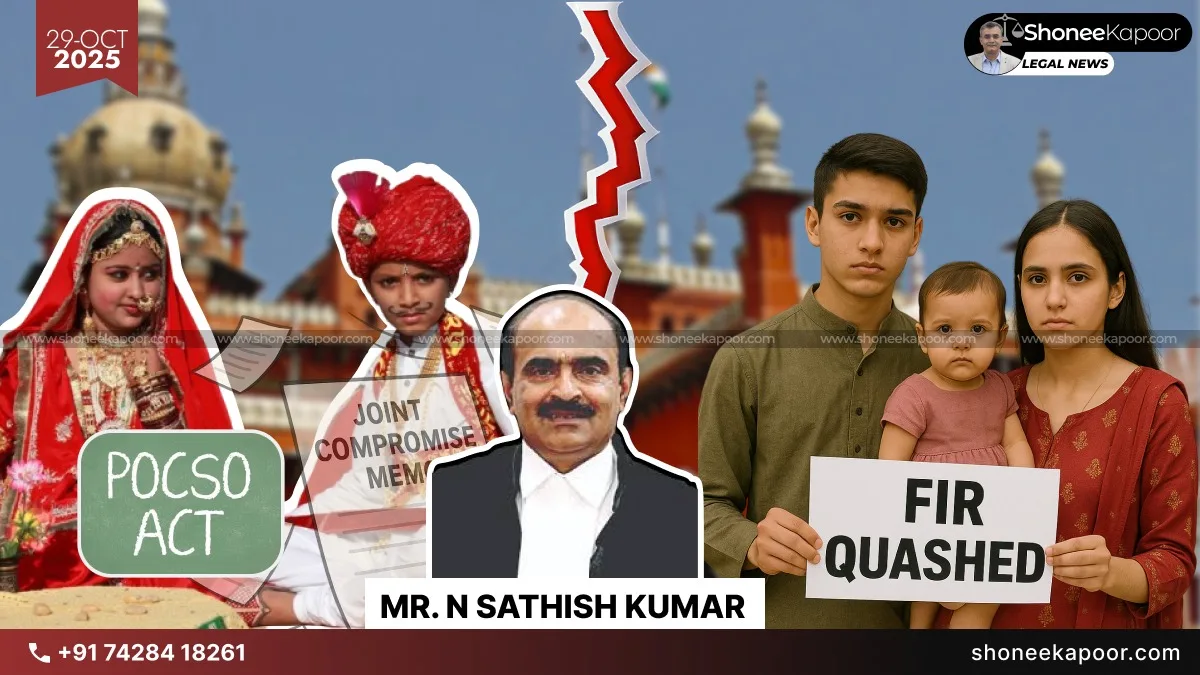
Justice N. Sathish Kumar, Madras High Court quashed a POCSO case and Demands Legal Reform after a young couple’s marriage and birth of a child, observing that criminalising consensual teenage relationships destroys the future of innocent boys.
Madras High Court Demands Legal Reform: In a progressive and humane decision, the Madras High Court has quashed a criminal case under the Protection of Children from Sexual Offences (POCSO) Act, 2012, holding that when a boy and girl in their teens are in a consensual relationship and later marry, continuing prosecution only shatters the young man’s life. Justice N. Sathish Kumar emphasised that such cases are “purely personal in nature” and do not involve any “overriding public interest.” The Court noted that the couple are now happily married with a daughter, and forcing the man to stand trial would “serve no useful purpose except to destroy his future.”
A young man from Perambalur was charged under Sections 5(1), 5(j)(ii), and 6 of the POCSO Act following the pregnancy of a 17-year-old girl he was dating. Following the FIR, the couple got married, both families approved of their relationship, and a joint compromise memo was submitted in an attempt to have the case dropped. The man claimed that the case was consensual, that the parties were now married, and that the prosecution would only ruin his life, so he moved the High Court to stop the proceedings under Section 528 BNSS / 482 CrPC.
Court’s Observations
Referring to this matter,Justice Kumar recalled that many POCSO prosecutions involve teenagers who “fall victim to the application of the POCSO Act at a young age without understanding the implication of the severity of the enactment.” He reiterated that relationships between adolescents often stem from “mutual innocence and biological attraction” and cannot be treated as criminal acts.
Quoting the earlier ruling, the Court observed that the definition of “child” under Section 2(d) should be reconsidered, suggesting that consensual relationships after age 16 should be excluded from the Act’s harsh provisions.
“Any consensual act after the age of 16 can be excluded from the rigorous provisions of the POCSO Act and tried under more liberal laws,” the judgment said.
Justice Kumar made a logical observation:
“After the complaint being lodged, the police register FIRs for such offences; invariably the boy gets arrested and thereafter, his youthful life comes to a grinding halt.”
He held that such prosecutions serve no societal purpose and that keeping them pending only prolongs mental agony for both families.
Final Order:
The High Court quashed the FIR on the file of the All Women Police Station, Perambalur, and accepted the Joint Compromise Memo dated 09 October 2025 as part of the record. “When two young persons have married and are raising a child, continuing POCSO prosecution serves no public purpose,” Justice Kumar declared.The Criminal Original Petition No. 27976 of 2025 was accordingly allowed.
Justice N. Sathish Kumar’s Message to Legal Reform POCSO
Justice N. Sathish Kumar’s order goes beyond one case, it shines a national light on a silent tragedy: how young men across India are being branded as sexual offenders for nothing more than consensual teenage love.
The judgment is a wake-up call for lawmakers, parents, police, and the judiciary. The Court recognised that hundreds of boys are dragged into POCSO prosecutions where both parties are emotionally immature, in love, and often end up marrying later. Yet, the boy alone faces arrest, social stigma, and a destroyed future.
“After the complaint being lodged, invariably the boy gets arrested and thereafter, his youthful life comes to a grinding halt.” — Justice N. Sathish Kumar, Madras High Court
The judge’s words deliver a powerful message that justice must be humane. Laws meant to protect children cannot become instruments that criminalise adolescence or punish affection. The ruling calls upon Parliament to redefine the term “child” under Section 2(d) of the POCSO Act, proposing that consensual acts after age 16 should not be prosecuted under the same provisions that punish predatory abuse.

This interpretation carries four vital legal and social messages:
- Safeguarding minors should not mean jailing teenage boys in love.
- Courts must distinguish predatory crimes from consensual youthful relationships.
- India needs an age-of-consent framework that reflects social realities instead of blind criminalisation.
It reminds the nation that the POCSO Act’s true purpose is to protect children from exploitation, not to ruin the lives of young men who loved sincerely. When the Court says, “Continuing prosecution serves no public purpose,” it isn’t just freeing one man it is freeing a generation of boys from silence, fear, and stigma.
Explanatory Table Of All Laws And Sections Mentioned
| Case / Provision | Citation / Section | Explanation / Relevance in the Case |
| Protection of Children from Sexual Offences Act, 2012 | Sections 5(1), 5(j)(ii), 6 | Charged the petitioner with aggravated penetrative sexual assault. |
| Code of Criminal Procedure 1973, (Now, BNSS 2023) | Section 482 CRPC/ 528 BNSS | Power of High Court to quash proceedings to secure justice. |
| Sabari v. Inspector of Police (2019 3 MLJ Crl 110) | – | Recommended redefining “child” as under 16 for consensual relationships. |
| Parbathbhai Aahir v. State of Gujarat (2017 9 SCC 641) | – | Permits quashing of non-compoundable offences when personal and not of public concern. |
| State of M.P. v. Dhruv Gurjar (2019 2 MLJ Crl 10) | – | Emphasised that offences of a purely personal nature can be settled by compromise. |
Case Summary
| Category | Details |
| Case Title | XYZ v. ABC |
| Court | Madras High Court |
| Judge | Hon’ble Mr Justice N. Sathish Kumar |
| Type of Order | Petition to Quash FIR under Section 528 BNSS / 482 CrPC |
| Statutory Grounds | Protection of Children from Sexual Offences Act, 2012 |
| Result | FIR quashed on compromise |
| Key Observation | When two young persons have married and are raising a child, continuing POCSO prosecution serves no public purpose. |
| Core Quote of Judgment | “After the complaint being lodged, the boy gets arrested and thereafter, his youthful life comes to a grinding halt.” |
When Empowerment Meets Accountability: A Judgment Everyone Should Read
The Madras High Court’s words cut through the silence that surrounds thousands of young men trapped under the rigid framework of POCSO. The law, created to protect minors from predators, has now become a weapon that punishes adolescent boys for love. When a 17-year-old girl and a 19-year-old boy fall in love, the boy alone bears the label of “sexual offender” even if the relationship was mutual, emotional, and later legitimised through marriage.
For years, men’s-rights advocates have been demanding recognition of this systemic injustice. Every teenage love story should not end in a police case. Every boy should not lose his youth to custody, stigma, and a lifetime record for being human. Justice Kumar’s judgment is more than a case order, it is a plea for sanity. It reminds India that protection should not turn into persecution, and that the law must differentiate between exploitation and affection. When a nation’s laws crush its boys in the name of safeguarding its girls, it’s not protection, it’s prejudice.
DISCLAIMER: Names and identifying details of the victim have been withheld in compliance with Section 228A IPC and Section 23 POCSO Act.
Disclaimer: The views and opinions expressed in this article are those of the Indian courts and do not necessarily reflect the official policy or position of “ShoneeKapoor.com” or its affiliates. This article is intended for informational and educational purposes only. The content provided is not legal advice, and viewers should not act upon this information without seeking professional counsel. Viewer discretion is advise.
