
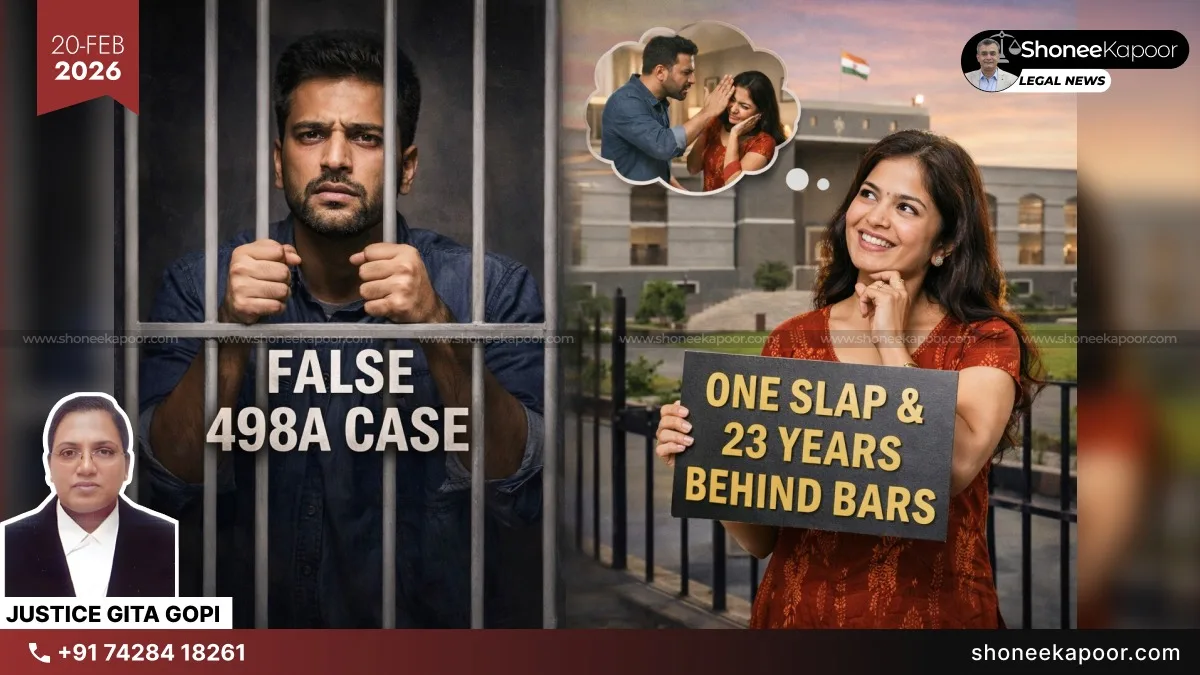
After 23 years of legal battle, the Gujarat High Court has ruled that a single slap and ordinary marital quarrels cannot be treated as cruelty under Section 498A IPC. The Court found no proof of continuous harassment or abetment to suicide, setting aside the conviction in a case that raises serious questions about misuse of law.
Ahmedabad: The Gujarat High Court has held that a single incident where a husband slapped his wife for staying overnight at her parental home without informing him does not amount to cruelty under Section 498A of the Indian Penal Code (IPC).
Justice Gita Gopi acquitted the husband after 23 years of criminal proceedings, observing that there was no reliable evidence to prove persistent cruelty or abetment to suicide.
The Sessions Court had earlier convicted the husband in 2003 under Sections 498A (cruelty) and 306 (abetment to suicide) IPC, sentencing him to seven years’ imprisonment for abetment and one year for cruelty. The High Court has now set aside that conviction and acquitted him of all charges
The prosecution case was that the wife had committed suicide by hanging herself within one year of marriage in May 1996. It was alleged that she was subjected to mental and physical cruelty by her husband, which drove her to take her life.
However, after examining the evidence in detail, the High Court found major gaps and inconsistencies in the prosecution case.
Justice Gopi noted that most allegations were general in nature. There was no prior complaint of cruelty. No medical records were produced to support claims of severe beatings. Independent witnesses did not confirm any persistent harassment. Even the father admitted that the marital relationship was otherwise cordial and that there was no demand for dowry.
The central issue between the couple appeared to be the husband’s habit of playing ‘banjo’ at night during marriage functions to earn extra income. The wife did not like him returning late at night, and quarrels would occur on that issue.
The Court specifically recorded:
“It appears that the quarrel was only on the ground as the husband was going out at night to play ‘banjo’ in marriage ceremonies and after returning late, there would be quarrel between the husband and wife. All the witnesses consistently stated that the deceased as a wife was not liking the accused returning late in the night after playing ‘banjo’. The quarrels were specifically stated to have occurred after accused returning back home at night, after his performance on the ‘banjo'”
On the allegation that the husband had slapped his wife one month prior to the incident for staying overnight at her parents’ home without informing him, the Court made a crucial observation. It held that one such incident cannot automatically be treated as cruelty under Section 498A IPC.
The Court clearly ruled:
“One incident of husband slapping the wife on the ground of staying overnight at parental home without informing him would not be counted as cruelty. The proximate cause to suicide was not proved. And persistent, unbearable continuous beatings, would require cogent evidence to be considered as proved, for the same to be believed as cruelty that drove the daughter to commit suicide by hanging herself to death finding no other alternative. The witnesses failed to prove the case of cruelty and of abetment for the commission of suicide. The conclusion reached by the trial Court becomes erroneous. The conviction and sentence thus cannot sustain”
The High Court further reiterated settled legal principles regarding abetment of suicide. Conviction under Section 306 IPC requires clear proof of mens rea and a direct or proximate act of instigation. Ordinary marital discord or trivial quarrels do not satisfy this requirement.
The Court relied upon established Supreme Court judgments which clarify that even if a woman commits suicide within seven years of marriage, the Court is not bound to presume abetment unless cruelty as defined under Section 498A IPC is clearly proved beyond reasonable doubt.
In this case, the Court found that:
- There was no proof of dowry demand.
- There was no documented history of continuous cruelty.
- There was no clear evidence of instigation.
- The alleged beatings were not supported by medical records.
- Independent witnesses did not corroborate serious harassment.
Even the police investigation revealed that no earlier complaint had been filed and no confirmed quarrel was recorded immediately before the incident.
After analysing the entire record, the High Court held that the trial court had wrongly convicted the accused without sufficient legal evidence. As a result, the conviction and sentence were set aside and the accused was acquitted of all charges.
Explanatory Table Of All Laws And Sections Referred In The Case
| Law / Section | Full Provision | What It Covers | Legal Requirement | Court’s Finding in This Case |
| Section 498A IPC | Cruelty by husband or relatives | Punishes cruelty against a married woman | Must prove wilful conduct likely to drive woman to suicide or cause grave injury, OR harassment for unlawful demand | Court held one incident of slap and ordinary quarrels do not amount to cruelty without cogent proof of persistent harassment |
| Section 306 IPC | Abetment of suicide | Punishes person who abets commission of suicide | Requires proof of instigation, intentional aid, or active participation with mens rea | No direct or proximate act of instigation proved; conviction set aside |
| Section 107 IPC | Definition of abetment | Explains what amounts to abetment (instigation, conspiracy, intentional aid) | Clear mens rea and positive act required | Court found no active act pushing deceased to commit suicide |
| Section 113A Evidence Act | Presumption as to abetment of suicide by married woman | Court may presume abetment if suicide within 7 years of marriage and cruelty proved | Cruelty under Section 498A must first be established beyond reasonable doubt | Presumption not applicable because cruelty was not proved |
| Section 428 CrPC | Set-off of detention period | Allows accused to get credit for period already undergone in custody | Procedural relief | Earlier granted by trial court |
| Section 498A Explanation (a) | Wilful conduct likely to drive woman to suicide | Defines cruelty | Conduct must be grave and proximate | Court held ordinary marital discord insufficient |
| Section 498A Explanation (b) | Harassment for dowry | Covers coercion for unlawful demand | Demand for property or valuable security must be shown | No dowry demand proved in this case |
Case Details
- Case Title: Dilipbhai Manglabhai Varli Versus State of Gujarat
- Case Number: R/Criminal Appeal No. 726 of 2003
- Court: High Court of Gujarat at Ahmedabad
- Date of Judgment: 05/02/2026
- Bench: Honourable Ms. Justice Gita Gopi
- Counsel for Appellant: Mr. Dhaval Vyas, Senior Counsel; Ms. Yukta Pandey, Advocate; Mr. D.A. Sankhesara, Advocate
- Counsel for Respondent (State): Ms. Jyoti Bhatt, Additional Public Prosecutor
- Neutral Citation: 2026:GUJHC:10136
Key Takeaways
- A single incident cannot be stretched into cruelty under Section 498A IPC without proof of persistent and grave conduct.
- Ordinary marital quarrels do not automatically amount to abetment of suicide under Section 306 IPC.
- Criminal conviction requires strict proof of mens rea and direct instigation — not assumptions or emotional allegations.
- No dowry demand, no medical records, no prior complaint — yet a man was convicted and made to suffer for 23 years.
- This judgment reinforces that misuse of criminal law cannot override the fundamental principle of proof beyond reasonable doubt.
This Could Change Your Case-Get FREE Legal Advice-Click Here!
Disclaimer: The views and opinions expressed in this article are those of the Indian courts and do not necessarily reflect the official policy or position of “ShoneeKapoor.com” or its affiliates. This article is intended for informational and educational purposes only. The content provided is not legal advice, and viewers should not act upon this information without seeking professional counsel. Viewer discretion is advised.
