
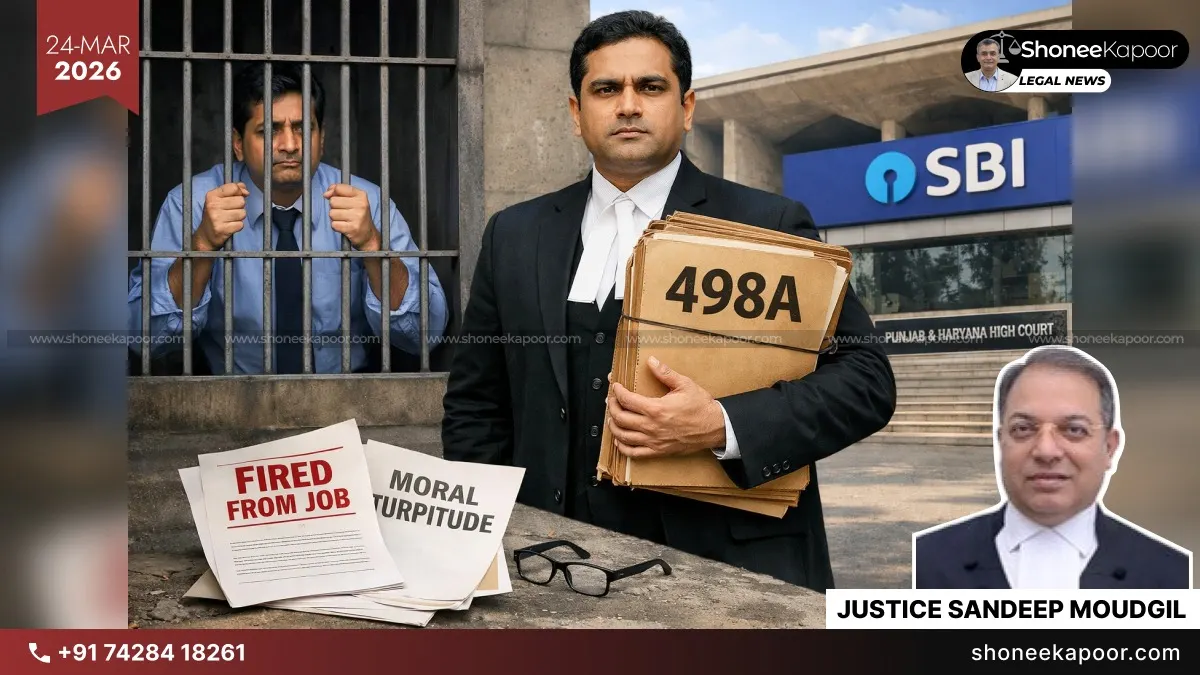
Can every 498A conviction destroy a career automatically?
High Court says NO, then what really counts as “moral turpitude” in law?
CHANDIGARH: The Punjab and Haryana High Court has made it clear that not every case under Section 498A of the Indian Penal Code (IPC) can be treated as an offence involving moral turpitude. This important ruling came in the case of Brahmjeet Kaushal v. Union of India & Ors., where the Court gave relief to a State Bank of India (SBI) branch manager who had been removed from service.
The Court observed that there is no clear and uniform legal position across courts on whether every conviction under Section 498A IPC automatically amounts to moral turpitude. This becomes important because such a label can have serious consequences like loss of job, denial of promotion, or restrictions in public employment.
Justice Sandeep Moudgil disagreed with earlier decisions of some High Courts which treated Section 498A offences as moral turpitude in all cases. The Court stressed the need to carefully examine the facts of each case instead of applying a blanket rule.
The Bench stated:
“With all humility at my command, a careful distinction becomes necessary, on the one hand, between the genuine cases of egregious dowry-related cruelty which shock the collective conscience of the society as a whole, and, on the other hand, prosecutions arising out of essentially personal disputes within the precincts of the matrimonial home, which may culminate in compromise, acquittal, or even conviction based on findings of only technical or marginal cruelty,”.
The Court referred to an earlier observation of the Supreme Court made in 1996, which defined moral turpitude as conduct that is “inherently base, depraved or contrary to accepted standards of morality”. This definition shows that not every offence can be automatically placed in this category.
The judgment also noted that different High Courts have taken different views. For example, the Madhya Pradesh High Court had upheld dismissal of an employee convicted under Section 498A IPC and Section 4 of the Dowry Prohibition Act, calling it moral turpitude linked to greed. Similar views were earlier taken by the Kerala and Andhra Pradesh High Courts.
However, Justice Moudgil clarified that there is still no uniform agreement on this issue and reasonable people can differ based on facts of each case.
The Court further held:
“What cannot be accepted, however, is any general rule that every offence under Section 498-A IPC, by its very nature, must automatically be translated into an offence involving moral turpitude for the purpose of civil consequences such as employment, promotion or higher education,”.
Importantly, the Court highlighted that many Section 498A cases arise from personal matrimonial disputes, which may not always reflect serious moral wrongdoing affecting society at large.
It stated:
“To elevate every prosecution under Section 498-A, irrespective of its factual substratum, into an ‘offence against society’ and, on that abstract footing, to brand it in all cases as an offence involving moral turpitude, is a proposition which cannot withstand legal scrutiny.
If that idea is accepted, then almost every offence in the Indian Penal Code or Bharatiya Nyaya Sanhita could easily be described as dealing with a ‘societal’ problem, and almost every conviction would have to be treated as involving moral turpitude.
This would wipe out the important difference between ordinary criminal offences and only those acts which are so base, vile, depraved or so shocking to the public conscience, that they deserve to be characterised against involving ‘moral turpitude’.”.
The Court added that the label of moral turpitude should be used only in cases where there is clear moral depravity, not just strained marital relations.
This case involved an SBI branch manager who was removed from service in 2018 after his conviction under Section 498A IPC. Notably, he had already been acquitted of the more serious charge of dowry death of his wife.
While setting aside his dismissal, the High Court held that authorities cannot simply use the phrase “conviction involving moral turpitude” without proper analysis. They must examine the nature of the offence, its connection with official duties, surrounding facts, service record, and whether the punishment is proportionate.
The Court finally ordered:
“The impugned order dated 27.06.2019 (Annexure P5) whereby the services of the respondents have been discharged from 14.12.2018 is hereby set aside and the respondents are directed to grant all consequential benefits to the petitioner from 15.12.2018 along with interest @ 6% p.a. within a period of 2 months from the date of receipt of certified copy of this order.”
Explanatory Table – Laws & Sections Involved
| Law / Section | What it Means (Simple Explanation) | Role in This Case |
| Section 498-A IPC | Cruelty by husband or relatives towards wife | Petitioner was convicted under this section; main issue was whether it equals moral turpitude |
| Section 304-B IPC | Dowry death | Petitioner was acquitted of this serious charge |
| Section 406 IPC | Criminal breach of trust (usually dowry-related property disputes) | Petitioner was acquitted |
| Section 10(1)(b)(i) Banking Regulation Act, 1949 | Bank employee cannot continue if convicted for moral turpitude offence | Bank used this to terminate employee |
| Rule 68(7)(i), SBI Officers’ Service Rules, 1992 | Allows discharge if convicted of moral turpitude | Invoked by SBI to remove petitioner |
| Article 226 Constitution of India | Power of High Court to issue writs | Petition filed under this to challenge termination |
| Supreme Court case: Pawan Kumar v. State of Haryana (1996) | Defines “moral turpitude” | Used to interpret whether 498A fits this category |
| Allahabad Bank v. Deepak Kumar Bhola (1997) | Requires nexus between offence and job | Court relied to reject automatic dismissal |
| Union of India v. Tulsiram Patel (1985) | Limits arbitrary dismissal without enquiry | Reinforces need for application of mind |
| Kranti Associates v. Masood Ahmed Khan (2010) | Orders must give reasons | Used to strike down mechanical termination |
| SBI v. P. Soupramaniane (2019) | No automatic dismissal on conviction | Strengthened petitioner’s case |
Case Details
- Case Title: Brahmjeet Kaushal vs. Union of India & Ors.
- Court: High Court of Punjab and Haryana at Chandigarh
- Case Number: CWP-24038-2021 (O&M)
- Bench: Hon’ble Mr. Justice Sandeep Moudgil
- Judgment Reserved On: 23.01.2026
- Judgment Pronounced On: 13.03.2026
- Judgment Uploaded On: 16.03.2026
Counsels
- For Petitioner: Mr. Karnail Singh, Advocate
- For Respondent No.1 (Union of India): Mr. Dheeraj Jain, Senior Advocate with Mr. Sahil Garg, Advocate
- For Respondents No.2 to 4: Ms. Madhu Dayal, Advocate
Key Takeaways
- 498A is being treated as automatic moral guilt, even when facts do not show real depravity or serious wrongdoing.
- Institutions like banks are mechanically terminating men without proper inquiry, simply relying on conviction labels.
- Courts have now acknowledged that many 498A cases arise from personal matrimonial disputes, not societal crimes.
- Even after acquittal in serious charges like dowry death, men continue to face life-destroying consequences based on lesser findings.
- The judgment exposes a systemic issue—men are penalised in employment and reputation without proportionality, due process, or factual evaluation.
This Could Change Your Case-Get FREE Legal Advice-Click Here!
Disclaimer: The views and opinions expressed in this article are those of the Indian courts and do not necessarily reflect the official policy or position of “ShoneeKapoor.com” or its affiliates. This article is intended for informational and educational purposes only. The content provided is not legal advice, and viewers should not act upon this information without seeking professional counsel. Viewer discretion is advised.
