
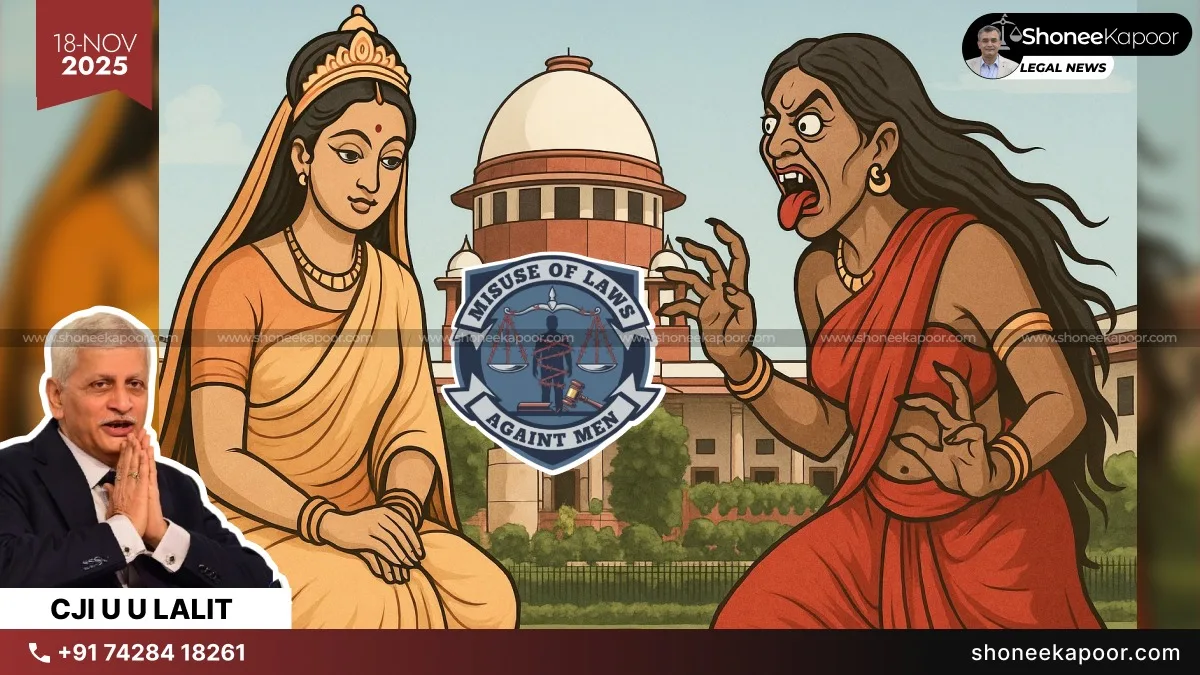
498A Misuse | In Society, There Are Sita Maiyas But There Are Also Shurpanakhas: Former CJI U.U. Lalit On Why Innocent Men Suffer

Written and analysed by Vaibhav Ojha
Head Of Legal CommunicationsFormer CJI reveals why innocent men suffer, 498A conviction rates are below 5%, and calls for urgent reforms to protect the innocent. At Ekam Nyaay Conference, Justice U.U. Lalit highlights how unsigned statements, bad policing, and dragging trials destroy innocent lives. Says men’s rights activism is not anti-woman but pro-justice.
NEW DELHI: Former Chief Justice of India Justice U.U. Lalit delivered a candid and powerful address at the Ekam Nyaay Conference on International Men’s Day, held on the 16thof November, stressing that advocating for men’s rights is not anti-woman but pro-justice.
Drawing on 42 years of experience in law, including 31 years as a lawyer, 8.5 years as a judge, and his current role as a law professor, Lalit highlighted systemic flaws in India’s criminal justice system, including low conviction rates, procedural loopholes, and the human cost of prolonged undertrials.
Drawing from an extraordinary 42-year journey in the legal field, Justice Lalit offered a rare, holistic perspective. 31 years as a lawyer, 8.5 years as a judge, and currently, a professor in leading law institutions, he has observed the system from every possible vantage point. This rich experience allowed him to speak not just from theory, but from decades of real-world engagement with India’s justice delivery mechanisms.
In one of the most striking moments of his speech, Justice Lalit invoked a timeless truth using a Ramayan reference:
“In society, there are Sita Maiyas who are pure, noble and wronged. But there are also Shurpanakhas who can misuse and manipulate.”
His message was razor-sharp: Justice systems cannot run on assumptions or emotion, they must run on balance, circumspection, and reality. Which is why he warned:
“Our machinery must be calibrated so that no innocent person is dragged to court, prosecuted, or exhausted by the process itself.”
Justice Lalit stressed that the legal system must be circumspect and balanced, ensuring that innocent individuals are not dragged unnecessarily into criminal proceedings, while also protecting genuine victims:
“We are not anti-woman. We are pro-justice. In society, there are Sita Maiyas; pure and wronged. But there are also Shurpanakhas; who manipulate and misuse the system.”
Justice Lalit highlighted the human cost of poorly designed laws:
“In cases under Section 498A, the conviction rate is less than 5%. Four out of five undertrials are ultimately acquitted. Are we not taking individuals into custody who will ultimately be found innocent?”
He argued that society must protect innocents from prolonged, unnecessary incarceration.
Reflecting on procedural changes in criminal law, Justice Lalit explained:
“Earlier, magistrates would record the statements of witnesses before committing the matter for trial. Today, police record statements under Section 161 CrPC, which are often unsigned. Witnesses resile before trial. As a result, the conviction rate in criminal matters rarely exceeds 20%.”
Justice U.U. Lalit then shared an analogy told to him by a lawyer; an analogy so simple yet so devastating that the entire hall fell silent. A lawyer once described the criminal justice process in this country in a painfully honest way:
“Our law-enforcement machinery is like cats employed to catch a mouse. They spend ten years chasing it. And at the end, it turns out it wasn’t even a mouse it was a rabbit.”
We put: the police, the prosecutors, the courts, the entire legal machinery into years of chasing a case only to discover, after a decade, that the accused was innocent all along.
Justice Lalit’s point was razor-sharp:
“Where does society stand if its machinery spends years chasing the wrong target?”
Because while the system runs after the “wrong mouse,” the real problems slip away. The real criminals walk free. The real injustices multiply. Justice Lalit stressed the ethos of Ekam Nyaay:
“Should we not insulate our system so that innocent rabbits are not chased for life? So that at the end of the chase, they are not left panting and destroyed? Doesn’t society owe them what is legally and morally due? This is the logic of Ekam Nyaay a system that protects the innocent and ensures justice for all.”
He reiterated that justice should not just punish the guilty but safeguard the innocent, ensuring fairness in legal procedures.
He criticized the lack of professional training, modern equipment, and specialization among police officers and investigators. Quoting the Supreme Court’s landmark Prakash Singh case, he highlighted the persistent problem of dual responsibilities, where the same officer manages both law-and-order duties and investigations, undermining efficiency and fairness.
“Our criminal justice system is one of the most neglected arms of the government.”
Justice Lalit summed up the ethos of Ekam Nyaay in a striking reflection:
“Should we not insulate our system so that innocent rabbits are not chased for life? So that at the end of the chase, they are not left panting? Doesn’t society owe it to such persons what is legally and morally due? This is the logic of Ekam Nyaay.”
He made it clear that a truly just society must safeguard the innocent while delivering justice efficiently, leaving no room for wrongful persecution.
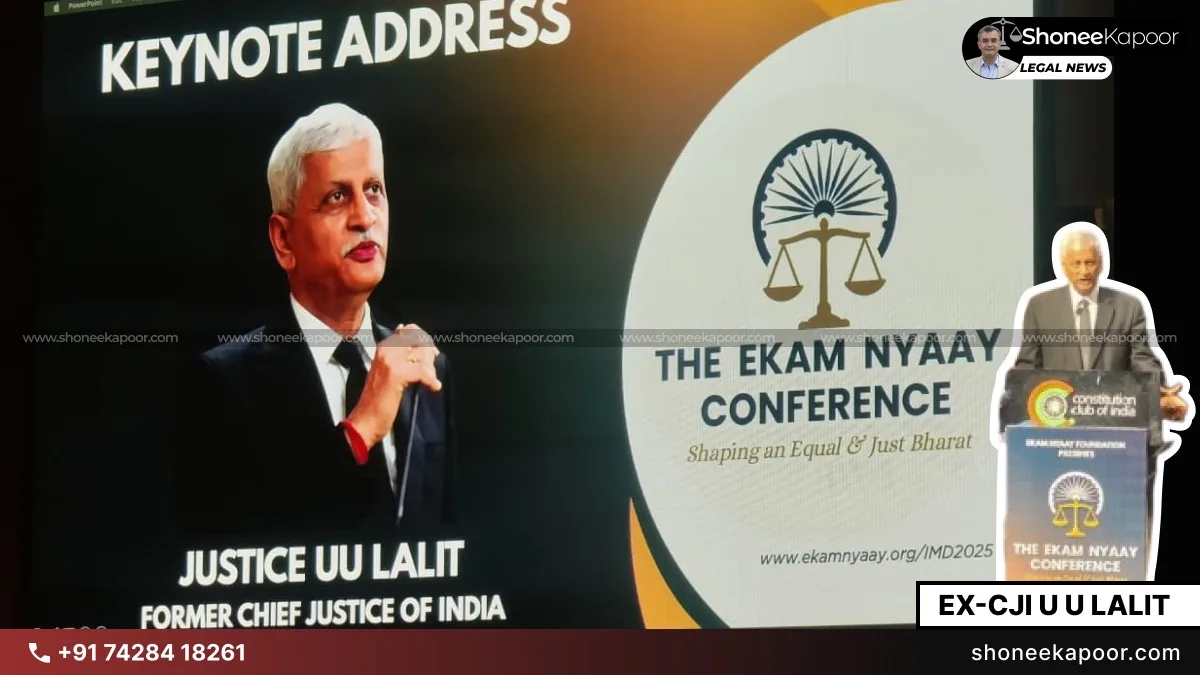
Explanatory Table Of Sections And Case Laws Cited
| Law/case | Meaning | What Justice U.u. Lalit Said |
| Section 498A IPC | Cruelty by husband or relatives, including harassment for dowry; punishable by imprisonment and fine. | Conviction rate is below 5%; most undertrials acquitted. Highlighted the human cost of wrongful incarceration. |
| Section 161 CrPC | Police powers to record witness statements during investigation; statements are not evidence unless repeated in court. | Statements often unsigned; witnesses resile before trial, reducing conviction rates. |
| Prakash Singh & Ors. v. Union of India (2006) | Supreme Court landmark judgment directing separation of law & order and investigation duties, ensuring accountability and professionalism in police work. | Criticized that police still wear “five hats” (riot control, VIP escort, FIR filing, investigation, law & order), undermining justice efficiency. |
Key Details Of The Event:
Event: Ekam Nyaay Conference on International Men’s Day
Date: 16th November
Location: New Delhi
Key Speaker: Former Chief Justice of India, Justice U.U. Lalit
Purpose: Highlight flaws in India’s criminal justice system and advocate for protection of innocent individuals
Key Points from Speech:
- Advocated that men’s rights activism is pro-justice, not anti-women
- Highlighted low conviction rates in criminal cases, especially Section 498A (<5%)
- Criticized procedural loopholes, e.g., unsigned police statements under Section 161 CrPC
- Emphasized human cost of prolonged undertrials
- Used Ramayan analogy: “Sita Maiyas vs. Shurpanakhas” to explain system misuse and genuine victims
- Shared “cats chasing a mouse” analogy for inefficiency of criminal investigations
- Urged systemic reforms to protect innocents and ensure balanced justice
- Quoted Prakash Singh case to highlight lack of specialization in police roles
Disclaimer: The views and opinions expressed in this article are those of the Indian courts and do not necessarily reflect the official policy or position of “ShoneeKapoor.com” or its affiliates. This article is intended for informational and educational purposes only. The content provided is not legal advice, and viewers should not act upon this information without seeking professional counsel. Viewer discretion is advised.
Related Articles
Can a ‘girlfriend’ of the husband be implicated under Section 498A?
From landmark Supreme Court rulings to ground-level misuse, this article unpacks how Section 498A defines ‘husband’ a...
False 498A – 85 BNS Fear And Need Legal Help? The Law Changed, The Risk Remains, The Defence Must Change Too
If arrest is “not automatic” now, why are families still rushing for bail and protection? Is Section 85 BNS just a ne...
Chef Kunal Kapur Divorce Case: Inside the Courtroom Battle, Allegations, and the Legal Victory That Redefined Matrimonial Cruelty
Celebrity chef Kunal Kapur fought a long and intense courtroom battle to prove mental cruelty.The Delhi High Court’s ...
Share Your Thoughts
Comments are moderated before publication.