
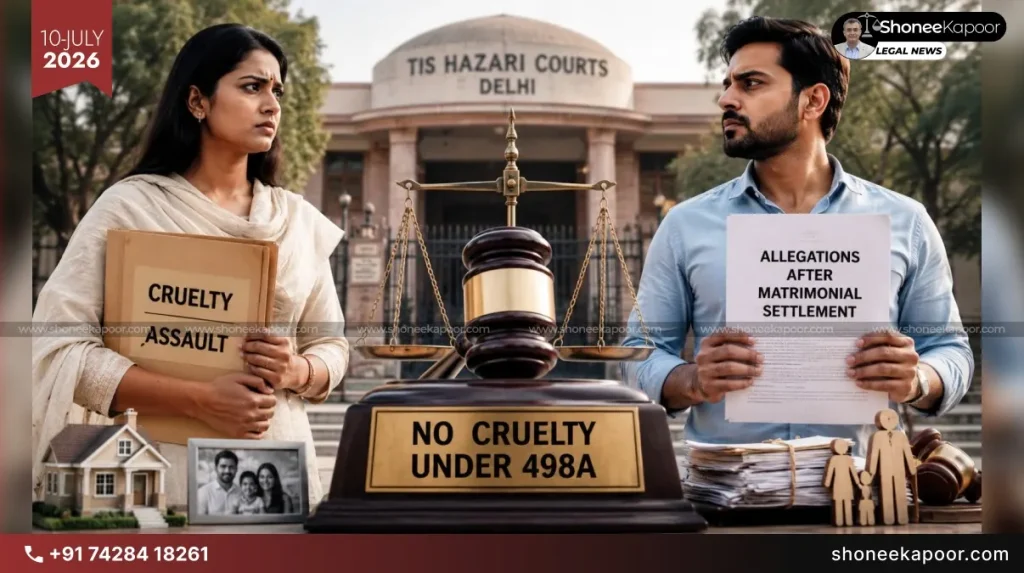
Can allegations of impotence, health issues, dowry articles and one simple injury automatically become a 498A and assault case? A Delhi Court said the material did not show grave suspicion and discharged the husband from the case.
NEW DELHI: A Delhi Court has discharged a husband from a criminal case under Sections 498A and 323 IPC after finding that the material collected during investigation did not show any prima facie offence. The Court held that the wife’s allegations were mostly vague, general and unsupported by specific details.
The order was passed by Ms. Shruti Sharma-II, Judicial Magistrate First Class, Mahila Court, West District, Tis Hazari Courts, Delhi. The prosecution argued that charges should be framed on the wife’s allegations of cruelty and assault.
The husband was represented by Ms. Jyoti Sharma and Sh. Rishabh Jain, from Tripaksha Litigation, who argued that the complaint was vague, delayed and filed after the matrimonial settlement had already taken place.
The Court noted that the wife had alleged concealment of medical condition, impotence, alcohol consumption, verbal abuse and cruelty. However, the Court found that these allegations did not satisfy the ingredients of Section 498A IPC.
The Court observed:
“At the outset, this Court is of the prima facie view that even if the allegations regarding the accused’s alleged impotency are assumed to be true for the purposes of the present proceedings, the same, by itself, would not constitute ‘cruelty’ within the meaning of Section 498A IPC.”
It further said:
“Alleged impotency or sexual incapacity may, in a given case, furnish grounds for seeking appropriate matrimonial relief before the Ld. Family Court.”
The Court also noted that the wife had married the husband in 2015 and a child was born in 2018. Therefore, her claim that the alleged impotence remained hidden till 2022 appeared inconsistent.
On the allegation of hidden medical ailments, the Court held:
“Mere non-disclosure of a medical condition, without any further allegations bringing the case within the statutory definition of cruelty, cannot, by itself, constitute an offence under Section 498A IPC.”
The wife had also alleged that cash, jewellery and articles worth about ₹7 lakh were given at the time of marriage. But the Court found no specific allegation of dowry demand by the husband before, during or after marriage.
The Court also found the allegations of alcohol use and verbal abuse to be general. No specific dates, incidents, words used, or witnesses were mentioned.
For Section 323 IPC, the wife alleged that the husband assaulted her on 2 May 2024. Though the medical report showed simple injuries, the Court said that this alone was not enough.
The Court observed:
“Although the MLC does establish that the complainant sustained simple injuries, the existence of an MLC, by itself, is not determinative of the question whether the offence under Section 323 IPC is prima facie made out.”
It further noted:
“The material collected during investigation does not clearly indicate that the accused had intentionally caused hurt to the complainant.”
The Court found that the police diary entry showed a scuffle involving two men and one woman, but it did not clearly show that the husband had intentionally assaulted the wife.
Finally, the Court held that no grave suspicion was made out for offences under Sections 498A or 323 IPC. Accordingly, the husband was discharged from the case.
EXPLANATORY TABLE: LAWS AND PROVISIONS INVOLVED
| Law / Provision | Purpose | How It Applied In This Case |
| Section 498A IPC | Cruelty by husband or relatives of husband | Allegations were vague, general and did not satisfy ingredients of cruelty. Husband discharged. |
| Section 323 IPC | Voluntarily causing hurt | MLC showed simple injuries, but material did not clearly show intentional hurt by husband. Husband discharged. |
| Sections 107/151 CrPC | Preventive action to stop breach of peace | Police initiated preventive proceedings after a scuffle involving two men and one woman. |
| Protection of Women from Domestic Violence Act, 2005 | Civil remedy for domestic violence allegations | Connected DV proceedings were dismissed for non-prosecution. |
| Dowry Prohibition Act | Law prohibiting giving/taking/demanding dowry | Court noted that wife herself used the word “dowry”; however, no specific unlawful demand was shown for 498A. |
| Mutual Consent Divorce Proceedings | Divorce by settlement between parties | Court noted that settlement and first motion had already taken place before the criminal complaint. |
| Dhananjay Rathi vs Ruchika Rathi, Criminal Appeal No(s). 1924 of 2026 | Supreme Court case on withdrawal of consent after settlement | Cited to note that spouse cannot withdraw consent for mutual divorce after agreeing in settlement of claims. |
CASE DETAILS
- Case Title: State Vs. Husband
- Criminal Case No.: 6438/2025
- FIR No.: 94/2025
- Police Station: Tilak Nagar
- Court: Mahila Court, West District, Tis Hazari Courts, Delhi
- Judge: Ms. Shruti Sharma-II, Judicial Magistrate First Class
- Date of Order: 09.07.2026
- Counsels:
- For State: Ms. Sonu Pandey, Ld. APP for the State
- For Accused: Ms. Jyoti Sharma and Sh. Rishabh Jain, Ld., from Tripaksha Litigation
KEY TAKEAWAYS
- A criminal case against a husband cannot be built on loose, general and emotional allegations without specific facts.
- If every matrimonial complaint is treated as criminal cruelty, then marriage disputes will become criminal trials by default.
- A medical issue, personal incompatibility or failed marriage may be a family court issue, but it cannot automatically become 498A.
- Simple injuries may show an incident, but they do not automatically prove that the husband intentionally caused hurt.
- Men should not be forced to face years of trial when the complaint itself does not disclose a clear offence.
This Could Change Your Case-Get FREE Legal Advice-Click Here!
Disclaimer: The views and opinions expressed in this article are those of the Indian courts and do not necessarily reflect the official policy or position of “ShoneeKapoor.com” or its affiliates. This article is intended for informational and educational purposes only. The content provided is not legal advice, and viewers should not act upon this information without seeking professional counsel. Viewer discretion is advised.