
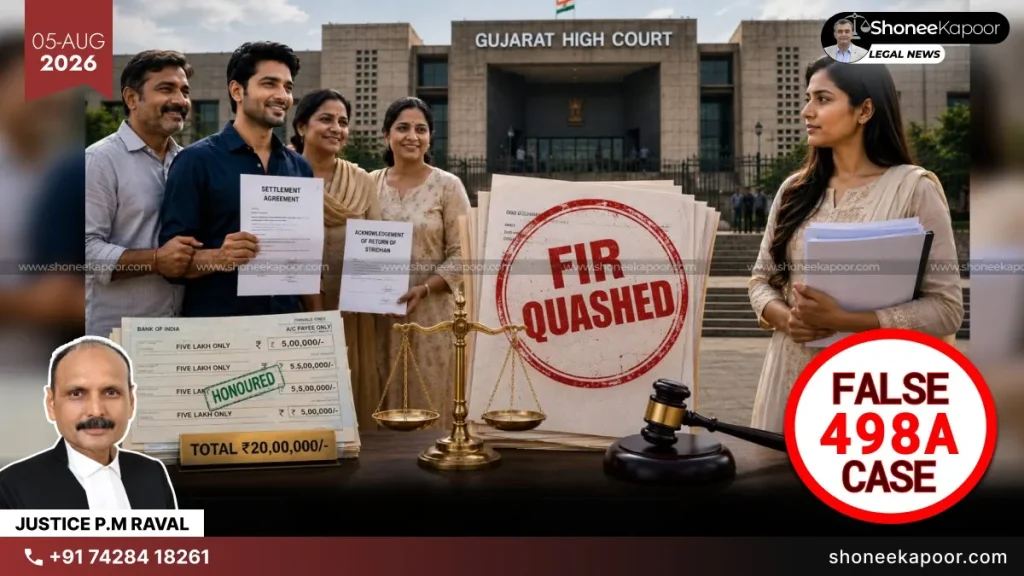
Can a wife file a Section 498A IPC case after accepting ₹20 lakh as full and final settlement and receiving her Stridhan?The Gujarat High Court examined the timing of the FIR, suppressed facts and vague allegations against the husband’s entire family.
AHMEDABAD: The Gujarat High Court has quashed a Section 498A IPC FIR against a husband and his family after finding that the complaint was based on vague allegations and was filed without disclosing an earlier settlement, payment of ₹20 lakh and return of the wife’s Stridhan.
Justice P. M. Raval was hearing a petition filed by five accused persons seeking quashing of FIR, registered under Sections 323, 498A, 506(1) and 114 of the Indian Penal Code, along with Sections 3 and 7 of the Dowry Prohibition Act.
According to the FIR, the wife alleged that the husband and his family criticised her household work, repeatedly demanded dowry and subjected her to physical and mental cruelty.
She also alleged that she was beaten and forcibly made to drink Dettol. The complaint further claimed that the harassment continued even after her father had given cash, gold and silver jewellery, a motorcycle and a car.
Appearing for the petitioners, Advocate Tapaswi P. Raval argued that the complainant had not approached the Court with clean hands.
He submitted that a settlement agreement had already been executed on March 17, 2017. Under the settlement, ₹20 lakh was paid through four cheques of ₹5 lakh each, and all the cheques were honoured.
The petitioners argued that the FIR was filed only after the payment was completed, with an intention to demand more money and harass the husband’s family.
It was also submitted that the complainant’s earlier case under the Protection of Women from Domestic Violence Act, 2005, had already been quashed.
The allegation regarding a flat was also disputed. The complainant had alleged that the flat was transferred by her father. However, the petitioners produced the sale deed to show that the mother-in-law had purchased the property directly from the developer.
The defence further argued that the FIR did not mention when the alleged incidents took place and did not explain the separate role of each accused family member.
The petitioners also informed the Court that the complainant’s Stridhan, jewellery and other articles had already been returned before the settlement.
The State told the Court that apart from four statements made by the complainant’s relatives, there was no statement from any independent witness showing the involvement of the petitioners.
The State also confirmed that the complainant’s father and father-in-law had entered into a compromise and that cheques worth ₹20 lakh had been handed over and honoured.
After examining the FIR and chargesheet, the Court found that the four statements relied upon by the prosecution were “nothing but reproduction of the contents in the FIR.
The Court further found that
“there are no independent statements supporting the allegations.”
The High Court noted that the wife’s Stridhan had been exchanged on February 20, 2017, and a written settlement was entered into on March 17, 2017.
The record showed that ₹15 lakh was paid in the name of the complainant’s father and ₹5 lakh was paid directly in the complainant’s name.
The allegation concerning the flat was also found to be false from the sale deed placed before the Court. The document showed that the mother-in-law had purchased the flat directly from the developer.
The Court considered the timing of the FIR important. It noted that
“the wife has lodged the complaint within 12 days of cheques being honoured worth of Rs.20,00,000/- by suppressing the factum of settlement, as full and final settlement arrived between the parties.”
The Court also examined the complainant’s conduct. It noted that she initially refused to accept notice and later failed to appear before the Court despite service.
The High Court found that the FIR had been lodged
“by suppressing material facts, by making vague and misleading statements.”
It further noted that the complaint was filed
“without stating the factum of Stridhan having received back.”
The Court also found that all members of the husband’s family had been included in the FIR without specific allegations showing their individual involvement.
The High Court finally held:
“Thus, merely on the basis of the vague allegations, the lodging of the present FIR would be abuse of process of law.”
It further stated that filing the case without full and fair disclosure of material facts and by invoking the criminal machinery is nothing but abuse of process of law.Accordingly, the Gujarat High Court allowed the petition and quashed FIR and all consequential criminal proceedings against the petitioners.
EXPLANATORY TABLE OF LAWS AND SECTION
| Law / Section | What It Means | How It Applied in This Case |
| Section 323 IPC | Punishes a person for voluntarily causing physical hurt. | The complainant alleged that she had been beaten and physically mistreated. The Court found no independent material supporting the general allegations. |
| Section 498A IPC | Punishes cruelty by a husband or his relatives against a married woman. Cruelty may include serious harassment, unlawful dowry demands or conduct likely to cause grave harm. | The husband and his family were accused of dowry harassment and physical and mental cruelty. The Court found vague allegations, suppressed settlement facts and no specific role assigned to each accused. |
| Section 506(1) IPC | Punishes criminal intimidation involving threats intended to cause alarm. | The FIR included allegations of threats, but the judgment records no specific independent evidence supporting them. |
| Section 114 IPC | Applies when an abettor is present at the time an offence is committed. | It was used to allege collective involvement of the family members in the alleged acts. |
| Section 3, Dowry Prohibition Act, 1961 | Punishes the giving, taking or abetment of dowry. | The complainant alleged that cash, jewellery, a motorcycle and a car had been given as dowry. |
| Section 7, Dowry Prohibition Act, 1961 | Governs how courts can take cognisance of offences under the Dowry Prohibition Act. | It was invoked in the FIR along with the alleged dowry offences. |
| Protection of Women from Domestic Violence Act, 2005 | Provides civil and protective remedies to women alleging domestic violence. | The petitioners stated that the complainant’s earlier application under this law had already been quashed. |
| Stridhan | Property, money, jewellery and gifts over which a woman has exclusive legal ownership. | The Court noted that the complainant’s Stridhan and other articles had already been returned before the FIR was filed. |
| Quashing of FIR | The High Court may end criminal proceedings where allegations are legally unsustainable, malicious or an abuse of judicial process. | The High Court quashed the FIR because of vague allegations, suppression of material facts and the prior settlement. |
| Vague and Omnibus Allegations | General allegations made collectively against several accused persons without identifying their separate roles. | The Court found that the husband’s family members had been implicated without specific allegations showing their active involvement. |
CASE DETAILS
| Case Particular | Details |
| Case Title | A & Ors. v. State of Gujarat & Anr. |
| Neutral Citation | 2026:GUJHC:42030 |
| Court | High Court of Gujarat at Ahmedabad |
| Case Number | R/Criminal Misc. Application No. 13600 of 2023 |
| Nature of Petition | Quashing and setting aside FIR/order |
| Bench | Justice P. M. Raval |
| Date of Judgment | July 8, 2026 |
| Trial Court | Additional Metropolitan Magistrate, Ahmedabad |
| Counsel for Petitioners | Advocate Tapaswi P. Raval |
| Counsel for State | Additional Public Prosecutor Rohan N. Shah |
| Respondent No. 2 | Notice served; no appearance |
| Final Decision | FIR and all consequential proceedings quashed against the petitioners |
KEY TAKEAWAYS
- Section 498A cannot be used to implicate a husband’s entire family through vague allegations.
- Settlement payments and return of Stridhan must be disclosed before starting criminal proceedings.
- The FIR was filed just 12 days after ₹20 lakh was received, raising serious questions about misuse of criminal law.
- Relatives repeating the FIR cannot replace specific allegations and independent evidence.
- Dragging an entire family into a suppressed-facts case is not justice. It is legal harassment.
This Could Change Your Case-Get FREE Legal Advice-Click Here!
Disclaimer: The views and opinions expressed in this article are those of the Indian courts and do not necessarily reflect the official policy or position of “ShoneeKapoor.com” or its affiliates. This article is intended for informational and educational purposes only. The content provided is not legal advice, and viewers should not act upon this information without seeking professional counsel. Viewer discretion is advised.