
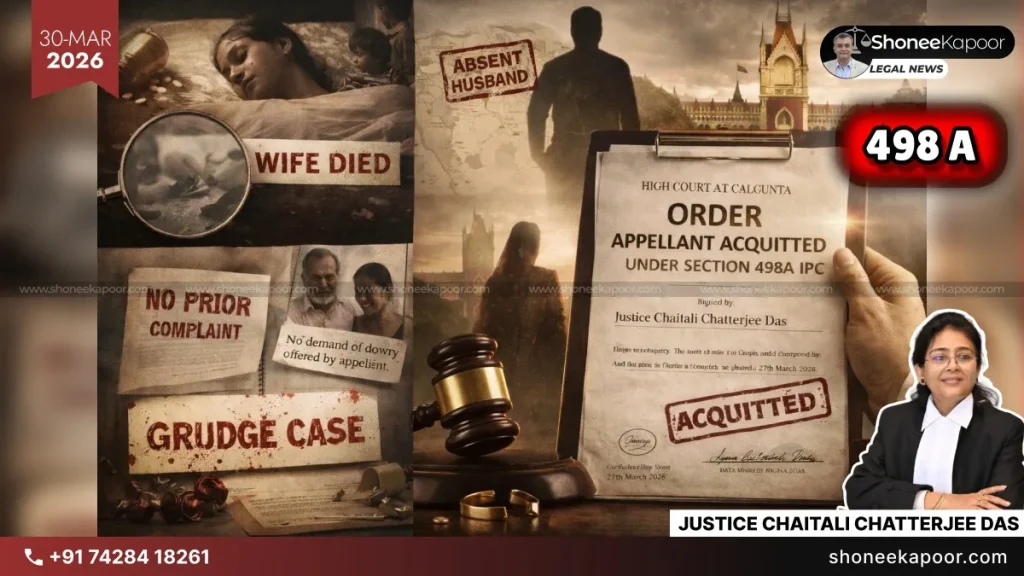
After a 498A conviction is overturned by the Calcutta High Court due to weak evidence, one question remains unanswered—
Can a man recover his dignity after being falsely implicated in a dowry case with no evidence against him?
West Bengal: Hon’ble Justice Chaitali Chatterjee Das of the Calcutta High Court examined a case where a husband was convicted under Section 498A IPC despite serious gaps in evidence. This case again shows how men can be convicted on weak, emotional and unverified allegations instead of strong legal proof.
The case was about a tragic incident where the wife consumed poison and also gave poison to her minor daughter. The prosecution claimed this happened due to cruelty and dowry harassment. However, the High Court carefully checked whether there was real evidence or just assumptions.
The Court clearly framed the main issue:
“The moot question falls for consideration is whether the learned Session Judge rightly passed the order of conviction against the appellant under Section 498A while passing the order of acquittal in respect of the charge under Section 304B of IPC.”
Upon examination of the evidence, serious issues emerged. The complainant himself admitted that the husband behaved normally and there was no complaint from the wife during her lifetime. The Court recorded:
“The appellants usually behaved with his sister properly, and she never raised any complaint against him, and also never raised any complaint of torture by appellant to her.”
This completely weakens the allegation of cruelty. If there was no complaint earlier and no independent witness, the case becomes doubtful.
The father’s statement also created doubt. He spoke about dowry demand but could not give any dates or details. He even admitted:
“He admitted that the appellant never demanded money from him but his daughter demanded money to pay to the appellant.”
This raises a serious question whether any real dowry demand existed.
Even more important, he accepted that no complaint was ever filed:
“He never informed the police about such demand of money by the appellant or lodged any diary regarding the physical assault on his daughter by her husband.”
The mother’s testimony further damaged the case. She clearly admitted:
“She filed the case out of grudge against the appellant to take revenge after the demise of her daughter.” This shows clear bias and weakens the prosecution’s credibility.
Another major point is that the husband was not even present at the time of the incident. Evidence showed he was staying at his sister’s house, far away. This breaks any direct connection between alleged cruelty and the suicide.
The Court also noted that there were no independent witnesses. Even the neighbour did not support the case and turned hostile. There was no strong medical or forensic evidence linking cruelty to the death.
This case shows that conviction cannot be based on emotions or assumptions. It must be based on proof beyond reasonable doubt. Yet, the trial court convicted under 498A while acquitting under 304B, even though both were based on the same facts.
This case once again highlights how Section 498A can be misused if courts do not properly test the evidence. It is a reminder that law must protect the innocent and not punish based on unverified claims.
Explanatory Table: Laws & Sections Involved
| Section / Law | Meaning (Simple Explanation) | Role in This Case |
| Section 498A IPC | Deals with cruelty by husband or his relatives towards a married woman | Husband was convicted under this section by trial court, but evidence was found weak |
| Section 304B IPC | Dowry death — applies when a woman dies unnaturally within 7 years of marriage due to dowry harassment | Trial court acquitted the husband due to lack of proof |
| Section 313 CrPC | Statement of accused recorded by court to explain evidence against him | Accused denied all allegations during examination |
| Section 161 CrPC | Police records statements of witnesses during investigation | Witness statements were recorded but found inconsistent |
| Indian Penal Code (IPC) | Main criminal law of India defining offences and punishments | Sections 498A and 304B were applied from IPC |
| Code of Criminal Procedure (CrPC) | Procedural law for conducting criminal trials | Governed investigation, trial, and evidence handling |
Case Details
- Case Title: Boren Mondal vs The State of West Bengal
- Court: High Court at Calcutta
- Case Number: CRA 309 of 2002
- Bench: Hon’ble Justice Chaitali Chatterjee Das
- Neutral Citation: 2026:CHC-AS:483
- Date of Judgment: 27.03.2026
- Counsels:
- For Appellant: Ms. Manasi Roy, Advocate
- For State: Mr. Debasish Roy, Advocate; Ms. Anusuya Sinha, Advocate
Key Takeaways
- Conviction under Section 498A cannot be sustained on vague allegations when there are no prior complaints or consistent evidence during the wife’s lifetime.
- Family testimonies without specific dates, details, or independent corroboration are legally weak and cannot justify criminal conviction.
- Admission of personal grudge by the complainant side seriously damages the credibility of the entire prosecution case.
- Absence of the accused at the time of incident breaks the direct link between alleged cruelty and suicide.
- The misuse of 498A is real, and courts must strictly apply the standard of proof beyond reasonable doubt to protect innocent men
This Could Change Your Case-Get FREE Legal Advice-Click Here!
Disclaimer: The views and opinions expressed in this article are those of the Indian courts and do not necessarily reflect the official policy or position of “ShoneeKapoor.com” or its affiliates. This article is intended for informational and educational purposes only. The content provided is not legal advice, and viewers should not act upon this information without seeking professional counsel. Viewer discretion is advised.