
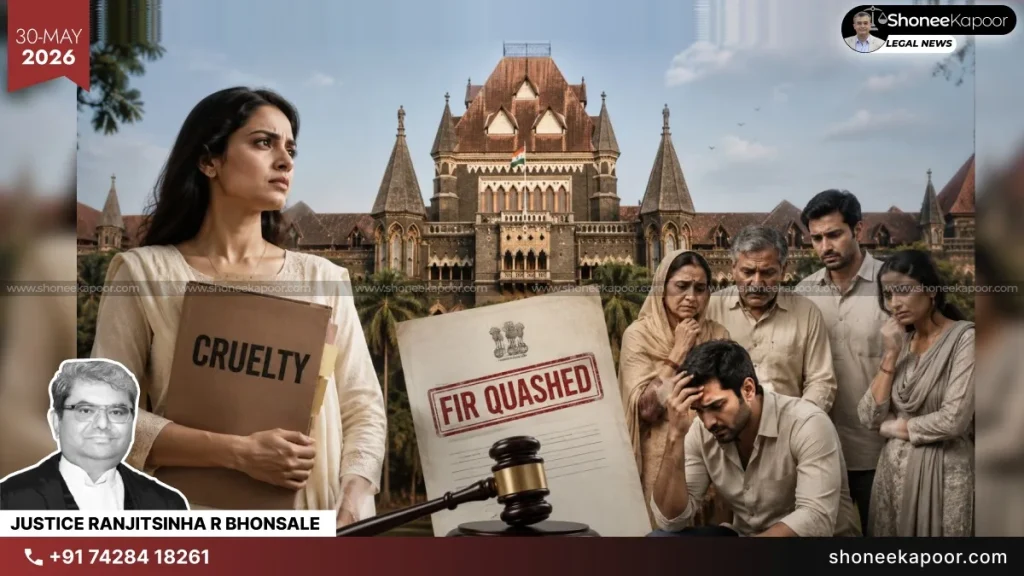
Does refusing to intervene in a husband-wife dispute make relatives guilty of cruelty?
Bombay High Court held that being a passive spectator, choosing not to interfere, or not actively supporting the wife cannot by itself constitute cruelty under Section 498A IPC.
MUMBAI: In a judgment delivered on 8 May 2026, Justice Ranjitsinha Raja Bhonsale of the Bombay High Court quashed a 498A case against a husband’s parents, brother and sister-in-law, while allowing the proceedings against the husband to continue.
The dispute arose from a marriage solemnised in January 2022. The wife alleged that she was subjected to mental and physical harassment by her husband and his family members, that her jewellery was retained by her in-laws, and that she was not allowed to freely visit or communicate with her parents. Based on these allegations, an FIR was registered under Sections 498A, 406, 323, 504 and 506 of the IPC.
While examining the case against the relatives, the Court noted that most of the allegations were general, vague and lacking in specific details. The wife had accused her in-laws of abusing and harassing her, forcing her to do household work and supporting the husband during matrimonial disputes.
However, the FIR did not clearly describe any specific acts by the relatives that would constitute cruelty under Section 498A. The Court also found contradictions in the allegations relating to jewellery and observed that the claims against the relatives were unsupported by credible material.
The Court noted that the brother-in-law and sister-in-law were employed and residing in Pune and that records placed before the Court supported their claim that they were not present during some of the alleged incidents. The allegations against them were found to be broad and omnibus in nature.
While discussing the law, the Court relied on several Supreme Court judgments dealing with misuse of Section 498A. Referring to Preeti Gupta v. State of Jharkhand, the Court reproduced the observation:
“The ultimate object of justice is to find out the truth and punish the guilty and protect the innocent.”
The Court also relied on Kahkashan Kausar v. State of Bihar, where the Supreme Court warned against the increasing tendency of implicating relatives of the husband through general allegations in matrimonial disputes.
Further relying on the recent judgment in Dara Laxmi Narayana v. State of Telangana, the Court quoted:
“A mere reference to the names of family members in a criminal case arising out of a matrimonial dispute, without specific allegations indicating their active involvement should be nipped in the bud.”
Justice Bhonsale observed that merely supporting the husband, remaining silent during marital disagreements, or being related to the husband cannot by itself amount to cruelty under Section 498A. The Court emphasized that criminal prosecution requires specific allegations and material showing active involvement in the alleged offence.
Finding that the allegations against the parents-in-law, brother-in-law and sister-in-law were vague, omnibus and unsupported by sufficient material, the Bombay High Court quashed the FIR and all criminal proceedings against them.
However, since the husband did not press for quashing, the case against him was left open to continue in accordance with law.
Explanatory Table: Laws And Sections Involved
| Law / Section | Purpose | How It Was Used In This Case |
| Article 226, Constitution of India | Gives High Courts power to protect legal rights and quash illegal proceedings. | Petitioners approached the High Court seeking quashing of the FIR and criminal case. |
| Section 482 CrPC | Inherent powers of High Court to prevent abuse of process and secure justice. | Invoked to seek quashing of criminal proceedings. |
| Section 498A IPC | Punishes cruelty by husband or relatives towards a married woman. | Wife alleged harassment by husband and relatives. Court found allegations against relatives vague and insufficient. |
| Section 406 IPC | Punishes criminal breach of trust. | Related to allegations regarding retention of jewellery and streedhan. Court found contradictions in allegations against relatives. |
| Section 405 IPC | Defines criminal breach of trust. | Discussed by Court while examining ingredients of Section 406 IPC. |
| Section 323 IPC | Punishes voluntarily causing hurt. | Included in FIR based on allegations of assault. |
| Section 504 IPC | Punishes intentional insult likely to provoke breach of peace. | Included due to allegations of abuse and insults. |
| Section 506 IPC | Punishes criminal intimidation. | Included based on allegations of threats. |
| Section 34 IPC | Acts done by several persons in furtherance of common intention. | Added to attribute collective liability to family members. |
| Section 156(1) CrPC | Police power to investigate cognizable offences. | Discussed through Bhajan Lal principles. |
| Section 155(2) CrPC | Magistrate’s permission required for investigation of non-cognizable offences. | Referred to in Supreme Court precedents cited by the Court. |
Case Details
- Case Title: Najeem Mahamd Sayad & Ors. v. State of Maharashtra & Anr.
- Case Number: Criminal Writ Petition No. 4349 of 2022
- Court: High Court of Judicature at Bombay
- Bench: Justice Ranjitsinha Raja Bhonsale
- Date of Judgment: 8 May 2026
- Neutral Citation: 2026:BHC-AS:22715-DB
- Counsels:
- For Petitioners: Mr. Jitendra Pathade
- For State: Mr. Amit A. Palkar, APP
- For Respondent No. 2 (Wife): Adv. Poonampal, and Mr. Sachin Hande
Key Takeaways
- Criminal law cannot be used to put an entire family on trial merely because they are related to one spouse in a matrimonial dispute.
- Standing by a son, brother, or family member during marital disagreements does not automatically amount to cruelty under Section 498A IPC.
- Every accused person must face prosecution only on the basis of specific allegations and credible evidence showing their individual role.
- Laws meant to address genuine cruelty should not be stretched to indiscriminately implicate parents, siblings, and extended relatives without proof of active involvement.
- Due process, individual accountability, and evidence-based prosecution must always prevail over collective punishment based solely on family relationships.
This Could Change Your Case-Get FREE Legal Advice-Click Here!
Disclaimer: The views and opinions expressed in this article are those of the Indian courts and do not necessarily reflect the official policy or position of “ShoneeKapoor.com” or its affiliates. This article is intended for informational and educational purposes only. The content provided is not legal advice, and viewers should not act upon this information without seeking professional counsel. Viewer discretion is advised.