
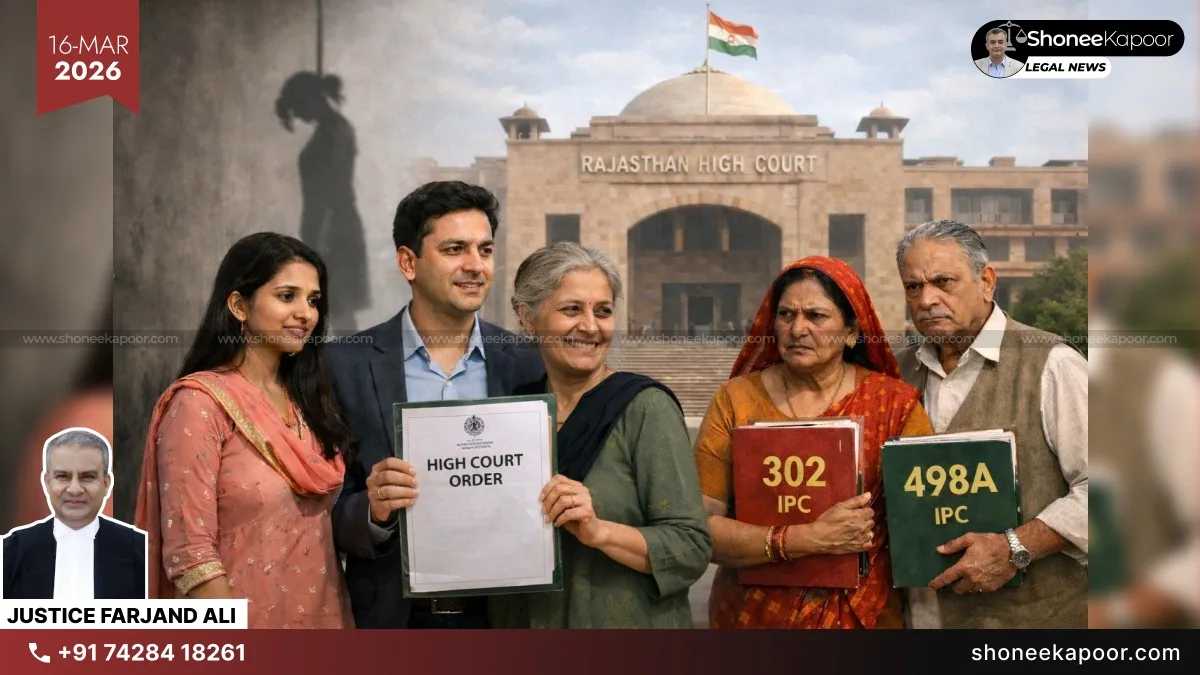
498A Cannot Be Used To Drag Entire Husband’s Family Into Criminal Trial Just For Living In The Same House: Rajasthan High Court On Misuse Of Laws By Women

Curated by NEWS DESK
Editorial DeskIn many matrimonial cases, entire families get dragged into criminal trials — even when no specific role is alleged. This Rajasthan High Court ruling explains why mere presence in a matrimonial home cannot automatically make relatives accused under Section 498A.
JODHPUR: The Rajasthan High Court, in a judgment delivered by Justice Farjand Ali, set aside a trial court order that had summoned several relatives of the husband in a dowry harassment case under Section 498A IPC. The Court held that criminal prosecution cannot be based on vague and general allegations against every member of the husband’s family.
The case arose after Santosh, who had been married to Deepak for about ten years and had three daughters, was found hanging in her matrimonial home. Her father filed a complaint alleging that she was harassed for ₹5 lakh by her husband and in-laws. A case was registered under Sections 302 and 498A IPC.
After investigation, the police filed a charge-sheet only against the husband, finding no material against the other family members. However, during trial the complainant sought to add the remaining relatives as accused under Section 319 CrPC. The trial court partly allowed the request and summoned the brother-in-law, sister-in-law, mother-in-law and father-in-law under Section 498A IPC.
Justice Farjand Ali explained that the power under Section 319 CrPC must be used cautiously and only when strong evidence appears during trial. The Court observed:
“The jurisdiction under Section 319 Cr.P.C. is not a routine procedural power; it is an extraordinary enabling provision.”
The Court further stressed that criminal trials cannot begin merely on suspicion or broad allegations. It stated that the court must find “strong and cogent evidence against the person sought to be summoned.”
After examining the statements of witnesses, the High Court found that the main allegations were directed only against the husband and father-in-law. The accusations against the other relatives were only general statements that “all in-laws used to harass” the deceased, without any specific act, date or incident mentioned.
The Court held that such omnibus allegations are not enough to prosecute relatives in a criminal case. It noted that criminal liability cannot arise merely because someone lives in the same household and observed that:
“Criminal law, being coercive in nature, demands strict adherence to evidentiary thresholds and procedural fairness.”
As a result, the High Court set aside the order summoning the brother-in-law, sister-in-law and mother-in-law and discharged them from the proceedings. The case, however, will continue against the father-in-law for the offence under Section 498A IPC.
Explanatory Table: Laws And Provisions Involved
| Law / Provision | Purpose | How Applied in This Case |
| Section 498A IPC | Criminal offence relating to cruelty by husband or relatives of husband against a married woman | Trial court had summoned several in-laws under this section alleging harassment for ₹5 lakh |
| Section 302 IPC | Punishment for murder | FIR initially included this section alleging the woman was killed and made to appear as suicide |
| Section 323 IPC | Punishment for voluntarily causing hurt | Mentioned in application seeking to summon more accused |
| Section 201 IPC | Causing disappearance of evidence of offence | Allegation that death was disguised as suicide |
| Section 143 IPC | Punishment for unlawful assembly | Included in FIR |
| Section 319 CrPC | Power of court to summon additional accused during trial if evidence shows their involvement | Trial court used this section to summon relatives; High Court reviewed legality of that decision |
| Sections 41 & 41A CrPC | Safeguards against unnecessary arrest and requirement of notice before arrest | High Court said these safeguards apply because offence under 498A carries maximum punishment of three years |
| Section 35 BNSS | Corresponding provision under new criminal procedure framework relating to arrest safeguards | Court referred to it while discussing safeguards |
| Arnesh Kumar v State of Bihar (2014) | Supreme Court judgment restricting automatic arrests in 498A cases | High Court directed that these safeguards must be followed |
| Hardeep Singh v State of Punjab (2014) | Constitution Bench ruling explaining scope of Section 319 CrPC | Court relied on it to hold that strong evidence is required before summoning additional accused |
| Sukhbeer Singh Khaira v State of Punjab (2023) | Supreme Court ruling reiterating strict standard for invoking Section 319 CrPC | Used to reinforce that courts must exercise this power cautiously |
Case Details
- Case Title: Rajni Soni & Others vs State of Rajasthan & Another
- Court: High Court of Judicature for Rajasthan at Jodhpur
- Case Number: S.B. Criminal Revision Petition No. 605/2017
- Neutral Citation: 2026:RJ-JD:7494
- Bench: Hon’ble Mr. Justice Farjand Ali
- Date of Judgment: 05 February 2026
- Counsels:
- For Petitioners: Mr. Sanjay Mathur and Ms. Ruchita Mathur
- For Respondents: Mr. Devendra Deelu appearing for Mr. Mahaveer Bishnoi
- For State: Mr. Surendra Bishnoi, AGA
Key Takeaways
- Vague and omnibus allegations are often used to implicate the entire husband’s family in matrimonial disputes, showing how easily criminal law can be weaponised against multiple relatives without clear evidence.
- Criminal prosecution should require specific acts and credible proof; general claims like “all in-laws harassed” cannot justify dragging several family members into years of litigation.
- Investigations sometimes find no material against relatives, yet they still face trial attempts through procedural mechanisms, highlighting the legal vulnerability of men and their families.
- Living in the same household cannot automatically create criminal liability; guilt must be based on individual conduct, not mere family association.
- Safeguards against arbitrary arrests and prosecutions remain critical, because once a criminal case begins, the social stigma, financial burden and emotional damage can affect men and their families for years even before guilt is established.
This Could Change Your Case-Get FREE Legal Advice-Click Here!
Disclaimer: The views and opinions expressed in this article are those of the Indian courts and do not necessarily reflect the official policy or position of “ShoneeKapoor.com” or its affiliates. This article is intended for informational and educational purposes only. The content provided is not legal advice, and viewers should not act upon this information without seeking professional counsel. Viewer discretion is advised.
Related Articles
Real Court Cases Where False Allegations Backfired On Wife
Real Indian court cases where false 498A, dowry, cruelty and defamatory allegations against husbands backfired, leadi...

False 498A – 85 BNS Fear And Need Legal Help? The Law Changed, The Risk Remains, The Defence Must Change Too
If arrest is “not automatic” now, why are families still rushing for bail and protection? Is Section 85 BNS just a ne...

The Silent Crisis: Men Destroyed by False Allegations in India – How Laws Meant for Protection Are Destroying Innocent Men
Laws Meant for Protection Are Destroying Innocent Men. An FIR is filed and a man’s life collapses before any evidence...
Share Your Thoughts
Comments are moderated before publication.