
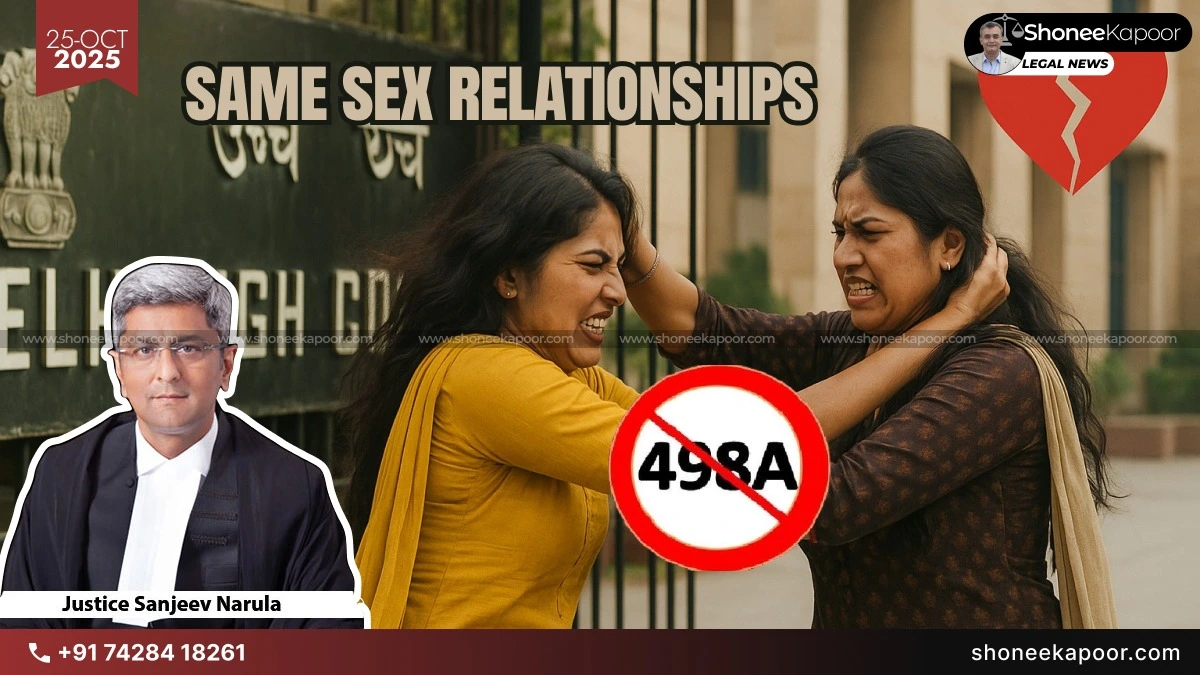
Delhi High Court To Decide: Can Section 498A Apply to Same-Sex Couples? A Landmark Case Begins

Written and analysed by Vaibhav Ojha
Head Of Legal CommunicationsThe Delhi High Court has agreed to hear a crucial case questioning if Section 498A of the IPC — meant for cruelty by a husband against a wife — can apply to same-sex relationships. Justice Sanjeev Narula has sought responses from Delhi Police and the complainant.
NEW DELHI: The Delhi High Court is all set to consider a first-of-its-kind legal question — whether Section 498A of the Indian Penal Code (IPC), which criminalizes cruelty by a husband towards his wife, can be extended to same-sex couples.
Justice Sanjeev Narula issued notice on a petition filed by Simmi Patwa, who has challenged the registration of FIR No. 328/2025 at P.S. Mehrauli, under Sections 498A, 406, 506, and 34 IPC. The petition seeks to quash the FIR and all subsequent proceedings, contending that the law does not recognize such offences within same-sex partnerships
Patwa’s plea argues that the primary requirement of Section 498A IPC is that the complainant must be a “wife” and the accused person a “husband.” Hence, the provision can only apply in heterosexual marriages. The plea asserts:
“The present case falls within the definition of a prohibited relationship as prescribed by law.”
According to the petition, Simmi Patwa, who is biologically female and suffers from gender dysphoria, entered into a symbolic marriage with her former female partner at the latter’s insistence.
The two began living together as partners, but the relationship turned turbulent. Patwa alleges that her partner emotionally and psychologically abused her, even blackmailing her to undergo gender transition surgery, and later threatening to file false criminal cases against her and her family.
“It is submitted that the intent of the Parliament has never been to recognise same sex marriages. In the present case, the petitioner and respondents both are female. Hence, the FIR should be quashed at the outset on this ground alone,” the plea states.
Patwa further informed the court that she had filed a nullity petition under Section 11 of the Hindu Marriage Act, 1955, declaring the so-called marriage void. In retaliation, her former partner allegedly filed the current criminal complaint. She has also submitted a certificate from AIIMS, confirming that she is genetically female.
Her plea continues to argue that neither the Hindu Marriage Act, 1955, nor the Protection of Women from Domestic Violence Act, 2005, can apply to same-sex relationships. The petition adds:
“Since there is no registered marriage in the case in hand, the said civil union is non-est in law and that no conjugal rights would accrue in the eyes of law between two persons belonging to same sex living without a registered marriage.”
After briefly hearing the submissions, Justice Sanjeev Narula issued notice to both the Delhi Police and the complainant, directing them to file their responses before the next hearing, scheduled for November 13, 2025.
“Status report be filed on or before the next date of hearing, and a copy thereof be supplied to the opposite party.”
This case has drawn major attention in legal and activist circles. It touches upon a critical gap in Indian law — while the Supreme Court’s Navtej Singh Johar v. Union of India (2018) judgment decriminalized same-sex relationships, India still lacks clear recognition of same-sex marriages or domestic partnerships under civil or criminal law.
The Delhi High Court’s upcoming decision could therefore redefine the scope of matrimonial offences like Section 498A IPC, potentially setting a precedent for how domestic violence, cruelty, and marital rights are understood in the context of LGBTQ+ relationships.
If the court rules that Section 498A cannot apply to same-sex couples, it may open the door for a larger legal debate on how India’s criminal and family laws must evolve to address non-heterosexual relationships — a debate that has long remained in the shadows of the country’s legal system.
Explanatory Table of Laws and Sections Mentioned in the Case
| Law / Section | Full Name / Statute | Purpose / Explanation | Relevance in the Case |
| Section 498A IPC | Cruelty by Husband or His Relatives | Protects a woman from cruelty by her husband or in-laws — includes mental and physical cruelty. | Core issue: whether this section can apply to same-sex relationships where both parties are female. |
| Section 406 IPC | Criminal Breach of Trust | Punishes dishonest misappropriation of property entrusted to someone. | Alleged by the former partner against Simmi Patwa in the FIR. |
| Section 506 IPC | Criminal Intimidation | Deals with threats intended to cause alarm to a person. | Included in the FIR for alleged threats. |
| Section 34 IPC | Common Intention | Holds people jointly liable for acts done in furtherance of common intention. | Applied because the complaint includes multiple accused persons (Patwa and her family). |
| Section 11 Hindu Marriage Act, 1955 | Void Marriages (Nullity) | Declares a marriage void if it is not valid under law (e.g., same-sex union not recognized). | Patwa filed a petition under this section to declare the relationship a nullity. |
| Protection of Women from Domestic Violence Act, 2005 | DV Act | Provides civil remedies for women facing domestic abuse. | Petitioner argues it does not apply to same-sex couples. |
| Article 226 Constitution of India | Writ Jurisdiction of High Courts | Allows High Courts to issue writs for enforcement of fundamental rights. | Petition filed under this Article for quashing the FIR. |
| Section 528 Bharatiya Nagarik Suraksha Sanhita, 2023 (BNSS) | Inherent Powers of High Court (Formerly Section 482 CrPC) | Empowers High Courts to intervene to prevent misuse of the law and ensure justice. | Used to seek quashing of FIR and related proceedings. |
| Navtej Singh Johar v. Union of India (2018) | Supreme Court Judgment | Decriminalized consensual same-sex relationships under Section 377 IPC. | Provides background for legal recognition of LGBTQ+ rights, though not marriage. |
Case Summary
| Particular | Information |
| Case Title | Simmi Patwa v. GNCT of Delhi & Anr. |
| Court | High Court of Delhi at New Delhi |
| Case Number | Crl.M.C. 7480/2025 & Crl.M.A. 31315/2025 |
| Date of Order | 17 October 2025 |
| Bench / Judge | Hon’ble Mr. Justice Sanjeev Narula |
| Petitioner | Simmi Patwa |
| Respondents | 1. Government of NCT of Delhi 2. Former Partner (Complainant) |
| Petitioner’s Counsel | Mr. Mohd. Yasin, Mr. Dawneesh Shaktivats, Mr. Aman & Mr. Sami Ahmed, Advocates |
| Respondent (State) Counsel | Mr. Hemant Mehla, APP for the State with SI Amit Kumar, PS Mehrauli |
| Relief Sought | Quashing of FIR No. 328/2025 registered under Sections 498A/406/506/34 IPC and all consequential proceedings |
| Next Date of Hearing | 13 November 2025 |
| Key Direction | Notice issued to Delhi Police and complainant; status report to be filed before next hearing |
Why This Case Matters
The petition asks whether criminal laws written for “husband and wife” can be stretched to same-sex partners, especially when India still does not legally recognize same-sex marriage.
Justice Narula’s order to hear the matter marks the first time a High Court is formally examining the scope of Section 498A in LGBTQ+ relationships.
If the court holds that the law does not apply to same-sex couples, it could reshape how domestic-abuse, cruelty, and marital-rights cases are handled in India’s future.
Disclaimer: The views and opinions expressed in this article are those of the Indian courts and do not necessarily reflect the official policy or position of “ShoneeKapoor.com” or its affiliates. This article is intended for informational and educational purposes only. The content provided is not legal advice, and viewers should not act upon this information without seeking professional counsel. Viewer discretion is advise
Related Articles
Karisma Kapoor – Sunjay Kapur Case Explained: Marriage, Divorce, 498A, Death & the Delhi High Court Property War
From a celebrity wedding to IPC 498A allegations, a Supreme Court-linked divorce settlement, and now a Delhi High Cou...
The Silent Crisis: Men Destroyed by False Allegations in India – How Laws Meant for Protection Are Destroying Innocent Men
Laws Meant for Protection Are Destroying Innocent Men. An FIR is filed and a man’s life collapses before any evidence...
Share Your Thoughts
Comments are moderated before publication.