
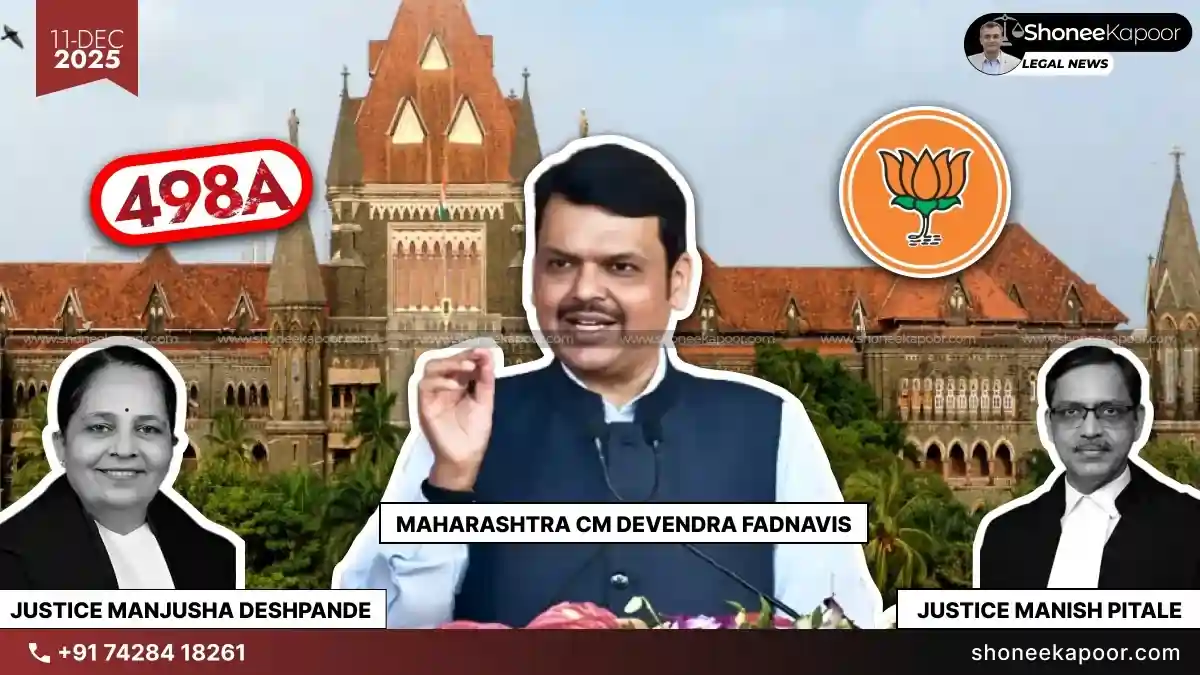
498A Amendment Silenced | “How Can the Executive Undo the Legislature?”: Bombay High Court Slams Maharashtra Government

Curated by NEWS DESK
Editorial DeskThe Bombay High Court has sharply questioned how the Maharashtra Government withdrew a 2018 proposal—passed by the State Assembly—to make Section 498A IPC a compoundable offence. The Court also pulled up the Union Government, calling the issue a “very serious matter” involving separation of powers.
MUMBAI: The Bombay High Court on Tuesday (Dec 9th) strongly questioned the Maharashtra Government for taking back its earlier proposal of 498A Amendment, even though that proposal had already been passed by the State Legislature in 2018.
The amendment aimed to make Section 498A – a frequently misused provision – a compoundable offence, allowing easier settlement between husband and wife, especially in cases where disputes are resolved mutually.
A division bench of Justice Manish Pitale and Justice Manjusha Deshpande was informed that the amendment was cleared by the State Assembly in 2018 and then sent through the Union Government for the President’s assent. However, the State Government recently withdrew this proposal.
Hearing this, Justice Pitale raised a critical constitutional question-
How could the Executive withdraw a decision already approved by the Legislature?
Quoting his remarks:
“This is a very serious matter… And what we hear is that the Executive has withdrawn the proposed amendment… How can the Executive withdraw it when the Legislature has passed the said amendment… There is something called separation of powers…”
Justice Pitale also questioned the role of the Union Government in permitting such withdrawal.
He noted:
“The Union too cannot act as if it is unable to understand… It could not allow the Executive to withdraw a decision the Legislature… But it appears nothing much has been done (by the Union)….”
The bench then stated:
“It is a matter of debate but the forum for it is not this court but the Legislature itself… This is a very serious matter and we hope by next hearing the Union and also the State would clarify their stands on this issue.”
The matter has now been adjourned to December 16.
This controversy connects back to an earlier order from October 2022, where the High Court asked the Union Government whether Section 498A could legally be made compoundable, highlighting the huge burden on families involved in matrimonial disputes.
Background: Court Had Already Raised Concern in 2022
Justice Revati Mohite-Dere had remarked:
“We may note, that everyday, we have a minimum of 10 petitions/applications seeking quashing of Section 498A by consent, since 498A is a non-compoundable offence. Concerned parties, have to come personally before the Court from wherever they are residing, including from villages, thus incurring tremendous hardships for the parties concerned, apart from travelling expenses, litigation expenses and staying expenses in the city. Parties, if working, are required to take a day off.”
The same bench had also pointed out that Andhra Pradesh had already made Section 498A compoundable in 2003, and therefore asked the Additional Solicitor General to take up the matter with the concerned ministry urgently.
That earlier case involved three petitioners from Pune, Satara, and Navi Mumbai, who had to travel to Mumbai repeatedly because they were required to appear personally.
The Court eventually quashed the FIR filed at Hadapsar Police Station, Pune, after the complainant wife and her in-laws reached a settlement. The order noted that the woman had already accepted ₹10 lakh out of the agreed ₹25 lakh alimony, and had no objection to quashing the case.
Explanatory Table Of All Laws & Sections Mentioned
| Law / Section | What It Means (Simple English) | Why It Matters in This Case |
| Section 498A IPC | Provision dealing with cruelty by wife/relatives towards a husband. It is non-compoundable, meaning cases cannot be settled in police/court without High Court intervention. | Maharashtra Assembly passed an amendment in 2018 to make 498A compoundable. Govt later withdrew it, which the High Court questioned. |
| Compoundable Offence | An offence that can be settled between parties without High Court quashing. | The whole dispute is about the State withdrawing the move to make 498A compoundable. |
| Separation of Powers (Constitutional Principle) | Legislature makes laws, Executive implements them, Judiciary interprets them. None can override the other. | Court questioned how the Executive can withdraw something already passed by the Legislature. |
| President’s Assent (Article 200/201 Process) | After a State Legislature passes a Bill, it is sent to the President (via Union Govt) for approval. | The 2018 amendment was already sent for Presidential approval when the Govt withdrew it. |
| Quashing of FIR under CrPC Section 482 (Implied) | High Courts use inherent powers to quash cases when parties settle. | Court noted that hundreds of couples must come to Bombay HC for quashing because 498A is non-compoundable. |
| Andhra Pradesh 2003 Amendment (Making 498A Compoundable) | Andhra Pradesh modified 498A through a State amendment long ago. | Court referenced this to show that Maharashtra’s step was neither new nor unprecedented. |
Case Summary
- Bench: Justice Manish Pitale & Justice Manjusha Deshpande
- Bench in 2022 Referenced Order: Justice Revati Mohite-Dere
What Happened?
- Maharashtra Assembly passed an amendment in 2018 to make Section 498A compoundable.
- The proposal was sent to the Union Government → then to the President.
- Recently, Maharashtra Government withdrew the proposal.
2022 Order Referenced
- Justice Revati Mohite-Dere noted daily 10+ petitions for quashing 498A cases due to mutual settlement.
- Quote: “Concerned parties have to come personally before the Court… incurring tremendous hardships… travelling expenses, litigation expenses and staying expenses.”
- Andhra Pradesh made 498A compoundable in 2003.
- Additional Solicitor General was directed to raise the issue with the Ministry.
- The Court quashed a Hadapsar Police Station FIR after settlement; wife received ₹10 lakh out of ₹25 lakh alimony.
Key Takeaways
- Bombay High Court openly questioned how the Executive can override the Legislature by withdrawing the 498A amendment already passed in 2018.
- The Court again highlighted the daily burden on thousands of husbands and families forced to approach High Courts for quashing because 498A remains non-compoundable.
- Judges noted that even the Union Government failed to stop the withdrawal, despite knowing the amendment came from the Legislature, not the Executive.
- Andhra Pradesh made 498A compoundable way back in 2003, proving that reform is possible but Maharashtra still refuses to ease the suffering of falsely accused men.
- The Court called it a “very serious matter,” exposing how legal reforms that could reduce misuse of 498A are being suppressed instead of implemented.
This Could Change Your Case-Get FREE Legal Advice-Click Here!
Disclaimer: The views and opinions expressed in this article are those of the Indian courts and do not necessarily reflect the official policy or position of “ShoneeKapoor.com” or its affiliates. This article is intended for informational and educational purposes only. The content provided is not legal advice, and viewers should not act upon this information without seeking professional counsel. Viewer discretion is advised.
Related Articles
498A का सच: झूठे मामलों में गिरफ्तारी नहीं, सुप्रीम कोर्ट ने पुरुषों की स्वतंत्रता पर खींची लाल रेखा
धारा 498A के नाम पर बिना जांच गिरफ्तारी ने हजारों निर्दोष पुरुषों और परिवारों की जिंदगी तबाह की है। सुप्रीम कोर्ट ने ...
Supreme Court Guidelines That Protect Men From False 498A Arrests in India
The Supreme Court has ruled that arrest under Section 498A is not automatic and personal liberty under Article 21 app...
Share Your Thoughts
Comments are moderated before publication.