
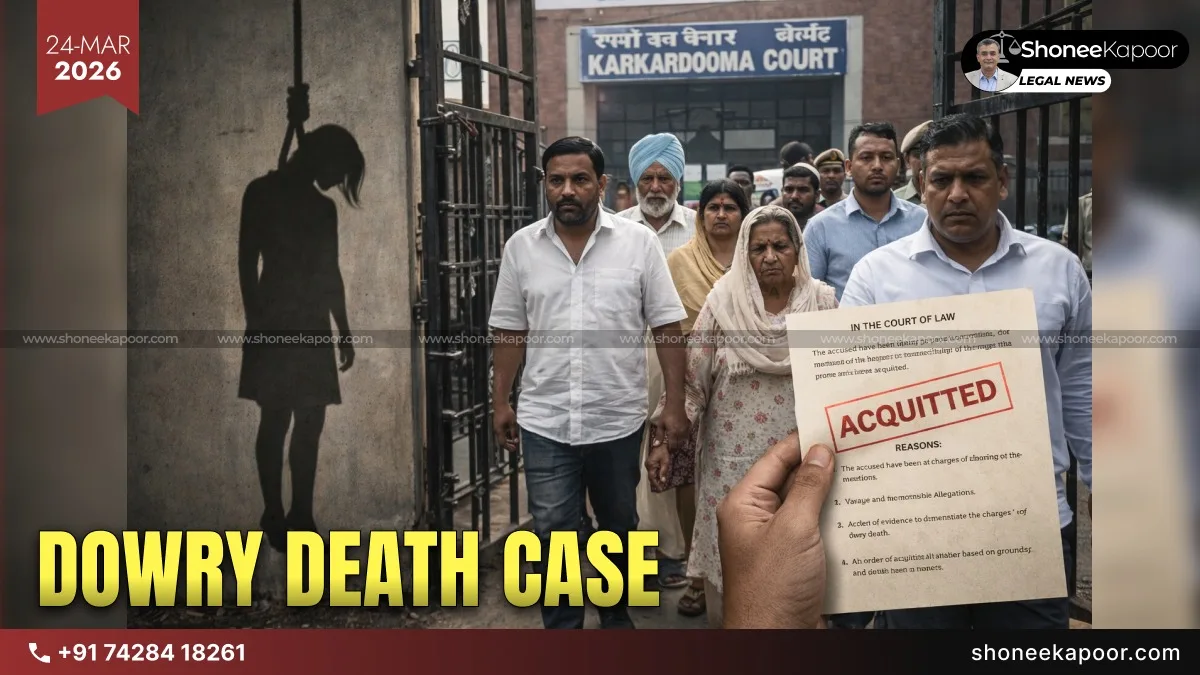
In dowry death cases, the prosecution strongly relies on the fact that the woman died within seven years of marriage, but does this fact alone automatically satisfy the legal requirements for conviction?
NEW DELHI: A Delhi court led by Additional Sessions Judge Babru Bhan acquitted husband Danish and his six relatives in a 2016 dowry death case, holding that cruelty for dowry was not proved beyond reasonable doubt. The judgment dated 12 March 2026 in a sessions trial case found that key legal requirements were not satisfied.
The woman had married in January 2016 and died by hanging in May 2016 at her matrimonial home. The post-mortem confirmed death due to hanging.
The prosecution alleged dowry harassment, but the court found no clear proof of cruelty “soon before death”. It noted that although death within 7 years of marriage was proved, the most important element—dowry-related harassment—was missing.
The court held:
“The requisite harassment and cruelty for demand of dowry has not been proved in this case. Although, some allegations have been levelled but same are too vague and general to prove anything.”
It found that statements of family members were general and lacked specific incidents, roles, or supporting evidence like medical records or prior complaints.
The court further observed:
“The general, ambiguous and omnibus allegations without specifying any particular incident and specific role played by each accused individually, may not be sufficient to prove the requisite cruelty in a criminal case.”
Relying on higher court rulings, the court noted that the allegations were general in nature, with no specific or distinct accusations against individual accused persons, making them broad and omnibus. It further observed that the complaint itself was vague, as it did not clearly explain who committed what act or the exact role played by each accused.
The court also clarified that not every allegation of harassment amounts to cruelty under law. It emphasized that Section 498A IPC cannot be applied mechanically, and normal marital disputes or day-to-day quarrels do not automatically qualify as legal cruelty.
Even the alleged incident on the day of death was not connected to any demand for dowry, and there was no medical evidence to support claims of physical assault. The court found that earlier disputes between the couple could have been due to personal issues, but such disputes alone do not fulfil the legal requirements of dowry-related harassment.
In conclusion, the court held that there was no reliable proof of dowry demand or specific acts of cruelty. As a result, all the accused were acquitted.
Explanatory Table: Laws & Sections Involved
| Law / Section | Purpose | How Applied in This Case | |
| 498A IPC | Protects married women from cruelty by husband or relatives, especially linked to dowry | Court found no specific acts of cruelty; allegations were vague and without clear incidents or proof | |
| 304B IPC | Deals with dowry death when a woman dies unnaturally within 7 years of marriage due to dowry harassment | Death within 7 years was proved, but no evidence of dowry harassment “soon before death”, so section failed | |
| 34 IPC | Fixes joint liability when multiple accused act with common intention | No specific role of each accused was proved, so common intention could not be established | |
| Section 113B Evidence Act | Creates presumption of dowry death if cruelty for dowry is proved before death | Presumption was not applied because prosecution failed to prove cruelty or dowry demand | |
| Section 65B Evidence Act | Governs admissibility of electronic evidence like call records | Formal compliance done, but such evidence did not prove harassment or dowry demand | |
Case Details
- Case Title: State vs Danish & Ors.
- Court: Karkardooma Courts, Delhi
- Sessions Case No.: 152/2016
- Judge: Babru Bhan (Additional Sessions Judge-04)
- FIR No.: 424/2016
- Police Station: Khajuri Khas
- Date of Judgment: 12.03.2026
- Final Order: Acquittal
- Sections: 498A / 304B / 34 IPC
Key Takeaways
- Courts are now clearly rejecting vague, omnibus allegations that drag entire families without specific roles or evidence.
- Legal scrutiny is tightening—mere emotional claims without documentation, complaints, or medical proof are not enough for conviction.
- The “soon before death” requirement is being strictly enforced, preventing automatic conversion of every suicide into a dowry death case.
- Independent and objective evidence is becoming critical; hearsay statements and generalized accusations are losing evidentiary value.
- Criminal law demands precision—specific acts, clear timelines, and direct linkage must be proved before holding anyone guilty.
This Could Change Your Case-Get FREE Legal Advice-Click Here!
Disclaimer: The views and opinions expressed in this article are those of the Indian courts and do not necessarily reflect the official policy or position of “ShoneeKapoor.com” or its affiliates. This article is intended for informational and educational purposes only. The content provided is not legal advice, and viewers should not act upon this information without seeking professional counsel. Viewer discretion is advised.
