
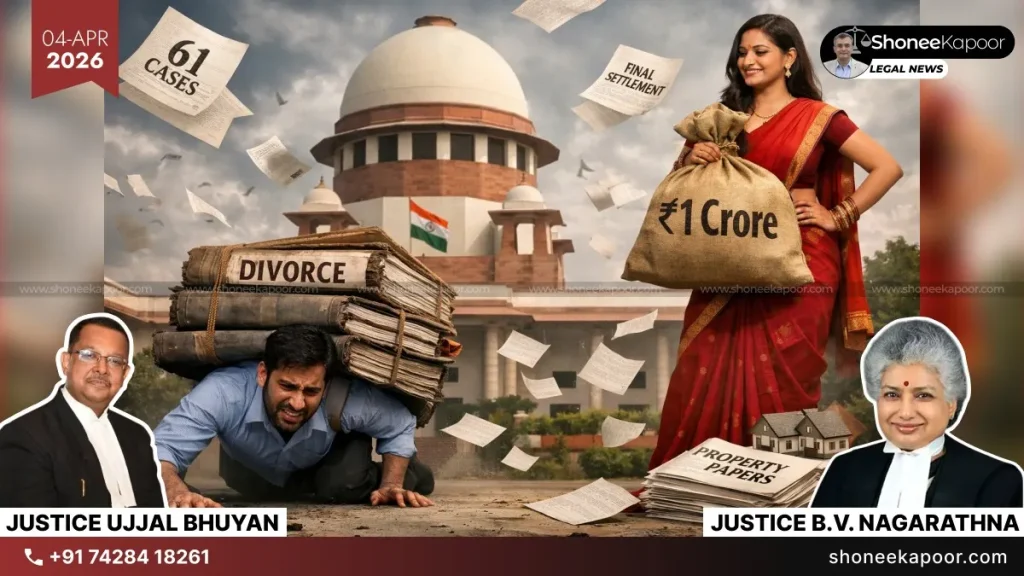
Can a marriage dispute drag into 61 cases across India for 10 years? The Supreme Court steps in—but what finally forced closure? A massive legal battle between a husband and wife, involving 61 cases, ends suddenly—but the terms raise serious questions.
NEW DELHI: The Supreme Court has ended a decade-long matrimonial dispute by granting divorce and closing all 61 cases filed between a husband and wife across multiple courts in India. The case had become one of the most prolonged and litigation-heavy marital disputes to reach the apex court.
A bench of Justices B V Nagarathna and Ujjal Bhuyan used Article 142 of the Constitution to bring a final end to the dispute. The court observed that both parties had agreed to settle all issues related to their marriage, which took place in 1994.
The matter initially came before the Supreme Court as a contempt petition. However, during hearings in January and February, the court actively engaged both sides and encouraged a settlement. This led to structured negotiations, and finally both parties jointly requested divorce by mutual consent.
The Supreme Court clearly recorded that the settlement was voluntary, stating it was done “on their own free volition without there being any coercion or undue influence”. After reviewing the agreement, the court found “no legal impediment” to accept it.
As per the settlement, the husband will pay permanent alimony of ₹1 crore to the wife. He will also transfer his share in a Lonavala property through a registered gift deed. Additionally, ₹90 lakh deposited in the Supreme Court registry has been released to the petitioner, completing the financial settlement.
The agreement also ensures that all disputes between the parties are permanently closed. It clearly states that all past, present, and future claims arising from the marriage are fully settled, and neither party will file any new civil or criminal case against the other.
Recognising this, the Supreme Court took a significant step and quashed all 61 cases pending between the parties. These included criminal cases, domestic violence complaints, writ petitions, contempt matters, and appeals across trial courts, high courts, and even the Supreme Court.
The court strongly directed both sides to “restrain from pursuing further litigation” and clarified that no new complaints on the same issues will be entertained in future. It also cancelled all earlier court orders passed in these cases to ensure complete closure.
The judgment shows how the Supreme Court guided the matter towards settlement through multiple hearings. Starting January 13, the court noted the parties’ willingness to separate and worked step-by-step on financial and property terms. It resolved disputes, verified compliance, and took undertakings from both sides before finalising the agreement.
During this period, the court also ensured a fair environment by directing that no coercive action be taken by either party, allowing negotiations to proceed smoothly.
By using Article 142, the Supreme Court ensured “complete justice” and removed all procedural hurdles, closing all cases in one go and bringing an end to years of litigation.
Laws And Legal Provisions Involved – Explanatory Table
| Law / Section | Explanation | Role in This Case |
| Article 142 – Constitution of India | Empowers Supreme Court to pass any order necessary to ensure “complete justice” | Used to grant divorce, quash all 61 cases, and enforce full settlement beyond procedural limits |
| Divorce by Mutual Consent (Hindu Marriage Act, 1955 – Section 13B) | Allows both spouses to dissolve marriage by agreement | Though not explicitly cited, settlement effectively mirrors mutual consent divorce |
| Domestic Violence Act, 2005 | Provides remedies for women alleging domestic abuse | Multiple proceedings included DV complaints, later quashed |
| Indian Penal Code (Various Sections) | Covers criminal allegations such as cruelty, harassment etc. | Criminal complaints filed during dispute, all quashed |
| Contempt of Court | Action for non-compliance of court orders | Case reached Supreme Court initially through contempt proceedings |
| Writ Jurisdiction (Articles 32/226) | Constitutional remedies for enforcement of rights | Writ petitions were part of the 61 litigations |
| Criminal Procedure Code (CrPC) | Governs criminal proceedings and trials | Applied across multiple criminal cases filed by parties |
Key Takeaways
- A matrimonial dispute was stretched into 61 cases, showing how legal provisions can be repeatedly used to prolong pressure on one party.
- The husband ultimately paid ₹1 crore and transferred property, highlighting the financial toll after years of litigation.
- Supreme Court had to invoke Article 142, proving that normal legal processes often fail to give timely relief in such disputes.
- Multiple criminal and civil cases were quashed together, indicating excessive parallel litigation arising out of one marriage.
- Final settlement came only after a decade, showing how prolonged legal battles can force compromise regardless of merits.
This Could Change Your Case-Get FREE Legal Advice-Click Here!
Disclaimer: The views and opinions expressed in this article are those of the Indian courts and do not necessarily reflect the official policy or position of “ShoneeKapoor.com” or its affiliates. This article is intended for informational and educational purposes only. The content provided is not legal advice, and viewers should not act upon this information without seeking professional counsel. Viewer discretion is advised.