
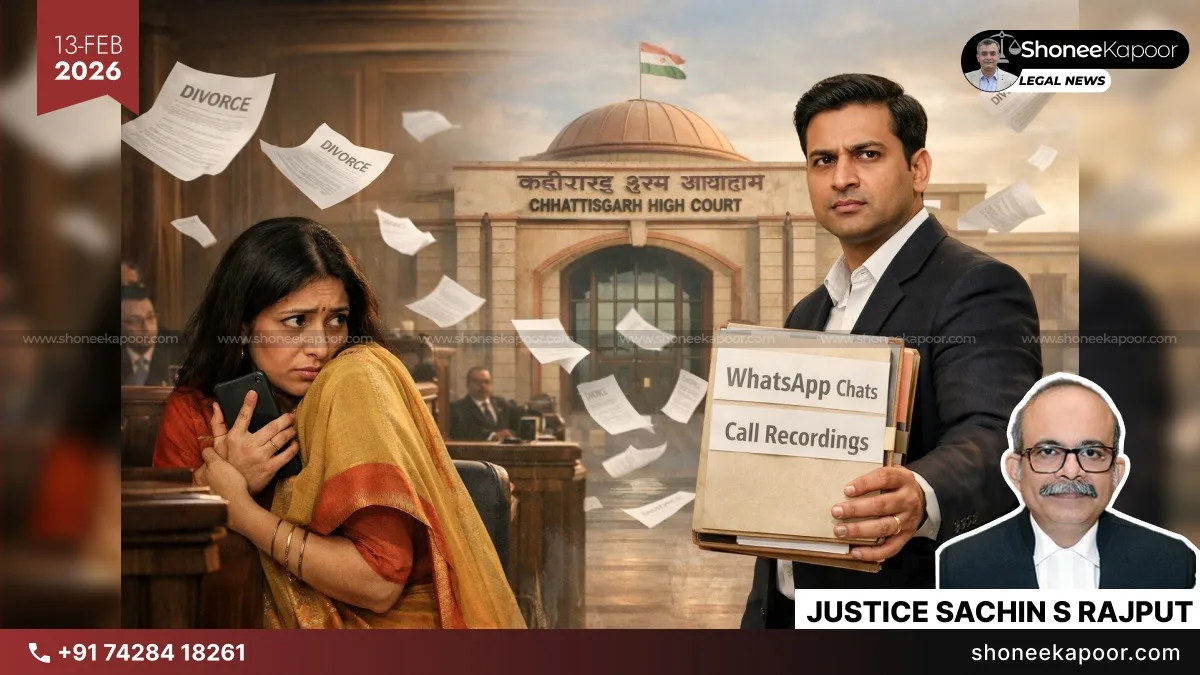
Wife’s WhatsApp Chats and Call Recordings Are Valid & Strong Evidence In Divorce Cases. Fair Trial More Important Than Privacy: Chhattisgarh High Court

Written and analysed by Shonee Kapoor
Legal Consultant, Author & Men's Rights ActivistThe Chhattisgarh High Court has upheld that Family Courts can accept WhatsApp chats and call recordings as evidence in matrimonial disputes. The Court ruled that the right to privacy is not absolute and cannot defeat the right to fair trial in divorce proceedings.
Wife WhatsApp Chats Valid Proof In Divorce: The High Court of Chhattisgarh has delivered a landmark ruling on the admissibility of electronic evidence in matrimonial disputes, holding that WhatsApp chats and call recordings can be taken on record by Family Courts if they are relevant to the dispute. The judgment was pronounced on 11 February 2026 by Justice Sachin Singh Rajput in WP227 No. 158 of 2025.
The case arose out of a divorce petition filed by the husband under Section 13(1)(ia)(ib) of the Hindu Marriage Act, 1955. During the pendency of the proceedings before the Family Court at Raipur, the husband filed an application under Order VII Rule 14 CPC seeking permission to bring on record certain electronic material, including mobile call recordings and WhatsApp chats allegedly exchanged between the wife, her relatives and other persons.
The wife opposed the application, alleging that the husband had obtained the material by hacking her mobile phone and without her consent. She argued that such conduct amounted to an invasion of her fundamental right to privacy under Article 21 of the Constitution of India and that the electronic evidence was not admissible.
By order dated 12.12.2024, the Family Court allowed the husband’s application, observing that the documents sought to be produced may assist in deciding the divorce petition effectively. Challenging this order, the wife approached the High Court by way of writ petition.
While examining the issue, the High Court placed strong reliance on Section 14 of the Family Courts Act, 1984, which grants wide powers to Family Courts to receive material that may help in resolving matrimonial disputes.
The Court reproduced the statutory provision:
“Section 14 of the Act of 1984. Application of Evidence Act, – A Family Court may receive as evidence any report, statement, documents, information or matter that may, in its opinion, assist it to deal effectually with a dispute, whether or not the same would be otherwise relevant or admissible under the Indian Evidence Act, 1872 (1 of 1872).”
The Court also noted:
“Under Section 20 of the Act of 1984. Act to have overriding effect.- The provisions of this Act shall have effect notwithstanding anything inconsistent therewith contained in any other law for the time being in force or in any instrument having effect by virtue of any law other than this Act.”
Referring to Section 122 of the Indian Evidence Act, the Court quoted:
“Section 122 of Evidence Act. Communication during marriage.- No person who is or has been married, shall be compelled to disclose any communication made to him during marriage by any person to whom he is or has been married; nor shall he be permitted to disclose any such communication, unless the person who made it, or his representative in interest, consents, except in suits between married persons, or proceedings in which one married person is prosecuted for any crime committed against the other.”
The High Court clarified that Section 14 of the Family Courts Act is a special provision that dilutes strict evidentiary rules in matrimonial matters. The primary test for admissibility before a Family Court is relevance and whether the material assists in effective adjudication.
On the argument that the electronic evidence was obtained illegally, the Court relied on Supreme Court precedents.
Quoting from R.M. Malkani v. State of Maharashtra, the Court observed:
“24. It was said by counsel for the appellant that the tape recorded conversation was obtained by illegal means. The illegality was said to be contravention of Section 25 of the Indian Telegraph Act. There is no violation of Section 25 of the Telagraph Act in the facts and circumstances of the present case. There is warrant for proposition that even if evidence is illegally obtained it is admissible… The reason given was that if evidence was admissible it matters not how it was obtained.”
The Court further quoted:
“25. This Court in Magraj Patodia v. R.K. Birla… This Court said that a document which was procured by improper or even by illegal means could not bar its admissibility provided its relevance and genuineness were proved.”
Addressing the conflict between privacy and fair trial, the High Court relied on Sharda v. Dharampal and reproduced:
“76. …it cannot be treated as an absolute right. What is emphasized is that some limitations on this right have to be imposed and particularly where two competing interests clash… Thus the court has to reconcile these competing interests by balancing the evidence interests involved.”
It also cited:
“77. …The court having regard to Article 21 of the Constitution of India must also see to it that the right of a person to defend himself must be adequately protected.”
In light of the landmark judgment in K.S. Puttaswamy v. Union of India, the Court acknowledged that privacy is a fundamental right but emphasized its limitations, quoting:
“325. Like other rights… privacy is not an absolute right… An invasion of life or personal liberty must meet the threefold requirement of (I) legality… (ii) need… and (iii) proportionality…”
The Court also referred to Vibhor Garg v. Neha and reproduced:
“12.6 Clearly therefore, the founding rationale for Section 122 of the said Act… was to protect the sanctity of marriage and not the right to privacy of the individuals involved… the right to privacy is not a relevant consideration…”
After analysing statutory provisions and judicial precedents, the High Court held that the Family Court was justified in permitting the husband to bring electronic evidence on record.
It concluded that the right to privacy cannot be used as a shield to prevent a litigating party from placing relevant evidence before the Court in a matrimonial dispute.
The writ petition was dismissed and the Family Court’s order was affirmed.
Explanatory Table – Laws And Sections Referred In The Case
| Law & Section | Purpose | How Applied in This Case |
| Section 13(1)(ia)(ib), Hindu Marriage Act, 1955 | Provides grounds for divorce including cruelty and desertion | Husband filed divorce petition under these provisions and sought to rely on electronic evidence to substantiate allegations |
| Order VII Rule 14 CPC | Allows a party to produce documents in support of pleadings | Husband filed application to bring WhatsApp chats and call recordings on record; Family Court allowed it |
| Section 65-B, Indian Evidence Act, 1872 | Governs admissibility of electronic records through certification | Husband submitted 65-B certificate claiming chats and recordings were original and untampered |
| Section 14, Family Courts Act, 1984 | Empowers Family Court to receive any material that assists effective adjudication, even if otherwise inadmissible | Court relied heavily on this provision to justify relaxed admissibility standards in matrimonial disputes |
| Section 20, Family Courts Act, 1984 | Gives overriding effect to Family Courts Act over inconsistent laws | Reinforced that Family Court powers prevail even over strict Evidence Act rules |
| Section 122, Indian Evidence Act, 1872 | Protects confidentiality of marital communications, with exceptions | Court held it does not protect privacy in suits between spouses; cited Supreme Court ruling |
| Article 21, Constitution of India | Protects right to life and personal liberty including privacy | Wife invoked privacy violation; Court held privacy is not absolute and must yield to fair trial |
| R.M. Malkani v. State of Maharashtra (1973) 1 SCC 471 | Illegally obtained evidence may still be admissible | Relied upon to reject argument that alleged illegal procurement bars admissibility |
| Magraj Patodia v. R.K. Birla AIR 1971 SC 1295 | Improperly obtained documents not automatically inadmissible | Cited to reinforce admissibility based on relevance and genuineness |
| Sharda v. Dharampal (2003) 4 SCC 493 | Privacy not absolute in matrimonial litigation; balancing test | Applied to show fair trial rights may override privacy claims |
| K.S. Puttaswamy v. Union of India (2017) 10 SCC 1 | Recognized privacy as fundamental right but subject to restrictions | Court emphasized that privacy must meet legality, need and proportionality standards |
| Vibhor Garg v. Neha 2025 INSC 829 | Section 122 not based on privacy rights | Relied upon to clarify that spousal communication privilege is not a privacy shield in matrimonial suits |
Case Details
- Case Title: Smt. Manjari Tiwari (Dubey) v. Vaibhav Dubey
- Bench: Hon’ble Shri Justice Sachin Singh Rajput
- Court: High Court of Chhattisgarh at Bilaspur
- Case Number: WP227 No. 158 of 2025
- Order Reserved On: 25.11.2025
- Order Pronounced On: 11.02.2026
- Uploaded On: 11.02.2026
Counsels
- For Petitioner (Wife): Shri Hemant Kesharwani and Shri Swapnil Keshari, Advocates
- For Respondent (Husband): Shri B.P. Sharma and Shri Pushp Gupta, Advocates
Key Takeaways
- Family Courts are not bound by strict Evidence Act technicalities; relevant WhatsApp chats and call recordings can be admitted if they help decide the truth in a matrimonial dispute.
- The right to privacy under Article 21 is not absolute and cannot be used as a blanket shield to block evidence in a divorce case.
- Even if evidence is alleged to be improperly obtained, admissibility depends on relevance and genuineness, not on how uncomfortable it is for one party.
- Section 14 of the Family Courts Act gives wide discretion to admit electronic material that assists in effective adjudication of matrimonial conflicts.
- This ruling strengthens the right of a husband to defend himself fully and place all relevant material before the court when serious allegations are made in matrimonial litigation.
This Could Change Your Case-Get FREE Legal Advice-Click Here!
Disclaimer: The views and opinions expressed in this article are those of the Indian courts and do not necessarily reflect the official policy or position of “ShoneeKapoor.com” or its affiliates. This article is intended for informational and educational purposes only. The content provided is not legal advice, and viewers should not act upon this information without seeking professional counsel. Viewer discretion is advised.
Related Articles
Chef Kunal Kapur Divorce Case: Inside the Courtroom Battle, Allegations, and the Legal Victory That Redefined Matrimonial Cruelty
Celebrity chef Kunal Kapur fought a long and intense courtroom battle to prove mental cruelty.The Delhi High Court’s ...

The Parliament’s Silence on Men’s Rights: When Equality Becomes a Political Risk
This article dives into India’s political silence on men’s rights uncovering why false cases, unfair maintenance, and...
Share Your Thoughts
Comments are moderated before publication.