
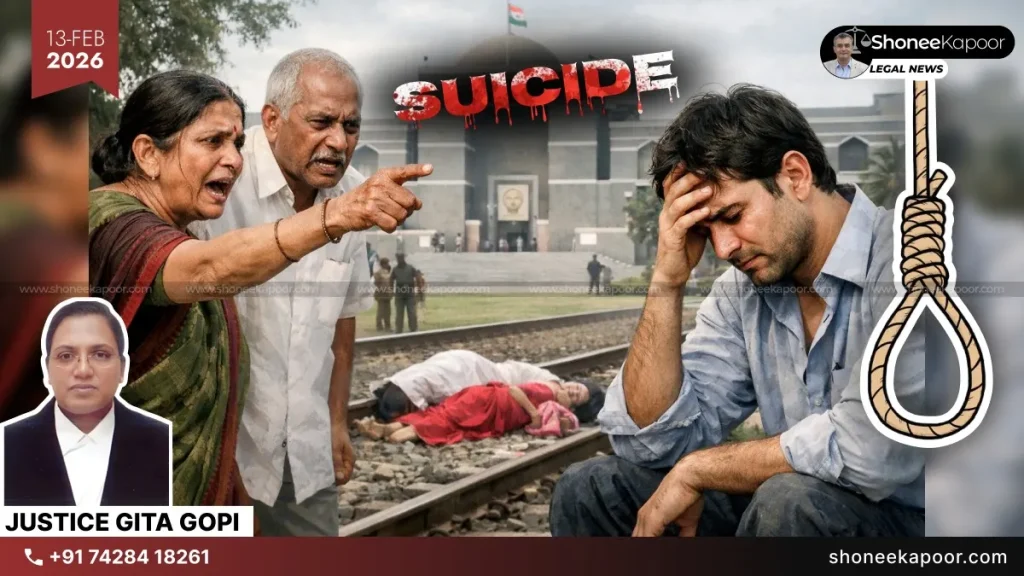
The Gujarat High Court held that in a wife’s suicide case, the husband’s conviction under Sections 498A and 306 IPC cannot rest merely on allegations of quarrels or drinking without clear proof of wilful cruelty or instigation. The Court found gaps in evidence and reaffirmed that guilt must be proved beyond reasonable doubt.
Wife Suicide Case 498A:In a strong judgment protecting a man against weak and exaggerated matrimonial prosecutions, the Gujarat High Court, through Hon’ble Justice Gita Gopi, examined an old conviction of a husband under Sections 498A and 306 of the Indian Penal Code and reinforced the principle that criminal law cannot run on assumptions.
The case related to the death of a young woman and her infant daughter, who were found dead on a railway track in Valsad in 1996. The prosecution claimed that the husband used to beat his wife after consuming alcohol and that this harassment pushed her to commit suicide by jumping in front of a train with the child.
The Sessions Court had convicted the husband mainly on the statements of the woman’s parents and sister.
However, during the appeal, the High Court closely analysed the evidence and found serious gaps. Railway authorities had initially treated the incident as an accidental death due to collision with a train.
No train driver or guard was examined. No independent witness was produced. The investigating officer admitted that he did not even investigate which train was involved. There was also no medical or scientific test to prove that the husband was intoxicated.
The entire case against the husband was based only on the allegation that he quarrelled and beat his wife after drinking alcohol. There was no allegation of dowry demand. There was no evidence of grave injuries. No prior complaint was filed by the deceased during her lifetime. There was no clear proof of continuous or wilful conduct intended to drive her to suicide.
The Court made it clear that Section 498A cannot be stretched to cover every marital quarrel. It clearly observed:
“It is not every harassment or every type of cruelty that would attract the provision of section 498A I.P.C.”
The Court underlined that criminal conviction requires strict proof and cannot be based on emotional statements alone.
On the charge under Section 306 IPC, the Court emphasised that abetment of suicide requires strong and direct evidence. Referring to the Supreme Court’s ruling in M. Mohan v. State, the Court quoted:
“Abetment involves a mental process of instigating a person or intentionally aiding a person in doing of a thing. Without a positive act on the part of the accused to instigate or aid in committing suicide, conviction cannot be sustained.”
“In order to convict a person under section 306 IPC there has to be a clear mens rea to commit the offence. It also requires an active act or direct act which led the deceased to commit suicide seeing no option and this act must have been intended to push the deceased into such a position that he/she committed suicide.”
The High Court also noticed contradictions in the conduct of the deceased’s family. Even after alleging cruelty, they had repeatedly sent her back to the matrimonial home. During cross-examination, it was admitted that the husband behaved properly when he was not under the influence of alcohol and that the in-laws treated her well.
Importantly, the Court raised serious doubt about whether the death was even a suicide. The presence of an umbrella and the absence of direct railway evidence made an accidental fall equally possible. In criminal law, when such a reasonable doubt exists, the benefit must go to the accused.
This judgment sends a clear message that serious criminal sections like 498A and 306 IPC cannot be used casually to punish a husband merely because a tragedy has occurred. Drinking habits and occasional quarrels, without clear proof of deliberate cruelty or instigation, cannot justify imprisonment.
The decision reinforces a fundamental principle: in matrimonial criminal cases, sympathy cannot substitute for evidence, and allegations cannot substitute for proof. Justice must be based on facts, not emotions or social pressure.
Explanatory Table: Laws And Sections Involved
| Law / Section | Purpose of Provision | Relevance in This Case |
| Section 498A IPC | Punishes cruelty by husband or relatives | Alleged beating after drinking |
| Section 306 IPC | Punishes abetment of suicide | Alleged instigation to suicide |
| Section 174 CrPC | Inquest in unnatural death cases | Initial railway accident report |
| Section 313 CrPC | Accused’s explanation in trial | Husband denied allegations |
| Section 113A Evidence Act | Presumption in suicide within 7 years of marriage | Discussed but strict proof required |
| Protection of Women from Domestic Violence Act, 2005 | Civil remedy for domestic violence | Mentioned in broader context |
| Medical Termination of Pregnancy Act, 1971 | Regulates termination of pregnancy | Referred in argument discussion |
Case Details
- Case Title: Niranjankumar Chhaganlal Mehta Versus State of Gujarat
- Case Number: R/Criminal Appeal No. 1148 of 2003
- Court: High Court of Gujarat at Ahmedabad
- Bench: Honourable Ms. Justice Gita Gopi
- Date of Judgment: 19/01/2026
- Neutral Citation: 2026:GUJHC:3499
- Counsels:
- For Appellant: H. B. Shethna
- For Respondent: Mr. Rohan H. Rawal, APP
Key Takeaways
- Not every marital quarrel or allegation of harassment can be branded as cruelty under Section 498A; criminal law demands strict legal proof, not emotional narratives.
- Conviction for abetment of suicide under Section 306 requires clear mens rea and a direct act of instigation; suspicion or a tragic outcome alone is insufficient.
- Cases built only on statements of interested family members, without independent or scientific evidence, cannot sustain serious criminal convictions.
- When two views are possible — accident or suicide — criminal jurisprudence mandates that the benefit of doubt must go to the accused.
- Criminal law must be applied with balance and restraint, ensuring it protects genuine victims while preventing its misuse as a tool of pressure or punishment.
This Could Change Your Case-Get FREE Legal Advice-Click Here!
Disclaimer: The views and opinions expressed in this article are those of the Indian courts and do not necessarily reflect the official policy or position of “ShoneeKapoor.com” or its affiliates. This article is intended for informational and educational purposes only. The content provided is not legal advice, and viewers should not act upon this information without seeking professional counsel. Viewer discretion is advised.