
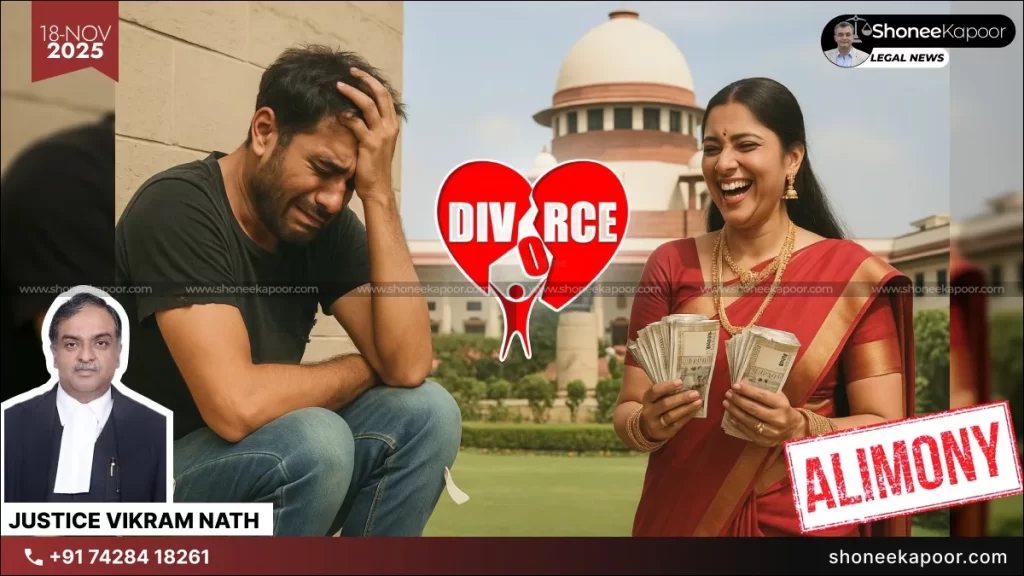
The Supreme Court upheld a divorce where the couple had lived apart since 2008 and the marriage was never consummated. The husband must now pay ₹50 lakh alimony to the wife.
NEW DELHI: In a long matrimonial dispute running for more than 17 years, the Supreme Court on 13 November 2025 confirmed the divorce granted by the Family Court and later upheld by the Rajasthan High Court.
The top court said that the couple had been living separately since 2008 and that no real marital relationship was left between them. While upholding the divorce, the bench of Justices Vikram Nath and Sandeep Mehta directed the husband to pay ₹50 lakh alimony to his wife, who is a practising advocate, so her financial future stays secure.
The couple got married on 18 April 2008 as per Hindu customs. However, after only eight months of marriage, the wife left the matrimonial home on 22 December 2008, saying she needed time to prepare for the judicial services examination.
According to the husband, she never returned, and the marriage was never consummated. He also claimed she had hidden her correct age before the marriage and was actually about two and a half years older than him. He stated that she focused more on her legal career instead of their marital life.
After waiting for almost four years, the husband filed a divorce petition on 21 December 2012 under Sections 13(1)(a) and 13(1)(b) of the Hindu Marriage Act, accusing the wife of cruelty and desertion. He told the court that he tried many times to bring her back, but she did not show any willingness to return to the matrimonial home.
In 2016, the wife filed her own petition under Section 9 of the Act, asking for restitution of conjugal rights and saying she was ready to live with him. But the Family Court found this claim not genuine, because she had not made any real attempt to resume their marital relationship in all those years.
The Family Court finally allowed the husband’s divorce petition on 4 May 2019 and dismissed the wife’s plea. It noted that the wife had chosen to focus on her profession and even contested and won Bar Association elections at Chippa Barod City. Mediation attempts also failed.
The wife later challenged this order before the Rajasthan High Court through two civil miscellaneous appeals. But on 27 March 2023, the High Court agreed with the Family Court.
The High Court division bench noted that the wife left the marital home within months of the marriage and showed no real intent to return. It also observed that her petition for restitution of conjugal rights, filed four years after the divorce case, did not seem sincere and looked more like a defensive reaction.
Still aggrieved, the wife approached the Supreme Court. During the hearing, the bench noted that the couple had lived separately since December 2008 and that nothing had worked to bring them back together.
The Supreme Court said:
“It is evident that no matrimonial bond remains between them and that neither party has any real intention to restore the relationship”.
The Court also noted that the husband had already remarried on 3 May 2023 and found no point in continuing a marriage that had completely broken down long ago. The Supreme Court upheld the decisions of both the Family Court and the High Court and dismissed the wife’s appeal.
While confirming the divorce, the bench ordered the husband to give the wife ₹50 lakh as permanent alimony. The Court said that even though the wife was a practising advocate, she still deserved financial protection for the future. The husband, who works as a Class-C contractor with Nagar Nigam, Pali, must pay this amount within three months.
The Supreme Court stated:
“The respondent-husband continues to bear a duty to provide alimony to the appellant-wife so as to maintain her financial stability and reasonably secure her future”.

Explanatory Table Of All Laws & Sections Mentioned
| Law / Section | Full Name | Purpose In This Case | How It Applies To The Parties |
| Hindu Marriage Act, 1955 – Section 13(1)(a) | Divorce on ground of Cruelty | Allows either spouse to seek divorce if the other has treated them with cruelty. | Husband alleged cruelty as wife left soon after marriage, never consummated marriage, never returned. |
| Hindu Marriage Act, 1955 – Section 13(1)(b) | Divorce on ground of Desertion | Divorce can be granted when one spouse deserts the other for 2+ years. | Wife left on 22 Dec 2008 and stayed away; court accepted desertion. |
| Hindu Marriage Act, 1955 – Section 9 | Restitution of Conjugal Rights | Allows a spouse to seek a court order directing the other spouse to resume marital life. | Wife filed RCR in 2016; courts held it lacked bona fides as she made no real effort to return. |
| Hindu Marriage Act, 1955 – Section 24 | Interim Maintenance / Expenses of Proceedings | Allows financially weaker spouse to seek temporary maintenance during case. | Wife filed for Section 24 before Family Court but did not receive interim maintenance. |
| Permanent Alimony (Court’s Inherent Powers) | Court’s power to grant one-time settlement | To secure financial future of spouse after divorce. | SC ordered husband to pay ₹50,00,000 lump sum. |
| Supreme Court Civil Appellate Jurisdiction | Appeal process under Article 133/136 (SLP) | Supreme Court reviews High Court decisions. | Wife challenged High Court’s order; SC dismissed appeal but granted alimony. |
Case Summary
- Case Title: Pankaj Shukla vs. Deepak Chaturvedi (Civil Appeal No(s). ___ of 2025 arising out of SLP (C) Nos. 19120–19121 of 2023)
- Bench (Judges): Justice Vikram Nath and Justice Sandeep Mehta
- Marriage: Married on 18 April 2008 according to Hindu rites.
Separation:
- Wife left matrimonial home on 22 December 2008.
- Parties living separately for 17 years.
Husband’s Divorce Petition:
- Filed on 21 December 2012 under Section 13(1)(a) & 13(1)(b).
- Grounds: cruelty, desertion, non-consummation, concealed age, no intent to return.
Wife’s RCR Petition:
- Filed under Section 9 in 2016.
- Courts found it lacked bona fides.
Family Court Order (4 May 2019):
- Divorce granted.
- Wife’s RCR petition dismissed.
High Court Order (27 March 2023):
- Dismissed wife’s appeals (1605/2019 & 1604/2019).
- Confirmed wife left soon after marriage and never returned.
- Found her RCR petition insincere.
Supreme Court Findings:
- Noted husband already remarried on 3 May 2023.
- Upheld divorce.
- Ordered ₹50,00,000 permanent alimony.
Supreme Court Direction:
- Payment deadline: within 3 months.
- Wife must furnish bank details.
Key Notes
- Marriage lasted 8 months, separation lasted 17 years — yet husband still pays.
- Marriage was never consummated, but the man is financially penalised anyway.
- Wife left voluntarily in 2008 to “prepare for exams” and never returned.
- Husband waited 4 years before filing for divorce — multiple reconciliation attempts failed.
- Wife filed Section 9 RCR after 4 years only as a defence strategy — courts found it insincere.
- Family Court, High Court, and Supreme Court — all agreed the wife deserted the marriage.
- Supreme Court noted: “No matrimonial bond remains between them.”
- Husband had already remarried, yet still ordered to pay a ₹50 lakh lump sum alimony.
- Wife is a practising advocate with her own income — yet compensation imposed on the man.
- Husband is just a Class-C contractor, but expected to pay a massive settlement.
- Another case showing that even when men are abandoned, they pay the price.
- Highlights the ongoing debate on gender-neutral matrimonial laws and fair alimony standards.
- Demonstrates why India urgently needs equal rights for husbands, especially where the wife deserts the marriage.
- Raises the bigger question:
Why must men fund a relationship the courts themselves admit “ceased to exist in substance”?
Disclaimer: The views and opinions expressed in this article are those of the Indian courts and do not necessarily reflect the official policy or position of “ShoneeKapoor.com” or its affiliates. This article is intended for informational and educational purposes only. The content provided is not legal advice, and viewers should not act upon this information without seeking professional counsel. Viewer discretion is advised.