
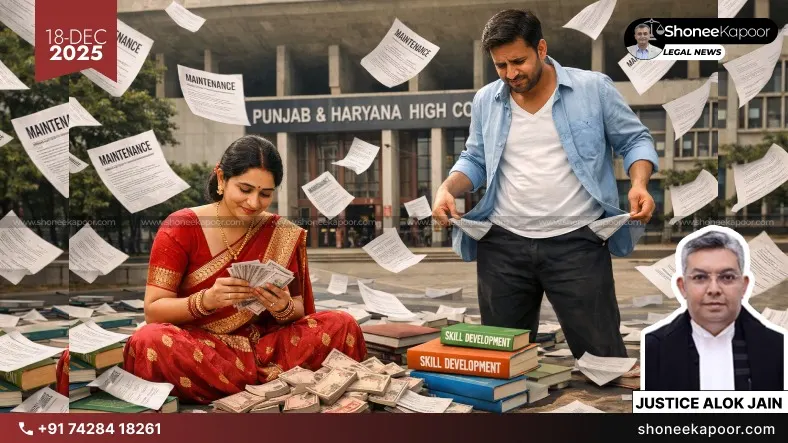
Maintenance Is Not Free Money. Wife Must Spend 10% Maintenance On Skill Development To Become Financially Independent: Punjab & Haryana High Court

Written and analysed by Vaibhav Ojha
Head Of Legal CommunicationsThe Punjab & Haryana High Court refused to further increase maintenance and directed the wife to use 10% of the amount for skill development. The Court said maintenance is meant for dignity and self-reliance, not lifelong dependency.
CHANDIGARH: While refusing to further increase the maintenance granted to a wife, the Punjab & Haryana High Court passed an important direction stating that she must use 10% of the maintenance amount for skill development so that she can become financially independent. The Court clearly stated that the purpose of maintenance law is not only to provide basic survival but also to help the person stand on her own feet with dignity in the long run.
Justice Alok Jain observed that maintenance laws must be understood in their true spirit and said,
“The petitioner is required to enhance her capabilities and stature in life so as to become self-reliant, only then it would reflect that the true intent of the maintenance legislation has been fulfilled and the maintenance awarded is being utilized in its correct perspective. Therefore, this Court considered it appropriate to direct the petitioner, that out of the maintenance amount of Rs. 15,000/- awarded to her, she must utilize at least 10% thereof, for improving her vocational skills.”
The revision petition was filed against an order passed by the Principal Judge, Family Court, by which the maintenance payable to the petitioner-wife was enhanced to one-third of the respondent-husband’s net salary, which came to ₹15,000 per month.
Even after this enhancement, the petitioner-wife was not satisfied and approached the High Court seeking a further increase in maintenance. She argued that maintenance should have been calculated on one-third of the respondent’s gross salary and not on his net salary.
The counsel for the petitioner submitted that the Family Court had committed an error while assessing the income of the husband. It was argued that as per the salary slip, the respondent was earning ₹58,016 per month, but the trial court wrongly deducted voluntary deductions and assessed the take-home salary as ₹45,000. Based on this reduced figure, maintenance was fixed at one-third of the net salary.
The petitioner further argued that maintenance law is a social welfare legislation and should be interpreted liberally. It was contended that the wife has a legal right to enjoy the same standard of living, comfort and facilities as enjoyed by the husband.
After hearing both sides, the High Court observed that the petitioner failed to place any concrete material on record to show that her reasonable needs had increased or that the maintenance already granted was insufficient to meet her expenses. The Court noted that a general rise in the cost of living cannot be considered alone, because salary revisions usually happen along with inflation.
In the present case, the Court found no material to show that the maintenance amount had lost its value due to inflation or that the petitioner was facing any financial hardship. The Court also held that even if some deductions shown in the salary slip were voluntary, it would not substantially change the overall assessment of maintenance.
While dealing with the issue, the Court made an important observation and stated that,
“The present petition appears to be an attempt to seek an enhancement beyond, what is reasonably justified, which is not the underlying intent of maintenance legislation. The husband is also a human being and a citizen of this country, and is equally entitled to lead a dignified life.”
The High Court further found that the Family Court had enhanced maintenance without properly analysing any evidence regarding an actual change in the wife’s expenses. The enhancement appeared to have been granted mechanically, only on the general assumption that the cost of living had increased and that ₹7,500 per month was insufficient. The Court held that such general observations, without supporting evidence, cannot be the sole basis for increasing maintenance.
The Court also took serious note of a growing trend where maintenance is claimed without proving a valid reason for living separately or without showing a condition of destitution. While reiterating that maintenance is meant to ensure a dignified life and not bare survival, the Court emphasised the need to encourage self-reliance and financial independence.
In this context, the Court observed:
“Although the law mandates that maintenance is to be granted to a wife who is living separately for a just cause and who is in a destitute condition, thereby, unable to maintain herself, however, the Court is equally conscious of the need to enhance the dignity, self-respect and independence of the women. In matters of maintenance, the object is not merely subsistence but also to enable the claimant to live with dignity, therefore, a part of maintenance amount must be utilized for skills enhancement and self-development so as to promote financial independence and long-term self-reliance,” it added.
Finally, while dismissing the plea for further enhancement, the High Court directed that at least 10% of the maintenance amount of ₹15,000 awarded to the petitioner must be utilised specifically for vocational skill development.
This judgment clearly states that maintenance is not meant to be a lifetime entitlement without accountability. The Court balanced women’s welfare with men’s dignity and reinforced that financial support must move towards self-reliance, not dependency.
Explanatory Table: Laws & Legal Principles Applied in the Case
| Law / Legal Principle | Section / Provision | Explanation | How Applied in This Case |
| Maintenance Law (General) | Not specifically cited | Maintenance laws are meant to support a spouse who cannot maintain herself and is living separately for a just cause | Court examined whether the wife was genuinely unable to maintain herself beyond the amount already granted |
| Social Welfare Legislation | Judicial Interpretation | Maintenance laws are considered social welfare laws and must be applied to ensure dignity, not dependency | Court rejected blind liberal interpretation without proof of increased need |
| Principle of Dignified Living | Judicial Principle | Maintenance should allow dignified living, not luxurious or unjust enrichment | Court held ₹15,000 sufficient for dignity in absence of evidence |
| Principle of Self-Reliance | Judicial Reasoning | Maintenance should help a person become independent rather than permanently dependent | Court directed 10% of maintenance to be used for skill development |
| Assessment of Income | Salary Slip Evaluation | Net income is considered after legitimate deductions | Court upheld calculation on net salary, not gross salary |
| Inflation Argument | Judicial Assessment | General rise in cost of living must be supported by evidence | Court rejected inflation argument due to lack of proof |
| Equality Before Law | Constitutional Value | Both husband and wife are entitled to live with dignity | Court explicitly recognised husband’s right to dignified life |
| Burden of Proof | Evidence Law Principle | Person seeking enhancement must prove increased expenses or hardship | Wife failed to produce evidence of increased needs |
Extracted Case Details
| Particular | Details |
| Case Title | ABC vs XYZ |
| Court | Punjab & Haryana High Court |
| Judge / Bench | Justice Alok Jain |
| Type of Case | Revision Petition (Maintenance Enhancement) |
| Maintenance Amount | ₹15,000 per month |
| Key Direction | 10% of maintenance to be used for skill development |
| Family Court Order Challenged | Order of Principal Judge, Family Court |
| Outcome | Petition dismissed, no further enhancement granted |
Sumary of the Judgment
| Issue | Court’s Finding |
| Further enhancement of maintenance | Rejected |
| Calculation on gross salary | Not accepted |
| Inflation as sole ground | Not sufficient |
| Mechanical enhancement by Family Court | Disapproved |
| Maintenance as lifelong support | Rejected |
| Skill development from maintenance | Mandated |
| Husband’s dignity | Explicitly recognised |
Key Takeaways
- Maintenance is not a lifelong free income; it is meant to support dignity and push self-reliance, not permanent dependency on the husband.
- Courts have clearly acknowledged that the husband is also a human being and equally entitled to live a dignified life, not just exist as a financial provider.
- Demanding maintenance enhancement without proof of real financial hardship or increased expenses will not be entertained.
- Net salary, not inflated gross figures with selective arguments, is the correct basis for fair maintenance calculation.
- This judgment sets a strong precedent that part of maintenance must be used for skill development, reinforcing accountability and financial independence instead of misuse.
This Could Change Your Case-Get FREE Legal Advice-Click Here!
Disclaimer: The views and opinions expressed in this article are those of the Indian courts and do not necessarily reflect the official policy or position of “ShoneeKapoor.com” or its affiliates. This article is intended for informational and educational purposes only. The content provided is not legal advice, and viewers should not act upon this information without seeking professional counsel. Viewer discretion is advised.
Related Articles
Unheard Voices: Understanding Men’s Rights and Legal Inequality in India
India speaks proudly of women’s empowerment but ignores the men who suffer in silence. With rising false accusations,...
Matrimonial Maintenance for NRIs: The Untold Legal Battle Every Overseas Indian Must Know
NRI Men, Take Note: A Power-Packed Guide to Indian Maintenance Laws from Section 125 CrPC to Cross-Border Enforcement...
Legal Mistakes Men Make During Divorce: Costly Errors That Destroy Cases
Costly legal mistakes Indian men make during divorce, maintenance, custody, 498A/BNS cruelty cases and evidence colle...
Share Your Thoughts
Comments are moderated before publication.