
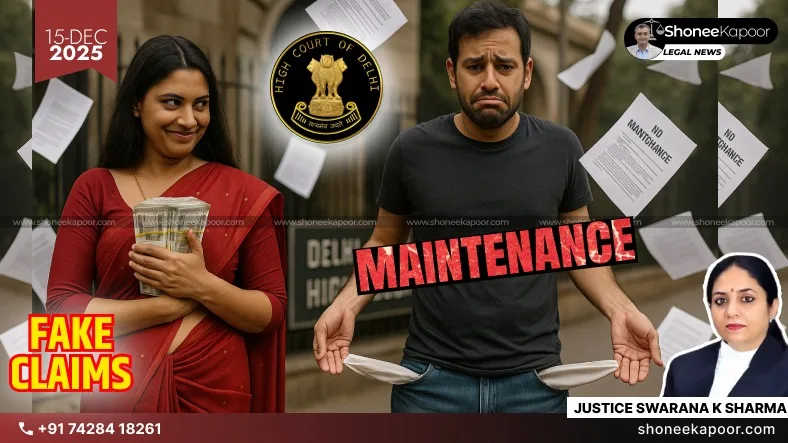
Wife Hiding Income Not Entitled to Maintenance: Delhi High Court’s Strong Warning Against False Claims Under DV Act

Curated by NEWS DESK
Editorial DeskThe Delhi High Court upheld that a wife who hides her income cannot claim Maintenance under the Domestic Violence Act. However, the Court protected the child’s rights and ordered rent support for basic residence.
NEW DELHI: The Delhi High Court delivered an important judgment clarifying that honesty in income disclosure is a basic requirement for claiming maintenance under the Protection of Women from Domestic Violence Act.
Justice Swarana Kanta Sharma held that a wife who conceals her earnings or financial capacity cannot seek interim maintenance by projecting herself as financially helpless.
The ruling came in Criminal Revision Petition No. 917/2024, filed by the wife challenging a Sessions Court order which had withdrawn her maintenance while continuing maintenance for the minor child. The parties were married in February 2012 and have a son born in January 2013.
In September 2020, the wife approached the Magistrate under Section 12 of the DV Act alleging dowry harassment and emotional abuse, claiming that she had been forced to live separately with her child.
At the initial stage, the Trial Court granted ad-interim maintenance of ₹30,000 per month after considering the husband’s admitted income. Subsequently, by order dated 08 April 2022, the Trial Court modified the relief and granted ₹15,000 per month each to the wife and the child. Both parties challenged this order. While the wife sought enhancement, the husband argued that the wife had deliberately hidden her income.
The Sessions Court accepted the husband’s plea, set aside maintenance granted to the wife, and upheld maintenance for the child.
Before the High Court, a detailed examination of income affidavits, bank statements, and income tax records revealed repeated non-disclosure by the wife. The Court noted that although she had filed an income affidavit in November 2020, she did not disclose her employment during 2020 and failed to place complete bank statements on record despite specific directions.
When statements were finally produced, they showed unexplained credit entries which were inconsistent with her claim of having no income.
The Sessions Court had earlier recorded that the wife concealed her job as a teacher in 2020 and admitted employment only after the husband produced documents suggesting that she was working with a private firm and earning about ₹18,000 per month. The courts also noted that no termination letter was filed and that the alleged salary was not reflected in her bank accounts, raising serious doubts about the truthfulness of her disclosures.
Material placed on record, including documents relating to private tuition activity and digital conversations, further supported the finding that she had additional income sources which were not disclosed.
While dealing with entitlement to maintenance, the Sessions Court relied on settled law and held:
“…before assessing the income of the husband, it is necessary to appreciate if is entitled for maintenance and for this, prima facie it should made out from the record that wife is unable to maintain herself… Reference in this regard may be made to Rajnish Vs. Neha (2021) 2SCC, 324… wherein it is held by Hon’ble Apex Court that “an order of interim maintenance is conditional on the circumstance that the wife or husband who makes a claim has no independent income, sufficient to her or his support.””
The Sessions Court also quoted binding precedent:
“Law does not expect persons engaged in the legal battles to remain idle solely with the objective of squeezing out money from the opposite party. Section 24 of HMA is not meant to create an Army of Idle people waiting for a dole to be awarded by the other spouse”.
Upholding these findings, the High Court agreed that the wife had not approached the court with clean hands. The Court reiterated that before determining the quantum of maintenance, the court must first examine whether the claimant is genuinely unable to maintain herself.
Relying on settled law, including the Supreme Court’s decision in Rajnish v. Neha, the Court reaffirmed that interim maintenance is conditional upon the absence of sufficient independent income.
The High Court also endorsed the principle that matrimonial laws are not meant to encourage capable individuals to remain idle during litigation solely to extract money from the other spouse. In light of the wife’s qualifications, past employment, bank transactions, and investments, the Court held that she was not entitled to interim maintenance.
However, the Court made a clear distinction between monetary maintenance and the right to residence. It noted that after vacating the rented premises, the wife and the minor child were living in her brother’s house without paying rent and purely on goodwill. The Court held that denial of maintenance does not automatically defeat a woman’s right to secure residence under the DV Act, especially when a minor child is involved.
Invoking Section 19(1)(f) of the DV Act, the High Court directed the husband to pay ₹10,000 per month towards rented accommodation for the wife and child. The child’s maintenance of ₹15,000 per month, which was not challenged, was left undisturbed. The Court also directed the Trial Court to expedite the proceedings, noting that the dispute has been pending since 2020.
The judgment sends a strong legal message that maintenance under matrimonial and DV laws is a relief based on truth and transparency. Suppression of income can defeat a maintenance claim, and courts will not permit misuse of welfare legislation.
At the same time, the ruling ensures that a child’s welfare and basic housing needs remain protected, striking a balance between accountability and compassion.
Explanatory Table: Laws & Sections Referred In The Case
| Law / Statute | Section | Simple Explanation |
| Protection of Women from Domestic Violence Act, 2005 | Section 12 | Provision under which an aggrieved woman can file a complaint seeking reliefs like protection, maintenance, residence, etc. |
| Protection of Women from Domestic Violence Act, 2005 | Section 19(1)(f) | Empowers the court to direct the husband to provide alternate accommodation or pay rent for the wife and child. |
| Protection of Women from Domestic Violence Act, 2005 | Section 23 | Power of the Magistrate to grant interim and ex-parte reliefs. |
| Protection of Women from Domestic Violence Act, 2005 | Section 29 | Provides the right to file an appeal against orders passed by the Magistrate. |
| Criminal Procedure Code, 1973 | Section 340 | Deals with proceedings for giving false evidence or filing false affidavits before court. |
| Hindu Marriage Act, 1955 | Section 24 | Interim maintenance during matrimonial proceedings; referred to by analogy in judgments. |
| Constitution / Judicial Precedent | — | Reliance on Supreme Court and High Court precedents governing maintenance and disclosure of income. |
Case Summary
- Case Title: Sahiba Sodhi vs. The State (NCT of Delhi) & Anr.
- Case Number: CRL.REV.P. 917/2024 CRL.M.A. 28189/2024
- Court: High Court of Delhi at New Delhi
- Bench: Hon’ble Dr. Justice Swarana Kanta Sharma
- Dates:
- Judgment Delivered on: 14.11.2025
- Judgment Pronounced on: 09.12.2025
- Judgment Uploaded on: 12.12.2025
Counsels Appearing:
- For the Petitioner (Wife):
- Mr. N. K. Sharma, Advocate
Mr. Gaurav Bhandari, Advocate
Mr. Harish Kumar, Advocate
- Mr. N. K. Sharma, Advocate
- For the State:
- Mr. Manoj Pant, APP
- For Respondent No. 2 (Husband):
- Tripaksha Litigation – Mr. Prateek Jindal, Advocate
Key Takeaways
- A wife who conceals her income or files misleading affidavits cannot claim maintenance — courts will not reward dishonesty under the guise of “women welfare” laws.
- Being well-qualified and employable matters — maintenance is for survival, not for turning capable adults into permanent dependents.
- Courts are now strictly applying the principle of “clean hands first” before granting any financial relief under DV or matrimonial laws.
- Child rights remain protected — even when a wife is denied maintenance, the father’s duty towards the child is non-negotiable.
- This judgment sends a strong message against misuse of maintenance provisions: law is for justice, not for creating “an Army of Idle people waiting for a dole.”
This Could Change Your Case-Get FREE Legal Advice-Click Here!
Disclaimer: The views and opinions expressed in this article are those of the Indian courts and do not necessarily reflect the official policy or position of “ShoneeKapoor.com” or its affiliates. This article is intended for informational and educational purposes only. The content provided is not legal advice, and viewers should not act upon this information without seeking professional counsel. Viewer discretion is advised.
Related Articles
How Is Alimony or Maintenance Calculated in Divorce Cases in India? The Real Legal Formula Courts Actually Use
Is alimony really fixed at 25% or decided randomly by courts? Or is there a deeper legal method that most people stil...
Family Courts Refuse My RTI To Reveal Divorce Data: Is Transparency Selective When It Comes to Men?
Family Courts have refused to provide year-wise divorce and alimony statistics under the RTI Act, citing technical gr...
Relevant Judgements
Can an NRI Husband Be Forced to Pay Maintenance in India? Supreme Court Rules Explained for Overseas Indian Men
Living abroad does not automatically protect an NRI husband from maintenance claims in India.But can Indian courts pa...
Share Your Thoughts
Comments are moderated before publication.