
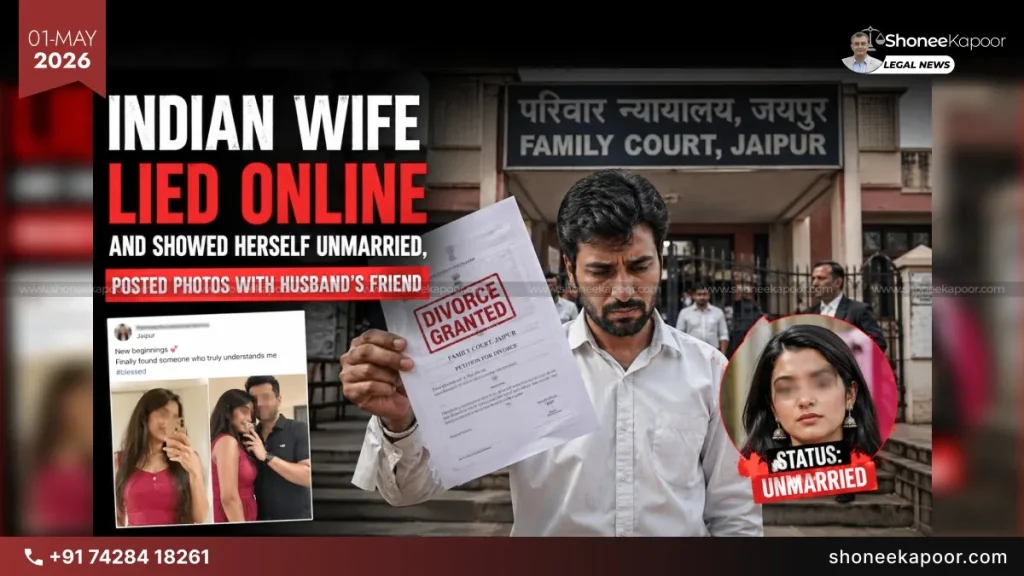
Was it just a “mistake” or something more serious behind the “unmarried” status? Court saw chats, photos, and silence on key evidence — and took a strict legal view.
RAJASTHAN: A Jaipur Family Court has granted divorce to a husband after finding mental cruelty and desertion by the wife, based on her conduct on social media and evidence placed on record. The case shows how digital behaviour and unexplained actions can legally impact matrimonial disputes under Indian law.
The order was passed on April 17 by Presiding Officer Aarti Bhardwaj of Family Court No. 1, Jaipur Metropolitan-First, in a petition filed under Section 13 of the Hindu Marriage Act, 1955. The court granted divorce under Section 13(1)(i-a) for cruelty and Section 13(1)(i-b) for desertion.
As per the husband’s case, the marriage took place on November 27, 2015 in Jaipur as per Hindu rituals. He stated that disputes started soon after marriage, mainly due to the wife insisting on living separately from his family. According to him, the couple last lived together as husband and wife on October 21, 2017.
The court examined whether the wife’s conduct amounted to cruelty. It was found that even after marriage, her social media profile continued to show her marital status as “unmarried”.
During cross-examination, she admitted that she had mentioned herself as “unmarried”. She tried to explain this by saying that an e-mitra operator had made the entry, but she failed to produce that person as a witness to support her claim. The court treated this unexplained conduct seriously and held that such representation can cause mental cruelty to the husband.
The matter did not stop there. The husband also alleged that the wife was in a relationship with another man, who was known to him. In support, he submitted photographs and chat messages as Exhibit-6. During cross-examination, the wife admitted that she had uploaded personal photographs with that man on social media. She attempted to justify this by calling him her brother-in-law (jijaji), but the court did not accept this explanation based on the available evidence.
The court noted that the wife’s conduct, including her online representation and association shown through chats and photographs, created a situation that went beyond normal matrimonial disputes. When such actions remain unexplained or unsupported by evidence, they legally strengthen allegations of cruelty.
On the issue of desertion, the court accepted that the parties had been living separately since 2017 without any reasonable cause attributable to the husband. This satisfied the legal requirement for desertion under the Hindu Marriage Act.
Based on the overall material on record, the court concluded that the husband had successfully proved both cruelty and desertion. Accordingly, the marriage was dissolved. Both parties were directed to bear their own legal costs, and the decree was ordered to be formally drawn as per procedure.
This case highlights an important legal reality — in matrimonial disputes, even indirect conduct like social media declarations, unexplained relationships, or failure to support claims with evidence can significantly affect the outcome.
Explanatory Table – Laws & Sections Involved
| LAW / SECTION | LEGAL PROVISION | WHAT IT MEANS IN SIMPLE TERMS | HOW COURT APPLIED IT |
| Hindu Marriage Act, 1955 | Section 13 | Governs divorce between Hindu spouses | Petition filed under this provision |
| Section 13(1)(i-a) | Cruelty | Any conduct causing mental or physical suffering to spouse | Wife showing herself as “unmarried” and unexplained conduct was treated as mental cruelty |
| Section 13(1)(i-b) | Desertion | One spouse leaving the other without reasonable cause for continuous period | Court accepted that parties lived separately since 2017 without valid justification |
Case Details
- Court: Family Court No. 1, Jaipur Metropolitan-First
- Presiding Officer / Bench: Aarti Bhardwaj
- Date of Order: 17 April
- Petitioner’s Counsel: D.S. Shekhawat (appeared for husband)
Key Takeaways
- Courts are now recognising that even indirect acts like false online identity can amount to mental cruelty against husbands.
- A man is expected to prove everything with evidence, while mere explanations without proof are rejected — the burden imbalance is evident.
- Social media behaviour is no longer “personal” — it can legally destroy a man’s marriage and reputation.
- False or misleading narratives, when exposed, still take years before courts correct the damage already done to men.
- Desertion by wife is often normalised socially, but legally it remains a valid ground — this case reinforces that men are not bound to suffer indefinitely.
This Could Change Your Case-Get FREE Legal Advice-Click Here!
Disclaimer: The views and opinions expressed in this article are those of the Indian courts and do not necessarily reflect the official policy or position of “ShoneeKapoor.com” or its affiliates. This article is intended for informational and educational purposes only. The content provided is not legal advice, and viewers should not act upon this information without seeking professional counsel. Viewer discretion is advised.