
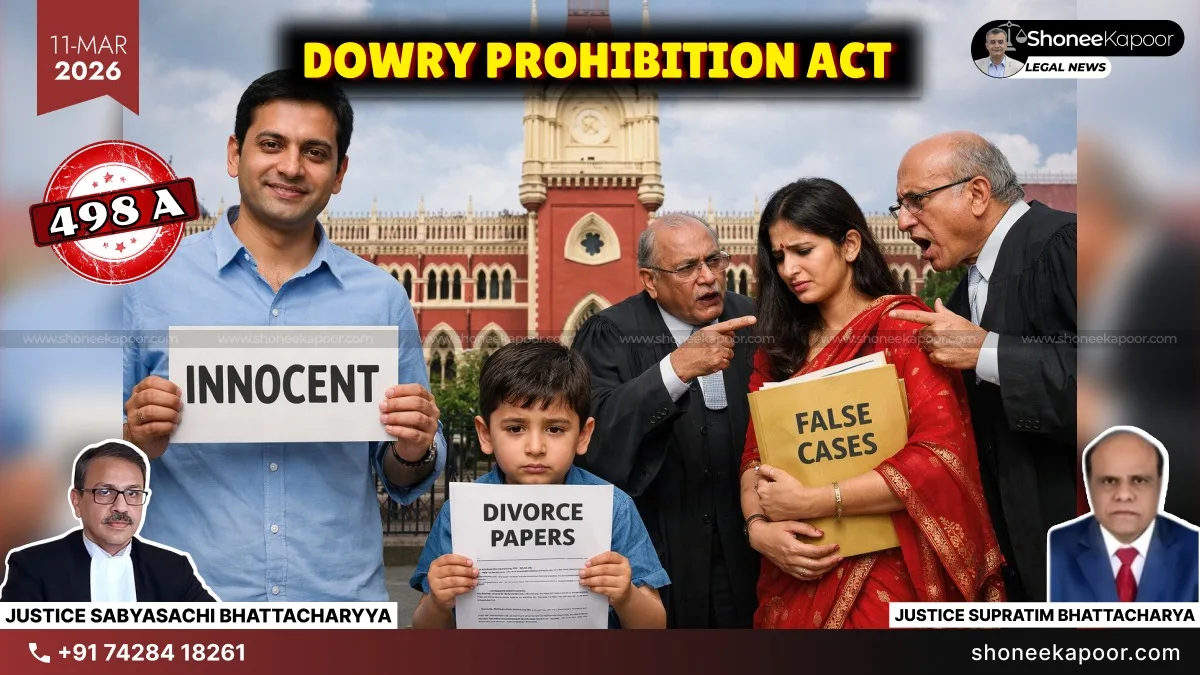
False 498A Case | Baseless Allegations Of Husband’s Affair, Attempt To Kill Child Amount To Mental Cruelty: Calcutta HC Slams Wife & Grants Divorce To Innocent Man

Curated by NEWS DESK
Editorial DeskCan baseless allegations of an affair and even trying to kill one’s own child destroy a marriage?
Calcutta High Court says reckless accusations without proof can amount to mental cruelty and grant divorce.
False 498A Case: The Calcutta High Court ruled that baseless and serious allegations made by one spouse against the other without evidence can amount to mental cruelty and can become a valid ground for divorce.
The decision came from a Division Bench of Justice Sabyasachi Bhattacharyya and Justice Supratim Bhattacharya while hearing an appeal filed by a husband challenging a trial court order which had earlier dismissed his divorce petition.
The husband had approached the court seeking divorce on the ground of mental cruelty. However, the Additional District Judge at Khatra in Bankura district had rejected his plea, saying he failed to prove cruelty by his wife.
The husband then challenged this decision before the High Court. He argued that the trial court ignored the serious allegations made by the wife in her written statement, even though those accusations were not supported by any evidence.
In her written statement, the wife made several serious claims. She alleged that the husband’s family attempted to kill their second daughter after her birth and also accused the husband of having an extramarital relationship with another woman. She further claimed that the husband circulated her mobile number among others and encouraged them to send immoral proposals to her.
Based on these allegations, the wife had also filed a criminal complaint against the husband and his family under provisions of Section 498A and Section 307 of the Indian Penal Code along with sections of the Dowry Prohibition Act.
While examining the case records and testimonies, the High Court found that the wife could not prove these allegations.
The Court pointed out a major contradiction in the wife’s own statement. She claimed that her in-laws attempted to kill the child on February 15, 2019. However, during cross-examination she admitted that she had not returned to her matrimonial home after December 15, 2018. This admission weakened her own claim regarding the alleged attempt to harm the child.
The Bench also noted that there was no independent evidence to prove the alleged extramarital affair of the husband. There were no call records, documents, or witness statements to support the claim that the husband circulated the wife’s phone number to others.
Even the testimony of the wife’s mother did not support her version fully and created further contradictions about the timeline of events.
While deciding the matter, the High Court relied on earlier judgments of the Supreme Court of India in Vijaykumar Ramchandra Bhate v. Neela Vijaykumar Bhate and K. Srinivas Rao v. D.A. Deepa.
The Court observed that reckless allegations, defamatory accusations, or indecent claims made against a spouse in legal pleadings without proof can amount to mental cruelty.
The Bench said such accusations can cause serious mental pain and social stigma not only to the spouse but also to their family members. The Court also noted that the husband was working in the Central Industrial Security Force, which is a disciplined force, and such allegations could negatively affect his professional career and reputation.
The Court also considered the fact that the couple had been living separately since December 2018 and neither side showed any willingness to continue the marriage.
Referring to the Supreme Court ruling in Rakesh Raman v. Kavita, the Bench noted that when a marriage becomes bitter and hostile over time, it can lead to cruelty for both parties.
After reviewing the entire evidence, the High Court concluded that the trial court had failed to properly consider the impact of the wife’s serious but unproven allegations.
The Court therefore allowed the husband’s appeal, set aside the judgment of the trial court, and granted a decree of divorce, legally dissolving the marriage between the parties.
Explanatory Table – Laws And Sections Involved
| Law / Section | Law Name | What It Means | Relevance In This Case |
| Section 13(1)(i-a) | Hindu Marriage Act, 1955 | Allows divorce if one spouse causes cruelty to the other | Court granted divorce on the ground of mental cruelty |
| Section 9 | Hindu Marriage Act, 1955 | Restitution of Conjugal Rights – spouse can ask court to restore marital cohabitation | Trial court wrongly expected husband to file this before divorce |
| Section 498A | Indian Penal Code | Criminal offence for cruelty by husband or his relatives | Wife filed criminal complaint under this section |
| Section 307 | Indian Penal Code | Attempt to murder | Wife alleged attempt to kill second daughter |
| Section 34 | Indian Penal Code | Liability when crime is committed with common intention | Added in the criminal case filed by wife |
| Section 3 | Dowry Prohibition Act, 1961 | Penalty for giving or taking dowry | Included in the complaint filed by wife |
| Section 4 | Dowry Prohibition Act, 1961 | Punishment for demanding dowry | Included in the police case |
Important Supreme Court Judgments Referred
| Case | Legal Principle |
| Vijaykumar Ramchandra Bhate v. Neela Vijaykumar Bhate (AIR 2003 SC 2462) | False and serious allegations in pleadings causing mental agony can amount to cruelty |
| K. Srinivas Rao v. D.A. Deepa (2013) 5 SCC 226 | Filing false complaints and defamatory allegations against spouse amounts to mental cruelty |
| Rakesh Raman v. Kavita (2023) 17 SCC 433 | Marriage that has irretrievably broken down and become bitter can itself amount to cruelty |
Case Details
| Particular | Details |
| Court | High Court at Calcutta |
| Jurisdiction | Civil Appellate Jurisdiction – Appellate Side |
| Case Title | Pintu Mahata vs Swarnalata Mahata |
| Case Number | F.A.T. No. 443 of 2023 |
| Type of Case | Matrimonial Appeal (Divorce) |
| Bench | Justice Sabyasachi Bhattacharyya and Justice Supratim Bhattacharya |
| Heard On | 19.02.2026 and 26.02.2026 |
| Reserved On | 26.02.2026 |
| Judgment Date | 09.03.2026 |
| Trial Court Order Challenged | Judgment dated 06 December 2023 |
| Trial Court | Additional District Judge, Khatra, District Bankura |
| Original Case | Matrimonial Suit No. 07 of 2020 |
| Result | Appeal Allowed – Divorce Granted |
Counsels
| Party | Advocates |
| For the Appellant (Husband) | Mr. D.K. Adhikari, Mr. Tarapada Das, Mr. Debdeep Adhikary |
| For the Respondent (Wife) | Mr. Debrup Choudhury, Mr. Arkaprabho Roy |
Bench
| Judge | Position |
| Justice Sabyasachi Bhattacharyya | Judge, Calcutta High Court |
| Justice Supratim Bhattacharya | Judge, Calcutta High Court |
Key Takeaways
- False allegations themselves can amount to mental cruelty. Courts have clearly recognised that reckless accusations of affairs, immoral conduct or serious crimes without evidence can justify divorce.
- Criminal laws meant for protection can also be misused. Sections like 498A IPC and provisions of the Dowry Prohibition Act were invoked, yet the allegations lacked supporting evidence.
- A man’s career and reputation can be severely damaged by unproven claims. In this case the husband was a CISF employee, and such allegations could have jeopardised his service in a disciplined force.
- Courts must examine pleadings carefully, not just the allegations made by one side. The High Court corrected the trial court’s failure to consider the impact of unsubstantiated accusations made against the husband.
- Marriage cannot survive when it becomes a battlefield of accusations. After years of separation and hostile litigation, the court concluded that continuing such a marriage only prolongs suffering for both parties.
This Could Change Your Case-Get FREE Legal Advice-Click Here!
Disclaimer: The views and opinions expressed in this article are those of the Indian courts and do not necessarily reflect the official policy or position of “ShoneeKapoor.com” or its affiliates. This article is intended for informational and educational purposes only. The content provided is not legal advice, and viewers should not act upon this information without seeking professional counsel. Viewer discretion is advised.
Related Articles
Karisma Kapoor – Sunjay Kapur Case Explained: Marriage, Divorce, 498A, Death & the Delhi High Court Property War
From a celebrity wedding to IPC 498A allegations, a Supreme Court-linked divorce settlement, and now a Delhi High Cou...

Adultery Patterns I See Repeatedly in Marital Cases: 8 Red Flags in a Wife, Men Shouldn’t Ignore (India)
It doesn’t begin with a confession. It begins with silence, secrecy, and small behavioural shifts most husbands dismi...

The Parliament’s Silence on Men’s Rights: When Equality Becomes a Political Risk
This article dives into India’s political silence on men’s rights uncovering why false cases, unfair maintenance, and...
Share Your Thoughts
Comments are moderated before publication.