
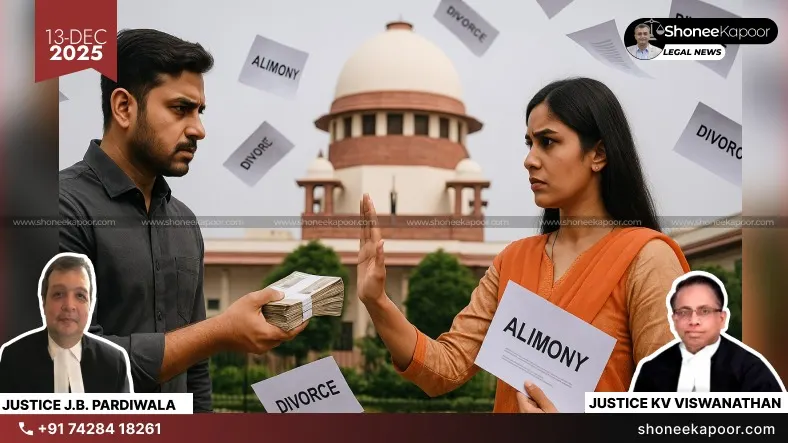
Supreme Court Praises Wife For Not Demanding Alimony In Divorce Settlement: “Rare Nowadays”

Written and analysed by Shonee Kapoor
Legal Consultant, Author & Men's Rights ActivistThe Supreme Court granted mutual consent divorce while appreciating a woman for not demanding alimony or any financial benefit. The Court called such settlements “rare nowadays” and praised her gesture as uncommon in today’s times.
NEW DELHI: The Supreme Court of India granted a divorce by mutual consent in a case that stood out for an unusual reason. The Court appreciated a woman for not demanding alimony, maintenance, or financial claim from her husband while settling the matrimonial dispute. Such conduct, the Court noted, is rarely seen in present times.
A Bench comprising Justice JB Pardiwala and Justice KV Viswanathan recorded that both parties had willingly agreed to the terms of settlement. While taking note of the agreement, the Bench described the matter as “one of the rare” cases where the wife chose not to claim anything from the husband during divorce proceedings.
Earlier, when the couple had approached the Supreme Court, the Bench had advised them to explore the possibility of an amicable settlement through mediation. Acting on this suggestion, the parties approached the Supreme Court Mediation Centre to resolve their differences peacefully.
The mediation process proved successful. The Court was later informed that the dispute had been resolved amicably and that, as part of the settlement, the wife had even returned the gold bangles that were given to her at the time of marriage. These bangles originally belonged to the husband’s mother, and their return was considered a significant gesture by the Court.
While passing the order, the Bench observed:
“This is one of the rare settlements we have come across over a period of time wherein nothing has been demanded by the wife from the husband.”
The Supreme Court further acknowledged and appreciated the conduct of the woman, highlighting how uncommon such gestures have become in matrimonial disputes today. The Bench stated:
“We appreciate this kind gesture which is very rare to be seen nowadays,”
while exercising its extraordinary powers under Article 142 of the Constitution to dissolve the marriage and grant complete justice to both parties.
Before concluding the proceedings, the Bench addressed the wife directly in open court. The judges encouraged her to move ahead in life with positivity and without carrying the burden of the past.
The Court remarked:
“This is one of the rare cases we have come across where there is no exchange of anything. We appreciate this. Go ahead in life. Forget the past. Live a happy life. Wish you the best.”
This judgment has drawn attention for highlighting a rare instance of a divorce settlement without financial demands, reinforcing the value of mutual understanding and peaceful resolution in matrimonial disputes.
Laws and Sections Involved – Explanatory Table
| Law / Provision | What It Means in Simple Terms | How It Was Used in This Case |
| Article 142 of the Constitution of India | This article gives the Supreme Court special power to pass any order necessary to do complete justice between parties, even if strict legal procedures might otherwise delay relief | The Supreme Court used Article 142 to directly dissolve the marriage after noting that both parties had settled all issues amicably and nothing further survived between them |
Case Summary
- Court: Supreme Court of India
- Bench: Justice JB Pardiwala & Justice KV Viswanathan
- Nature of Case: Divorce by mutual consent
Counsels and Mediator
- Counsel for Wife: Advocate Vrinda Bhandari
- Counsel for Husband: Advocate Sagar Pahune Patil
- Mediator: Advocate Yugandhara Pawar Jha (Supreme Court Mediation Centre)
Key Takeaways
- The Supreme Court itself called this case “rare”, clearly showing that zero-alimony settlements are an exception, not the norm, in Indian divorce litigation.
- This order exposes how financial claims have become routine in matrimonial disputes, even when marriages end by mutual consent.
- The Court’s appreciation proves that law does not mandate alimony in every case; it depends on conduct, consent, and genuine need.
- By using Article 142, the Supreme Court reaffirmed that peaceful settlement without monetary extraction deserves encouragement, not suspicion.
- This case strengthens the demand for gender-neutral divorce and maintenance laws where men are not treated as default financial providers.
This Could Change Your Case-Get FREE Legal Advice-Click Here!
Disclaimer: The views and opinions expressed in this article are those of the Indian courts and do not necessarily reflect the official policy or position of “ShoneeKapoor.com” or its affiliates. This article is intended for informational and educational purposes only. The content provided is not legal advice, and viewers should not act upon this information without seeking professional counsel. Viewer discretion is advised.
Related Articles
Legal Mistakes Men Make During Divorce: Costly Errors That Destroy Cases
Costly legal mistakes Indian men make during divorce, maintenance, custody, 498A/BNS cruelty cases and evidence colle...

Prenup for NRI Marriage in India: What Couples Must Sign Before the Wedding to Avoid Future Legal Warfare
A prenup in India is not a magic shield. For NRI marriages, enforceability depends on where and how you marry, what y...
How Is Alimony or Maintenance Calculated in Divorce Cases in India? The Real Legal Formula Courts Actually Use
Is alimony really fixed at 25% or decided randomly by courts? Or is there a deeper legal method that most people stil...
Relevant Judgements
Can an NRI Husband Be Forced to Pay Maintenance in India? Supreme Court Rules Explained for Overseas Indian Men
Living abroad does not automatically protect an NRI husband from maintenance claims in India.But can Indian courts pa...
Share Your Thoughts
Comments are moderated before publication.