
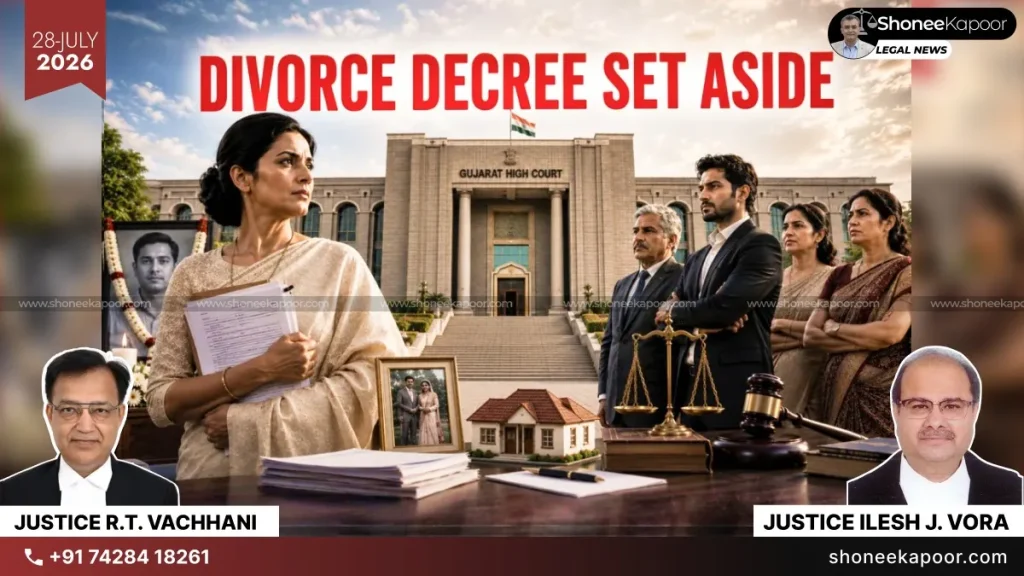
Can a divorce decree granted to a husband be cancelled even after his death, restoring the wife’s status and possible pension rights?The Gujarat High Court examined whether one statement by the wife was enough to prove that she had deserted her husband for nearly two decades.
AHMEDABAD: The Gujarat High Court has held that a wife’s right to challenge a divorce decree does not automatically end merely because her husband dies during the appeal proceedings.
The Court observed that once a divorce decree is passed, the legal status of the spouses changes from husband and wife to former spouses. Such a change may directly affect the surviving spouse’s widow status, inheritance rights, property claims and social standing.
The Division Bench of Justice Ilesh J. Vora and Justice R. T. Vachhani passed the order in an appeal filed by a wife against an ex parte divorce decree granted by the Family Court.
The parties were Christians and had married on 5 June 1976. Six children were born from the marriage. Their marital relationship later became strained.
The husband filed Family Suit No. 16 of 2020 seeking dissolution of the marriage on the grounds of desertion and the wife’s alleged withdrawal from his society.
The divorce petition was filed under Sections 10(1)(vii) and 10(1)(ix) of the law referred to in the order as the Divorce Act. Since the wife did not appear before the Family Court despite service, the proceedings continued in her absence.
The Family Court passed an ex parte divorce decree on 19 September 2022, dissolving the marriage.
The wife later challenged the judgment before the Gujarat High Court. During the pendency of the appeal, the husband died on 23 February 2024. His legal heirs were thereafter joined as respondents in the proceedings.
The principal question before the High Court was whether the wife’s appeal could continue after the husband’s death.
Appearing for the wife, AdvocateAkash Modh argued that there was no sufficient material before the Family Court to hold that she had deserted her husband or withdrawn from the matrimonial relationship.
He further argued that the appeal did not become meaningless after the husband’s death because the divorce decree continued to affect the wife’s legal status.
The counsel submitted that if the divorce decree remained in force, the wife would lose her legal status as the deceased man’s widow. This could directly affect her rights in his estate and any property held by his legal heirs.
The High Court considered the Supreme Court judgment in the case of Yallawa (Smt.) v. Shantava (Smt.), (1997) 11 SCC 159.
The Supreme Court had held that where a spouse dies after a divorce decree has already been passed, the appeal against that decree may continue because the decree has changed the parties’ legal status.
The Gujarat High Court noted that a divorce decree may have a direct impact on the spouses’ property rights and may also carry a social stigma for the affected spouse.
The Court observed that where the husband or wife dies before a divorce decree is passed, the personal cause of action may come to an end and the original proceedings may abate.
However, the legal position is different when a divorce decree has already been passed.
The Court stated that after the decree, the parties’ earlier status as husband and wife is destroyed and replaced by the status of former spouses. This change can have civil consequences beyond the matrimonial dispute itself.
The Bench observed:
“Once the decree passed, the status of the spouses gets changed and they become ex-husband and ex-wife.”
It further noted that the decree has a:
“direct impact on the property rights of the spouses”and may also attach “social stigma on the spouse concerned.”
The Court therefore held that the cause of action does not die with the deceased spouse in such circumstances.
The surviving spouse remains entitled to challenge the findings and decree passed by the Family Court, particularly where those findings may affect the estate of the deceased.
The Bench also examined the Family Court’s finding that the wife had intentionally deserted her husband.
The High Court found that the finding required interference. It noted that the wife’s rights relating to her status and possible property claims required protection.
The Court said:
“the right to sue would survive after death of any of the party to the proceedings and party concerned is entitled to challenge the findings of the court concerned.”
Considering the peculiar facts, the Court set aside the finding that the wife had intentionally deserted her husband.
The High Court consequently allowed the appeal and quashed the judgment and decree dated 19 September 2022 passed by the Family Court, Anand.
The Court passed no order as to costs.
EXPLANATORY TABLE OF LAWS AND SECTION
| Law / Section | Meaning | Application in This Case |
| Section 19, Family Courts Act, 1984 | Provides for an appeal to the High Court against certain judgments and orders of a Family Court. | The wife filed the First Appeal against the Anand Family Court’s divorce decree under this section. |
| Section 10(1)(vii), Divorce Act | The order records this provision as one of the grounds relied upon for dissolution of marriage. | The husband alleged desertion by the wife. |
| Section 10(1)(ix), Divorce Act | The order records this provision in connection with the wife’s alleged withdrawal from the husband’s society. | It formed part of the husband’s case before the Family Court. |
| Ex Parte Decree | A decree passed when one party does not appear or contest the proceedings despite service. | The Family Court granted divorce in the wife’s absence. |
| Abatement of Matrimonial Proceedings | A personal matrimonial proceeding may end if a spouse dies before the court passes a decree. | The High Court distinguished such a situation from death occurring after a divorce decree. |
| Survival of Right to Sue | A legal proceeding may continue after a party’s death when enforceable civil or property consequences remain. | The wife’s appeal survived because the divorce decree affected her status and possible rights in the deceased husband’s estate. |
| Property and Inheritance Rights | Rights that may arise in the estate of a deceased spouse. | The Court held that the divorce decree could directly affect such rights. |
| Case:Yallawa v. Shantava | Supreme Court precedent holding that an appeal against a divorce decree can survive the death of a spouse because the decree changes legal status and affects property rights. | The Gujarat High Court relied on this precedent to continue and allow the wife’s appeal. |
CASE DETAILS
| Particular | Details |
| Case Title | Dinaben Lucasbhai Macwana W/o Late Daudbhai Benardbhai Chauhan v. Daudbhai Benardbhai Chauhan Through His Proposed Legal Heirs & Others |
| Case Number | R/First Appeal No. 3127 of 2025 |
| Neutral Citation | 2026:GUJHC:42620-DB |
| Court | High Court of Gujarat at Ahmedabad |
| Date of Order | 9 July 2026 |
| Bench | Hon’ble Mr. Justice Ilesh J. Vora and Hon’ble Mr. Justice R. T. Vachhani |
| Order Authored By | Hon’ble Mr. Justice Ilesh J. Vora |
| Appellant | Dinaben Lucasbhai Macwana — Wife |
| Original Respondent | Daudbhai Benardbhai Chauhan — Husband, deceased |
| Counsel for Appellant-Wife | Mr. Aakash K. Modh, Advocate |
KEY TAKEAWAYS
- A divorce decree may still be reopened after the husband’s death if the surviving wife’s property or widow status is affected.
- The husband’s legal heirs may be forced to continue defending a matrimonial dispute even after his death.
- Men seeking divorce must ensure that allegations of desertion are supported by proper evidence and not merely one-sided statements.
- An ex parte decree may not provide lasting closure if the absent spouse later challenges it on legal or evidentiary grounds.
- Matrimonial litigation can outlive the husband and directly affect his estate, children and legal heirs.
This Could Change Your Case-Get FREE Legal Advice-Click Here!
Disclaimer: The views and opinions expressed in this article are those of the Indian courts and do not necessarily reflect the official policy or position of “ShoneeKapoor.com” or its affiliates. This article is intended for informational and educational purposes only. The content provided is not legal advice, and viewers should not act upon this information without seeking professional counsel. Viewer discretion is advised.