
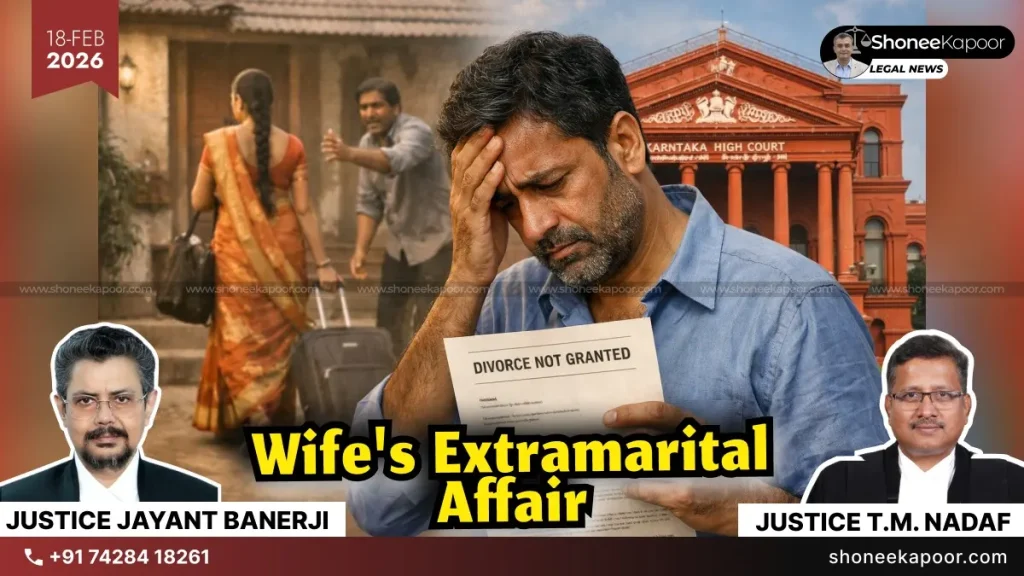
Karnataka High Court refused divorce to a husband deserted for over a decade and acquitted in a 498A case. Despite the wife’s absence, his extra marital affair allegation was treated as mental cruelty. After years of separation and acquittal, what more must a husband prove?
BENGALURU: The Karnataka High Court at Bengaluru, through a Division Bench comprising Hon’ble Mr. Justice Jayant Banerji and Hon’ble Mr. Justice T.M. Nadaf, delivered its judgment on 10 February 2026, dismissing the husband’s appeal and upholding the Family Court’s decision refusing divorce under Section 13(1)(b) of the Hindu Marriage Act.
The husband had approached the Court claiming that his wife left the matrimonial home in 2015 and never returned. He alleged that she was involved in an extra-marital relationship and had also filed a criminal case under Section 498A IPC and the Dowry Prohibition Act against him. Though he was later acquitted in the criminal case, he argued that the long separation and false case amounted to desertion and that the marriage had completely broken down.
However, the Family Court had earlier dismissed his petition stating that he failed to prove desertion. Challenging that order, the husband filed an appeal before the High Court. Even in the High Court, the wife did not appear, and an Amicus Curiae was appointed to represent her.
The High Court made it clear that simply living separately for a long period is not enough to grant divorce. The Bench clearly observed:
“It is trite that mere living separately for considerable period of time may not amount to desertion.”
The Court explained that what matters is whether there was an intention to permanently abandon the marriage without any reasonable cause.
The judges further stated that the husband failed to produce strong proof to show that the wife had deserted him with such intention. The Court also noted that allegations of extra-marital relationship were not supported by evidence. In fact, the Bench recorded that:
“Mere accusation of relationship with some other person itself is a mental cruelty and perhaps is the reasonable cause for the wife to live apart.”
On the issue of burden of proof, the Court strongly emphasized:
“It is trite that burden is always on the party who approaches the Court for the relief sought in his case and not on the weakness of other side.”
The Court also rejected the argument that acquittal in the 498A case automatically proves desertion. It held that acquittal due to lack of evidence does not by itself establish that the wife deserted the husband without cause.
Finally, after examining all materials, the Bench concluded that the husband had failed to prove the essential ingredients required under Section 13(1)(b) of the Hindu Marriage Act. As a result, the appeal was dismissed, and the Family Court’s order was upheld.
This judgment once again shows that in divorce cases based on desertion, the husband must strictly prove the intention of abandonment and cannot rely only on long separation or acquittal in criminal cases.
Explanatory Table: Laws And Sections Involved
| Law / Section | Purpose | How Applied in This Case |
| Hindu Marriage Act, 1955 – Section 13(1)(b) | Provides divorce if one spouse deserts the other for at least two continuous years without reasonable cause and without consent. | Husband sought divorce claiming wife deserted him since 2015. Court held he failed to prove intention to permanently abandon the marriage. |
| Family Courts Act, 1984 – Section 19(1) | Gives right to appeal against Family Court decisions before the High Court. | Husband filed appeal in High Court challenging dismissal of his divorce petition. |
| Indian Penal Code, 1860 – Section 498A | Penal provision dealing with cruelty by husband or his relatives towards a married woman. | Wife had filed a 498A case against husband. He was acquitted, but Court said acquittal alone does not prove desertion. |
| Dowry Prohibition Act, 1961 – Sections 3 & 4 | Section 3 punishes giving/taking dowry; Section 4 punishes demanding dowry. | These sections were invoked in the criminal case filed by the wife. The acquittal did not automatically support husband’s divorce claim. |
Case Details
- Case Title: Husband v. Wife
- Court: High Court of Karnataka at Bengaluru
- Date of Judgment: 10 February 2026
- Bench: Hon’ble Mr. Justice Jayant Banerji & Hon’ble Mr. Justice T.M. Nadaf
- Counsels:
- For Appellant (Husband): Sri K.S. Ganesha, Advocate
- For Respondent (Wife): Smt. Archana K.M., Amicus Curiae
Key Takeaways
- Long separation alone is not enough for divorce. Even if a husband is forced to live separately for years, he must still strictly prove “intention to desert” by the wife.
- Acquittal in a false 498A or dowry case does not automatically help a husband get divorce. Criminal acquittal and matrimonial relief are treated separately by courts.
- The entire burden of proof remains on the husband. Even if the wife does not appear in court, the man must independently prove every legal ingredient.
- Unproven allegations of extra-marital affairs can backfire. The Court may treat such accusations as mental cruelty against the wife if not supported by solid evidence.
- In desertion cases, men must produce clear, strong, and documented proof of both separation and deliberate abandonment. Emotional hardship or long litigation alone is not legally sufficient.
This Could Change Your Case-Get FREE Legal Advice-Click Here!
Disclaimer: The views and opinions expressed in this article are those of the Indian courts and do not necessarily reflect the official policy or position of “ShoneeKapoor.com” or its affiliates. This article is intended for informational and educational purposes only. The content provided is not legal advice, and viewers should not act upon this information without seeking professional counsel. Viewer discretion is advised.