
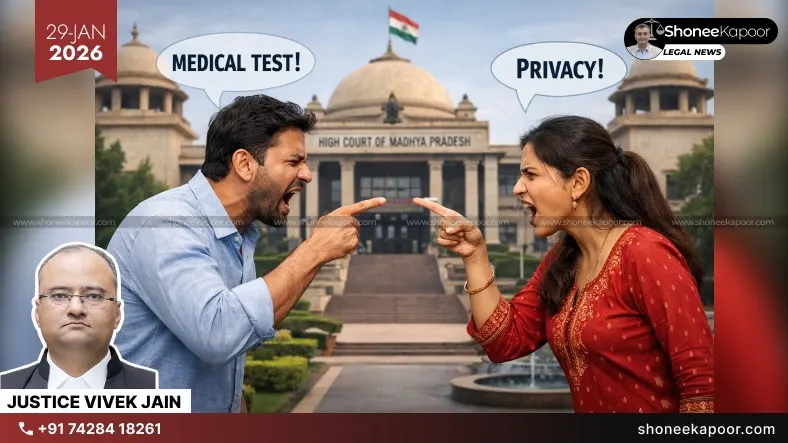
The Madhya Pradesh High Court has refused a husband’s request for medical examination of his wife, calling it an indirect virginity test. The Court ruled that such tests violate dignity and privacy and are not necessary to decide cruelty in divorce cases.
JABALPUR: The Madhya Pradesh High Court at Jabalpur refused to allow a husband to force his wife to undergo medical examination during an ongoing divorce case. The Court made it clear that such an examination, especially in matters involving alleged sex-related issues between the couple, would seriously harm a woman’s dignity and privacy and is not required to decide a case based on cruelty.
In this case, a husband had filed a divorce petition alleging cruelty. One of his main complaints was that his wife consistently refused physical relations, which according to him caused mental suffering.
The wife strongly denied this and instead accused the husband of dowry harassment, physical and mental cruelty, and even unnatural sexual acts. She also denied any claim of mental illness.
Because the wife made serious counter-allegations, the husband approached the Family Court and requested a medical examination of the wife. His purpose was to verify whether the allegations of sexual acts were true and whether any physical proof existed.
The Family Court rejected this request. The husband then moved the High Court, relying on the Supreme Court judgment in Sharda vs Dharmpal, arguing that medical examination can be ordered in matrimonial cases and privacy cannot always block truth.
The High Court analysed this argument but clarified that every case must be judged on its own facts. The Court explained that refusal of sexual relations alone is not a direct legal ground for divorce under the Hindu Marriage Act. It can only be one of the supporting factors while examining cruelty.
Since there was no allegation of impotence or any medical condition that legally required examination, the Court found no strong reason to compel medical testing.
The Court also observed that allegations of sodomy made after many years cannot be scientifically verified through medical examination. Such testing would only cause humiliation and unnecessary intrusion into a person’s body without giving reliable evidence.
Importantly, the Court made it clear that asking whether a woman has ever had sexual relations is effectively the same as demanding a virginity test. Courts across India have repeatedly held that virginity tests and two-finger tests are unscientific, unreliable, and deeply violative of human dignity.
The Court reminded that the condition of the hymen cannot prove anything, because it can remain intact even after intercourse or tear due to normal physical activities like sports.
While explaining the constitutional aspect, the Judge observed that forcing such tests amounts to invasion of privacy and dignity.
The Court noted in simple terms that such an exercise would be “nothing but invasion of privacy” and unnecessary humiliation. The Court also reminded that dignity and bodily autonomy are protected under the Constitution and cannot be sacrificed in private disputes.
This case highlights an important reality. When matrimonial disputes turn into allegation battles, truth must be established through proper evidence, not through invasive or sensational demands that violate constitutional safeguards.
At the same time, it also shows the difficulty faced by men when serious accusations are made and medical verification is legally restricted. This reinforces the urgent need for gender-neutral investigation standards, scientific evidence collection at the correct time, and accountability for false or exaggerated claims, instead of emotional litigation tactics.
The Court finally held that cruelty, if claimed, must be proved through lawful evidence such as conduct, documents, witnesses, and surrounding circumstances, not by violating personal dignity. The husband’s petition was therefore dismissed and the Family Court order was upheld.
This judgment reminds all litigants that courts will protect constitutional dignity, but it also exposes the systemic gap where delayed allegations and lack of neutral evidence mechanisms often leave genuine disputes unresolved. Real justice demands balanced laws that protect dignity while also safeguarding innocent men from misuse of matrimonial allegations.
Explanatory Table – Laws, Sections & Legal Principles Involved
| Hindu Marriage Act, 1955 – Section 11 | Declares when a marriage is void. | Court clarified that refusal of sexual relations does not make a marriage void. |
| Hindu Marriage Act, 1955 – Section 12 | Deals with voidable marriages. | Court held that this case does not fall under voidable marriage grounds. |
| Hindu Marriage Act, 1955 – Section 13 | Lists legal grounds for divorce. | Refusal of sexual relations alone is not a statutory ground for divorce. |
| Article 21 – Constitution of India | Protects life, personal liberty, dignity, and privacy. | Court held forced medical or virginity testing violates dignity and privacy. |
| Sharda vs Dharmpal (Supreme Court) | Medical examination can be ordered when absolutely necessary to prove a legal ground like impotence or mental illness. | Court distinguished this case, saying medical test here was not legally required. |
| State of Jharkhand vs Shailendra Kumar Rai (Supreme Court) | Virginity and two-finger tests are unscientific, unconstitutional, and humiliating. | Court relied on this to reject any indirect virginity testing. |
| SR Sephy vs CBI (Delhi High Court) | Virginity testing violates human dignity even for accused persons. | Used to reinforce constitutional protection of bodily integrity. |
| Lillu vs State of Haryana (Supreme Court) | Condemns two-finger test and invasive examinations. | Supported the view that such tests have no evidentiary value. |
| D.K. Basu vs State of West Bengal (Supreme Court) | Protects dignity and rights of persons in custody. | Highlighted that dignity cannot be compromised under any circumstance. |
| Sunil Batra vs Delhi Administration (Supreme Court) | Established concept of custodial dignity and humane treatment. | Cited to emphasise constitutional protection of dignity. |
| Medical Guidelines – Ministry of Health & Family Welfare | Hymen status does not prove sexual activity; two-finger test is irrelevant. | Court relied on medical science to reject virginity testing logic. |
Case Details
- Case Title: Petitioner (Husband) Versus (Respondent/Wife), M.P. No. 109 of 2026
- Court: High Court of Madhya Pradesh, Jabalpur
- Date of Order: 21 January 2026
- Bench: Hon’ble Shri Justice Vivek Jain
- Neutral Citation: 2026:MPHC-JBP:7081
- Counsels:
- For Petitioner: Mr. Mohd. Aadil Usmani, Advocate
- For Respondent: Not known
Key Takeaways
- Refusal of physical relations alone is not a legal ground for divorce, so men must rely on solid behavioural evidence instead of assumptions or emotions.
- Courts will not permit invasive medical or virginity testing, even when serious counter-allegations are made, reinforcing constitutional privacy protections.
- Delayed sexual allegations cannot be medically verified later, highlighting how false or exaggerated claims can remain legally unchecked once time passes.
- Men must document cruelty, mental harassment, communication records, witnesses, and conduct patterns early, because medical shortcuts are legally closed.
- Courts expect proof through proper legal evidence, so men must build cases smartly instead of making risky or intrusive demands that weaken their case.
This Could Change Your Case-Get FREE Legal Advice-Click Here!
Disclaimer: The views and opinions expressed in this article are those of the Indian courts and do not necessarily reflect the official policy or position of “ShoneeKapoor.com” or its affiliates. This article is intended for informational and educational purposes only. The content provided is not legal advice, and viewers should not act upon this information without seeking professional counsel. Viewer discretion is advised.