
Was there really a “institutional bias” in the investigation of Twisha Sharma’s death? Why did the Supreme Court step in directly and order urgent hearing in the matter?
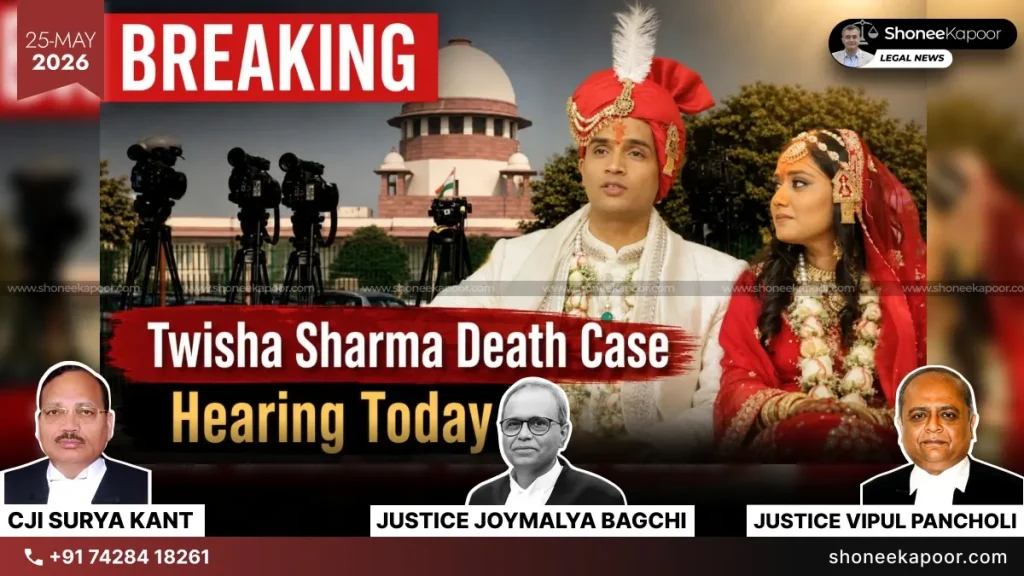
NEW DELHI: The Supreme Court has taken suo motu cognisance of the alleged dowry death case of Twisha Sharma and will hear the matter today, May 25, in a case that has now drawn nationwide attention. The case has been registered as “In Re: Alleged Institutional Bias and Procedural Discrepancies in the Unnatural Death of Young Woman at Matrimonial Home”.
The matter will be heard by a bench comprising Chief Justice of India Surya Kant, Justice Joymalya Bagchi and Justice Vipul Pancholi. The Supreme Court reportedly registered the suo motu case at around 6:30 PM on the basis of “media reports and other attending circumstances.”
Twisha Sharma’s husband Samarth Singh, a practising advocate, and her mother-in-law Giribala Singh, a former District Judge, have been accused of dowry harassment and abetment to suicide. Samarth Singh surrendered before the Trial Court after withdrawing his anticipatory bail plea from the Madhya Pradesh High Court. He has now been sent to seven-day police custody. The Madhya Pradesh Police has also approached the High Court seeking cancellation of anticipatory bail granted to Giribala Singh.
According to reports, Twisha Sharma, a 33-year-old former Miss Pune winner and model, was found dead at her husband’s residence in Bhopal’s Katara Hills area on May 12. The marriage had reportedly taken place only five months ago after the couple met through a dating application.
Twisha’s family alleged that she faced continuous domestic violence and harassment after marriage. They also sought a second post-mortem, claiming that the actual cause of death needed proper investigation. The Madhya Pradesh High Court allowed the plea for a second autopsy.
The Supreme Court today will hear the death case of Twisha Sharma, who was found hanging at her matrimonial home just months after her marriage to Samarth Singh.
The family of Twisha Sharma has further alleged that her husband and in-laws attempted to influence the investigation and mislead authorities during the probe. Samarth Singh was arrested around ten days after the incident.
Explanatory Table Of Relevant Laws & Sections
| Law / Section | Legal Provision | Meaning In Simple English | Punishment / Effect | Relevance In Present Case |
| Section 80, Bharatiya Nyaya Sanhita (Earlier 304B IPC) | Dowry Death | Applies when a married woman dies unnaturally within 7 years of marriage and cruelty for dowry is alleged soon before death | Minimum 7 years imprisonment, may extend to life imprisonment | Central allegation in this matter |
| Section 108, BNS (Earlier 498A IPC) | Cruelty by Husband or Relatives | Punishes mental or physical cruelty by husband/in-laws | Up to 3 years imprisonment and fine | Allegations of harassment and domestic violence |
| Section 45, BNS (Earlier 306 IPC) | Abetment of Suicide | Punishes a person accused of provoking or driving someone to suicide | Up to 10 years imprisonment and fine | Family alleges harassment led to death |
| Section 85, Bharatiya Sakshya Adhiniyam | Presumption in Dowry Death Cases | Court may presume involvement of husband/in-laws if cruelty linked to dowry is proved | Evidentiary presumption | Important during trial stage |
| CrPC / BNSS Provisions for Post-Mortem | Medical Examination in Unnatural Death | Allows investigation and autopsy in suspicious deaths | Investigative safeguard | Second autopsy ordered by High Court |
| Anticipatory Bail Provisions | Pre-Arrest Bail | Protection from arrest before custody | Conditional liberty | Husband withdrew plea; mother-in-law obtained interim protection |
| Suo Motu Jurisdiction of Supreme Court | Court Takes Case On Its Own | Supreme Court can intervene without formal petition in exceptional situations | Constitutional supervisory power | Basis of present proceedings |
| Article 142, Constitution of India | Complete Justice Powers | Supreme Court may pass extraordinary orders for justice | Wide constitutional authority | Could be invoked for investigation monitoring |
| Article 21, Constitution of India | Right to Life & Fair Investigation | Guarantees fair procedure and fair investigation | Fundamental Right | Central constitutional concern raised |
Case Details
- Case Title – In Re: Alleged Institutional Bias and Procedural Discrepancies in the Unnatural Death of Young Woman at Matrimonial Home
- Case Number: SMW (Crl.) 4/2026
- Court: Supreme Court of India
- Nature of Matter: Suo Motu Criminal Writ Proceedings
- Date of Hearing: 25 May 2026
- Bench: Chief Justice of India Surya Kant, Justice Joymalya Bagchi & Justice Vipul M. Pancholi
- Accused Persons Mentioned:
- Samarth Singh – Practising Advocate
- Giribala Singh – Former District Judge
Key Takeaways
- Allegation is not conviction. Yet in matrimonial death cases, husbands are socially declared criminals before trial even begins.
- The Supreme Court using the words “institutional bias” is a serious warning that investigations cannot run on media pressure and emotional narratives alone.
- Every unnatural death deserves fair investigation, but fairness also means protecting innocent family members from automatic criminal branding.
- In high-profile matrimonial cases, the husband’s side is rarely heard publicly, while media coverage often creates one-sided public perception.
- Criminal law must work on evidence, forensic findings and due process — not social pressure, gender-based assumptions or selective outrage.
This Could Change Your Case-Get FREE Legal Advice-Click Here!
Disclaimer: The views and opinions expressed in this article are those of the Indian courts and do not necessarily reflect the official policy or position of “ShoneeKapoor.com” or its affiliates. This article is intended for informational and educational purposes only. The content provided is not legal advice, and viewers should not act upon this information without seeking professional counsel. Viewer discretion is advised.