
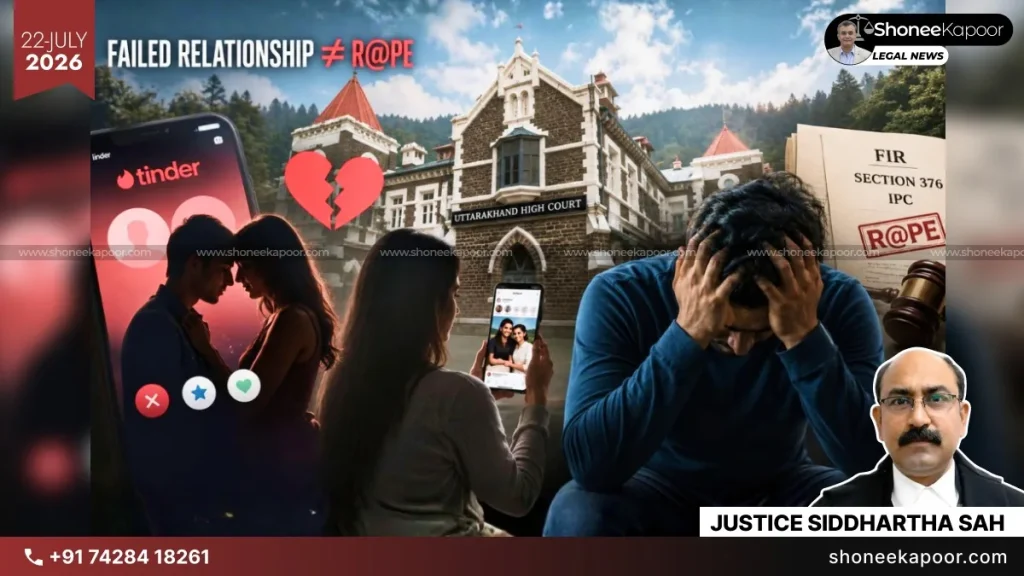
Can a consensual relationship started on Tinder later become a rape case merely because the man did not marry the woman? The Uttarakhand High Court examined whether a failed relationship can be treated as sex obtained on a false promise of marriage.
UTTARAKHAND: The Uttarakhand High Court has held that a consensual relationship between two adults cannot later be called rape merely because the relationship ended and did not result in marriage.
The Court said that when two mature adults meet through a dating application such as Tinder, voluntarily enter into a relationship and establish physical relations by mutual consent, the failure of that relationship cannot automatically attract Section 376 of the Indian Penal Code.
Justice Siddhartha Sah passed the order while hearing a petition filed under Section 482 of the Code of Criminal Procedure. The applicant had sought the quashing of criminal proceedings arising from an FIR registered against him under Section 376 IPC.
According to the FIR, the complainant met the applicant through the Tinder dating app in August 2019. They became friends and later met . The complainant stated that they consumed liquor at the applicant’s hotel and entered into a physical relationship.
She alleged that the applicant later continued having physical relations with her by repeatedly assuring her that he would marry her. She filed the rape case after discovering through Instagram that he had become engaged to another woman.
The applicant argued that Tinder is a dating platform and not a matrimonial website. He submitted that the relationship was consensual from the beginning and that the criminal case was filed only after the relationship failed.
The High Court examined the FIR and the statements recorded under Sections 161 and 164 Cr.P.C. It found that both parties had connected through Tinder, met voluntarily and entered into a physical relationship.
The Court also noted that the complainant was a mature adult who had entered into the relationship of her own choice. There was no material showing that the applicant had made a false promise of marriage at the very beginning only to obtain her consent.
The Court observed:
“the respondent no. 2 was a mature person who, out of her own free will and accord, entered into a physical relationship with the applicant. If subsequently, the relationship turns sour and did not culminate in marriage, that by itself cannot be a ground to term the relationship between the parties as one involving physical relationship on the false pretext of marriage,”
The Court held that every failed relationship cannot be converted into a criminal prosecution for rape. A later refusal or failure to marry is different from a false promise made from the very beginning with no intention of fulfilling it.
It accepted the applicant’s argument that since the parties had met through a dating app, the facts did not establish that the relationship had started because of a promise of marriage.
The High Court concluded that the allegations did not disclose an offence of physical relations established on a false promise of marriage. It further held that continuing the prosecution under Section 376 IPC would amount to an abuse of the process of law.
Accordingly, the Court allowed the application under Section 482 Cr.P.C. and quashed the entire criminal proceedings pending before the Additional Chief Judicial Magistrate.
The ruling once again makes it clear that criminal law cannot be used to punish a man merely because an adult relationship ended badly. Courts must carefully distinguish between genuine sexual offences and consensual relationships that later result in disappointment, disagreement or separation.
EXPLANATORY TABLE OF LAWS AND SECTION INVOLVED
| Law and Provision | What It Means | APPLICATION IN THIS CASE |
| Section 376, Indian Penal Code, 1860 | Prescribes punishment for the offence of rape. In false-promise-of-marriage cases, the prosecution must establish that consent was obtained through deception and that the promise was false from the beginning. | The FIR was registered under Section 376 IPC. The High Court found that the allegations disclosed a voluntary relationship between two mature adults and did not establish that a false promise of marriage existed at the beginning. The proceedings were therefore quashed. |
| Section 482, Code of Criminal Procedure, 1973 | Gives the High Court inherent power to prevent abuse of the court process and to secure the ends of justice. | The applicant invoked this provision to seek quashing of the rape case. The Court held that continuing the prosecution despite the absence of the essential ingredients of Section 376 IPC would amount to an abuse of the process of law. |
| Section 161, Code of Criminal Procedure, 1973 | Allows the investigating police officer to examine persons acquainted with the facts of the case and record their statements during investigation. | The Court considered the complainant’s statement recorded during the police investigation. It found that the parties had met voluntarily through Tinder and entered into the relationship willingly. |
| Section 164, Code of Criminal Procedure, 1973 | Permits a Judicial Magistrate to record a statement or confession during an investigation. Such a statement carries greater procedural significance than an ordinary police statement. | The complainant’s judicial statement was examined along with the FIR and the Section 161 statement. The material indicated a voluntary relationship rather than physical relations caused by coercion or deception. |
| Section 19, Indian Contract Act, 1872 | Provides that an agreement is voidable when consent is caused by coercion, fraud or misrepresentation. | The judgment referred to the principle while examining whether the complainant’s consent was affected by fraud or misrepresentation. The available judgment record indicates that the relationship was considered free from such factors. |
CASE DETAILS
| Particular | Details |
| Case Title | Ankush Sehgal v. State of Uttarakhand and Another |
| Case Number | Criminal Miscellaneous Application No. 1248 of 2022 |
| Case Type | Application under Section 482 of the Code of Criminal Procedure |
| Court | High Court of Uttarakhand at Nainital |
| Neutral Citation | 2026:UHC:5936 |
| Bench | Hon’ble Justice Siddhartha Sah |
| Date of Judgment | 16 July 2026 |
| Counsel for Applicant | Mr. Pankaj Kumar Sharma |
| Counsel for State | Mr. Rakesh Kumar Joshi, learned AGA, assisted by Mr. M.C. Bhatt, learned Brief Holder |
| Counsel for Respondent No. 2 | Mr. Rajendra Arya, Legal Aid Counsel |
KEY TAKEAWAYS
- A consensual relationship cannot be converted into rape merely because the man later refuses to marry or gets engaged elsewhere.
- The law must distinguish between a false promise made from the beginning and a relationship that genuinely failed later. Every breakup is not a criminal offence.
- A rape case can destroy a man’s reputation, career, family and liberty even before trial. Courts must intervene when the basic ingredients of the offence are missing.
- An adult woman’s voluntary choices cannot be erased retrospectively only because the relationship ended against her expectations. Consent cannot change after a breakup.
- Weaponising Section 376 after a failed relationship is not justice. It punishes an innocent man, misuses the criminal process and weakens the credibility of genuine rape cases.
This Could Change Your Case-Get FREE Legal Advice-Click Here!
Disclaimer: The views and opinions expressed in this article are those of the Indian courts and do not necessarily reflect the official policy or position of “ShoneeKapoor.com” or its affiliates. This article is intended for informational and educational purposes only. The content provided is not legal advice, and viewers should not act upon this information without seeking professional counsel. Viewer discretion is advised.