
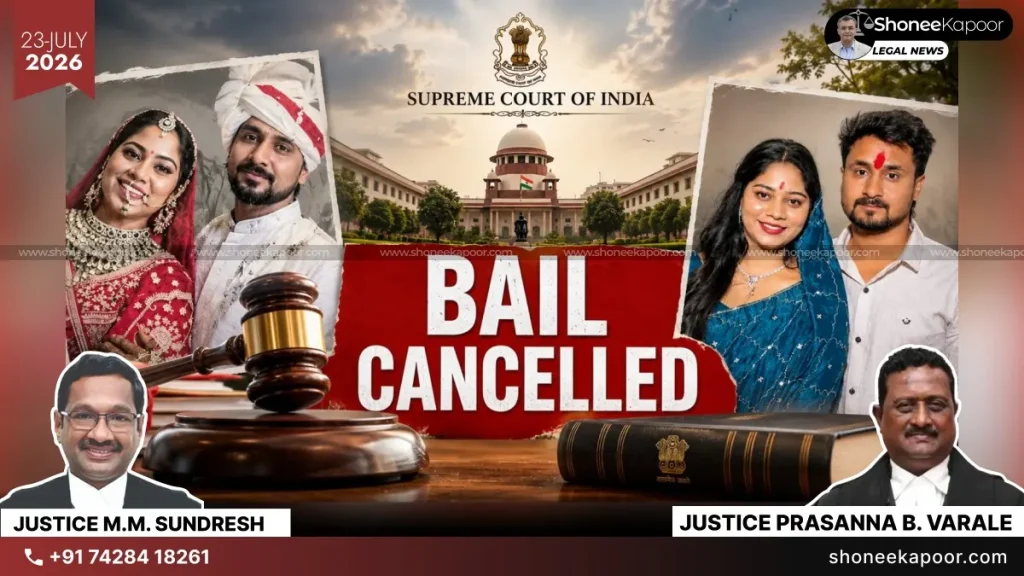
Should a technical mistake in an arrest memo overshadow the alleged planned murder of a husband? The Supreme Court held that a clerical error cannot outweigh the gravity of the allegations and directed Sonam Raghuvanshi to surrender within three weeks.
NEW DELHI: The Supreme Court has cancelled the bail granted to Sonam Raghuvanshi, the main accused in the alleged murder of her husband, Raja Raghuvanshi, during their honeymoon in Meghalaya, holding that a mere clerical error in the arrest documents could not justify her continued release. The Court has directed her to surrender before the trial court within three weeks.
A Bench comprising Justice M.M. Sundresh and Justice P.B. Varale allowed the appeal filed by the State of Meghalaya, setting aside the orders of the trial court and the Meghalaya High Court that had granted her bail.
The Supreme Court, while allowing the State of Meghalaya’s appeal,observed
“We are inclined to observe that the continued enlargement of the respondent will hinder the ongoing trial.”
The Supreme Court held that the High Court committed an error in treating the mention of “Section 403” instead of Section 103 of the Bharatiya Nyaya Sanhita (BNS) in the arrest memo as a sufficient ground to release an accused facing allegations of a planned murder.
The Supreme Court observed that the object of informing an arrested person of the grounds of arrest is to ensure fairness and prevent arbitrary detention, but every typographical or clerical mistake cannot automatically invalidate an arrest or justify bail.
According to the Court, the accused was fully aware that she had been arrested in connection with the alleged murder of her husband and had actively participated in the subsequent proceedings.
The Bench also questioned why Sonam had never raised the issue of non-communication of arrest grounds before the Magistrate or during her earlier bail applications.
The Court noted that the objection regarding the incorrect section was raised only at a much later stage and appeared to be an afterthought.
Consequently, the Supreme Court concluded that the High Court had attached disproportionate importance to a technical defect while overlooking the seriousness of the allegations and the stage of the criminal trial.
Accordingly, the Court cancelled Sonam’s bail and directed her to surrender before the concerned trial court within three weeks.
The trial court and later the Meghalaya High Court had granted bail mainly because:
- the arrest memo repeatedly referred to Section 403 BNS, which does not exist;
- the courts believed this indicated non-application of mind;
- they held that proper grounds of arrest had not been communicated in accordance with Article 22(1) of the Constitution.
The Supreme Court disagreed with the High Court for several reasons:
- The Court held that mentioning an incorrect section number by itself does not establish that the accused was unaware of the allegations.
- The constitutional requirement is that the accused must know why she is being arrested.
- Minor clerical mistakes cannot override the substance of the arrest if the allegations were otherwise communicated.
- The Court found it significant that Sonam did not raise the issue immediately before the Magistrate or during her earlier bail applications.
- The Court observed that allegations involve a planned conspiracy to murder the husband.
EXPLANATORY TABLE OF LAWS AND SECTION
| LAW / PROVISION | WHAT IT PROVIDES | RELEVANCE TO THIS CASE |
| Article 22(1), Constitution of India | Every arrested person must be informed of the grounds of arrest. | Sonam argued that the wrong section number meant proper grounds were not supplied. |
| Section 103, Bharatiya Nyaya Sanhita, 2023 | Punishment for murder. | The substantive offence alleged against the accused. |
| Section 3(6), BNS | Common intention. | Relevant because prosecution alleges multiple accused acted together. |
| Section 238(a), BNS | Causing disappearance of evidence. | Allegedly applicable because Raja’s body was thrown into a gorge. |
| Article 136, Constitution | Supreme Court’s power to hear Special Leave Petitions. | Meghalaya challenged the High Court bail order through this provision. |
| “Section 403(1), BNS” | No such section exists in the Bharatiya Nyaya Sanhita in the form mentioned in the arrest documents. | The arrest memo and other documents allegedly mentioned Section 403(1) instead of Section 103(1). The High Court treated the repeated mistake as evidence of non-application of mind and ineffective communication of the grounds of arrest. |
| Bail | Temporary release of an accused from custody subject to conditions while investigation or trial continues. Bail is not an acquittal and does not decide guilt or innocence. | Sonam was released on bail because the courts below found defects in the communication of the grounds of arrest and now the Supreme Court cancelled Bail and ordered her to surrender. |
CASE DETAILS
| PARTICULAR | DETAILS |
| Case Title | State of Meghalaya v. Sonam Raghuvanshi @Bitti @Bittu |
| Court | Supreme Court of India |
| Bench | Justice M.M. Sundresh & Justice P.B. Varale |
| Petitioner | State of Meghalaya |
| Person Allegedly Murdered | Raja Raghuvanshi, husband of Sonam Raghuvanshi |
| Main Accused Named in Reports | Sonam Raghuvanshi |
| Other Principal Accused Named | Raj Kushwaha, described by the prosecution as Sonam’s alleged lover |
| Respondent | Sonam Raghuvanshi @Bitti @Bittu |
| Nature of Proceedings | Appeal against grant of bail |
| Alleged Victim | Raja Raghuvanshi |
| Alleged Co-Accused | Raj Kushwaha and others |
| Impugned High Court Order | Meghalaya High Court order dated June 29, 2026, upholding the trial court’s order granting bail |
| Direction Issued | Surrender within two weeks |
| Present Status | Sonam required to surrender within 3 weeks ; trial to continue |
KEY TAKEAWAYS
- A husband’s right to justice cannot be defeated by technical loopholes in serious criminal cases.
- Constitutional protections must safeguard liberty and not become shields against prosecution in grave offences.
- Justice demands equal concern for male victims and not just the procedural rights of the accused.
- Higher courts can overturn bail where it is granted solely on technical or clerical defects.
- Raja Raghuvanshi and his family deserves a full and fair trial, and the truth must be determined on evidence rather than procedural technicalities.
This Could Change Your Case-Get FREE Legal Advice-Click Here!
Disclaimer: The views and opinions expressed in this article are those of the Indian courts and do not necessarily reflect the official policy or position of “ShoneeKapoor.com” or its affiliates. This article is intended for informational and educational purposes only. The content provided is not legal advice, and viewers should not act upon this information without seeking professional counsel. Viewer discretion is advised.