
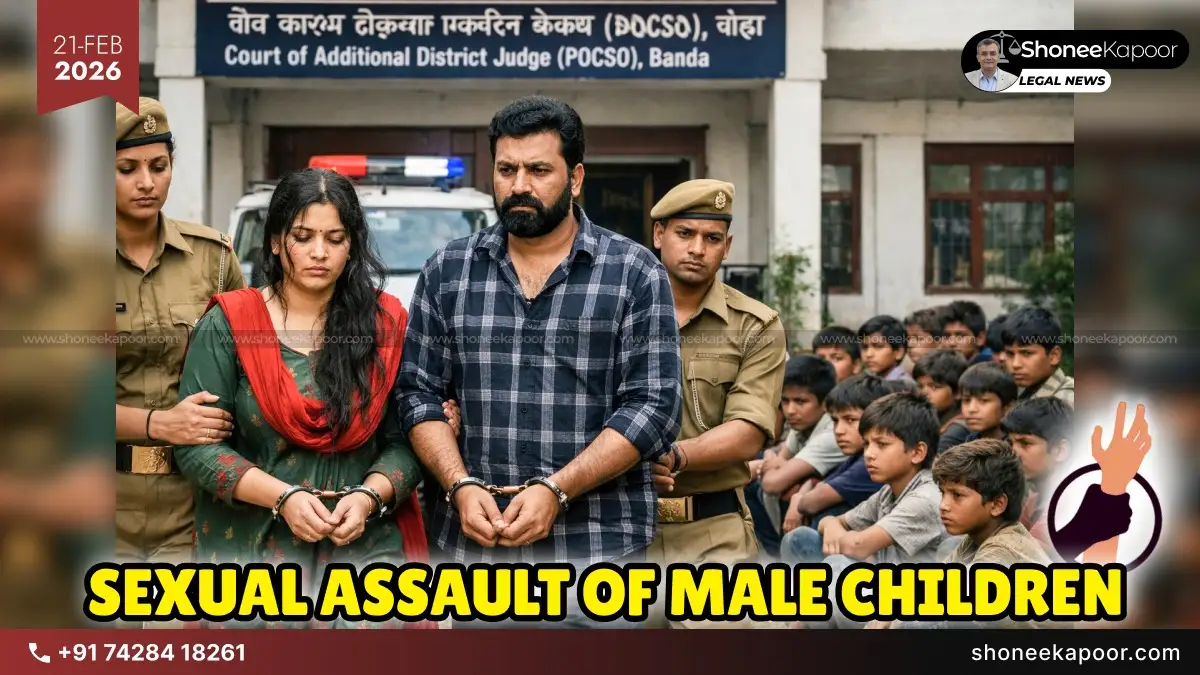
Dark Web And Sexual Assault Of 33 Minor Boys: POCSO Court Sentences Two Child Predators To Death

Written and analysed by Shonee Kapoor
Legal Consultant, Author & Men's Rights ActivistOver a decade, 33 minor boys were allegedly groomed, abused, and exploited in Uttar Pradesh. The Special POCSO Court’s death sentence verdict exposes a disturbing pattern many failed to notice for years.
Sexual Assault 33 Boys: A Banda court in Uttar Pradesh on 20 February 2026 sentenced two convicts, Rambhawan and his wife Durgawati, to death after finding them guilty in a serious child abuse case involving 33 minor boys.
The case was investigated by the Central Bureau of Investigation (CBI) and included offences under the Indian Penal Code and the Protection of Children from Sexual Offences (POCSO) Act, along with charges relating to exploitation of children for pornographic material, criminal conspiracy, and related digital offences.
The matter dates back to 2020, when the CBI registered a case against Rambhawan and unidentified persons based on allegations of systematic abuse of children and the circulation of illegal child exploitation material online. During the investigation, authorities found that the accused had operated for a long period, from 2010 to 2020, in the Banda and Chitrakoot regions of Uttar Pradesh.
Investigators reported that the accused allegedly used inducements such as access to online video games, gifts, and money to attract children. Rambhawan, who worked as a Junior Engineer in the Department of Irrigation, was found to have played a central role in the criminal acts, while his wife was held responsible for aiding and participating in the offences.
The investigation further revealed that several victims suffered physical and psychological harm, with some requiring medical treatment and counselling support. Authorities emphasised that sensitive procedures were followed while recording statements of minor victims, including coordination with child protection agencies, medical professionals, and forensic experts. Digital evidence was carefully preserved as part of the prosecution case.
Following completion of the investigation, the CBI filed a chargesheet on 10 February 2021, and formal charges were framed on 26 May 2023. After trial and evaluation of the evidence, the court concluded that the crimes were exceptionally grave due to their organised nature, duration, and the number of victims affected.
While awarding the maximum punishment, the court described the acts as “rarest of rare” and highlighted the extreme severity and moral depravity involved.
The court observed that the systematic exploitation of multiple children across districts demonstrated such serious criminality that it left no possibility of reform and warranted the strongest judicial response.
In addition to the death sentence, the trial court directed the Uttar Pradesh government to provide compensation of ₹10 lakh to each victim. The court also ordered that money seized from the residence of the convicts be distributed equally among the victims as additional relief.
This case is a painful reminder that child safety cannot be viewed through a one-sided lens. Not only girls, but boys too are vulnerable and require equal protection, care, and institutional support.
Crimes against male children often remain underreported due to stigma and social silence. As a society and as lawmakers, child protection and its implementation must be gender-neutral in spirit. Every child, regardless of gender, deserves safety, dignity, and equal protection under the law.
Explanatory Table: Laws And Sections Involved
| Law / Section | Purpose | How It Applies In This Case |
| IPC Section 377 | Criminalizes unnatural sexual offences and protects bodily integrity, especially of minors | Invoked due to allegations involving prohibited sexual acts against minor victims |
| IPC Section 120B | Punishes criminal conspiracy where multiple persons plan or execute unlawful acts together | Applied as the offences were allegedly committed jointly by the accused in a coordinated manner |
| IT Act Section 67B | Penalizes creation, storage, transmission, or viewing of child sexual abuse material in electronic form | Used because investigation indicated digital exploitation and circulation/storage of illegal child material |
| POCSO Section 6 | Provides punishment for aggravated penetrative sexual assault on minors | Invoked due to the seriousness and aggravated nature of alleged offences against children |
| POCSO Section 5(c) | Defines aggravated assault where offender holds trust, authority, or influence over child | Applied because the accused allegedly used trust and proximity to gain access to children |
| POCSO Section 5(l) | Covers repeated sexual assault on a child | Invoked due to allegations of continued and repeated abuse over a long period |
| POCSO Section 5(m) | Addresses assault resulting in grievous injury or serious harm | Applied considering medical and psychological harm reported during investigation |
| POCSO Section 5(n) | Covers assault involving multiple perpetrators or organized pattern | Invoked as allegations suggest joint participation and systematic conduct |
| POCSO Section 14 | Criminalizes use of child for pornographic purposes | Applied due to allegations relating to exploitation of children in pornographic material |
| POCSO Section 15 | Punishes storage of pornographic material involving children | Invoked based on recovery of digital evidence indicating possession/storage |
| POCSO Section 17 | Punishes abetment of offences under POCSO | Applied against co-accused for aiding, facilitating, or participating in the offences |
Case Details
- Case Title: State Govt. of U.P. vs Rambhawan and Other Unknown Persons
- Court: Court of Additional District Judge (POCSO), Banda
- Case No.: Sessions Case 251/2021
- Judge: PK Mishra, ADJ (POCSO)
- Investigating Agency: Central Bureau of Investigation (CBI) with Interpol assistance
- Date of Judgment: 20 February 2026
- Prosecution Counsel: Special Public Prosecutor Kamal Singh Gautam
Key Takeaways
- Child abuse is not gender-specific. Boys are equally vulnerable, yet their suffering is often ignored due to social stigma and silence.
- Society must accept that male children also need structured protection, counselling support, and equal recognition under child protection frameworks.
- Crimes against boys are underreported because masculinity stereotypes discourage victims from speaking out.
- Law enforcement and judiciary must implement child protection laws in a gender-neutral and unbiased manner.
- Real child safety begins when we protect every child equally, without assuming that only girls are at risk.
This Could Change Your Case-Get FREE Legal Advice-Click Here!
Disclaimer: The views and opinions expressed in this article are those of the Indian courts and do not necessarily reflect the official policy or position of “ShoneeKapoor.com” or its affiliates. This article is intended for informational and educational purposes only. The content provided is not legal advice, and viewers should not act upon this information without seeking professional counsel. Viewer discretion is advised.
Related Articles
Supreme Court Backs Romeo–Juliet Clause in POCSO, But How Many Young Men Were Destroyed Before This Wake-Up Call?
The Supreme Court of India has openly acknowledged rampant misuse of the POCSO Act against consensual adolescent rela...
Truth on Trial : My RTI Reveals How False Rape Complaints Have Pushed Delhi’s Conviction Rate Down to 4.3%
An RTI-based investigation uncovering the numbers, patterns, and judicial realities behind Delhi’s 4.3% rape convicti...
Share Your Thoughts
Comments are moderated before publication.