
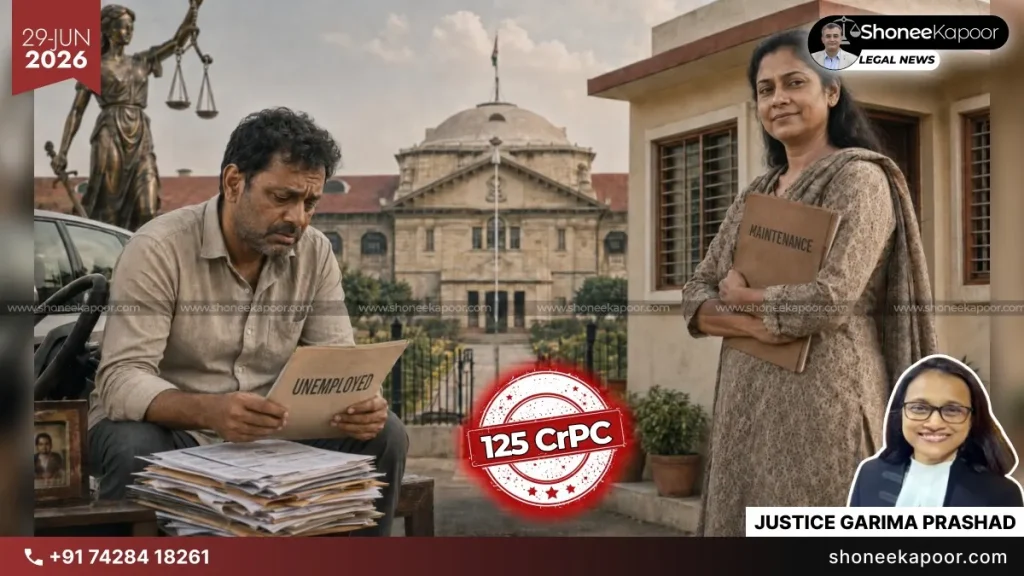
Is a welfare scheme house in wife’s name not enough to protect husband from maintenance? Allahabad High Court said yes. Even though the wife had a house allotted under a welfare scheme, the husband still remained liable to pay maintenance because the Court held that a house is not a source of livelihood.
PRAYAGRAJ: The Allahabad High Court, through Justice Garima Prashad, dismissed a husband’s criminal revision and upheld the maintenance order passed in favour of his wife under Section 125 Cr.P.C.
The husband had challenged the Family Court, Bulandshahr order directing him to pay Rs.4,000 per month from the date of filing of the case and Rs.5,000 per month from the date of the order.
The husband argued that he was illiterate, worked as a driver, earned only around Rs.5,000 per month, and was now unemployed. He also claimed that his wife was earning through sewing and embroidery work and had been allotted a house under Pradhan Mantri Awas Yojana.
The wife’s case was that their marriage took place on 03.12.2016 according to Muslim rites and customs. She alleged cruelty and harassment for additional dowry and said she was forced to leave the matrimonial home. She claimed that the husband had sufficient means but neglected and refused to maintain her.
The Family Court found that she was the legally wedded wife, was living separately for sufficient cause, and had no proved regular income to maintain herself.
The High Court said the object of Section 125 Cr.P.C. is to prevent destitution and provide quick relief to a wife who cannot maintain herself. It referred to the Supreme Court view that “unable to maintain herself” does not mean the wife must be completely destitute before claiming maintenance.
The Court also noted that maintenance law is meant to protect the dignity of the wife and that an able-bodied husband cannot avoid his duty to maintain her.
In important observations, the High Court said that:
“Mere assertions in pleadings, unsupported by satisfactory evidence, cannot be accepted as proof of financial independence.”
The Court also made it clear that:
“Allotment of a residential house under a welfare scheme cannot be treated as a source of livelihood disentitling a wife from claiming maintenance.”
Rejecting the husband’s plea of low income and unemployment, the High Court observed that:
“A husband cannot avoid his statutory obligation to maintain his wife merely by asserting that he is unemployed or earning a meagre income.”
It further held that:
“The capacity to earn and the obligation to maintain are relevant considerations while determining maintenance under Section 125 Cr.P.C.”
In this case, the High Court found that the husband had only made allegations about the wife’s income from sewing and embroidery but had not given cogent evidence to prove regular and sufficient income.
The husband’s claim of financial incapacity was also rejected. The Court noted that he was a skilled driver and an able-bodied person capable of earning.
The High Court held that Rs.4,000 per month from the filing date and Rs.5,000 per month from the order date was not excessive. Considering the cost of living, the amount was modest and justified.
The Court further said that in revision, the High Court does not re-appreciate evidence like an appeal court unless there is illegality, perversity, or serious error.
Finding no such defect in the Family Court order, the Allahabad High Court dismissed the husband’s revision and upheld the maintenance granted to the wife.
EXPLANATORY TABLE: LAWS AND PROVISIONS INVOLVED
| Law / Provision | Purpose | Relevance In This Case |
| Section 125 Cr.P.C. | Maintenance remedy for wife, children, or parents unable to maintain themselves. | Wife claimed maintenance under this provision. |
| Criminal Revision | Higher court checks legal error in lower court order. | Husband challenged the Family Court order. |
| Revisional Jurisdiction | Limited power; not like a full appeal. | High Court refused to re-appreciate evidence. |
| Chaturbhuj v. Sita Bai, (2008) 2 SCC 316 | Wife need not be completely destitute to claim maintenance. | Supported wife’s right to maintenance. |
| Bhuwan Mohan Singh v. Meena, (2015) 6 SCC 353 | Maintenance protects wife’s dignity. | Used to explain purpose of maintenance law. |
| Shamima Farooqui v. Shahid Khan, (2015) 5 SCC 705 | Able-bodied husband cannot avoid maintenance. | Used against husband’s unemployment plea. |
| Pradhan Mantri Awas Yojana | Government housing welfare scheme. | House allotment was not treated as income. |
CASE DETAILS
- Case Title: Mannan @ Abdul Mannan v. State of U.P. and another
- Court: High Court of Judicature at Allahabad
- Case Number: Criminal Revision No. 363 of 2024
- Neutral Citation: 2026:AHC:127679
- Date Of Judgment: 17.06.2026
- Bench: Hon’ble Justice Garima Prashad
- Counsels:
- For Revisionist: Shravan Kumar Pandey, Shyam Narain Pandey, and Balram Bind
- Counsel for State: Pradeep Kumar, learned A.G.A.
KEY TAKEAWAYS
- A husband may be unemployed, low-paid, or struggling, but in maintenance litigation, his vulnerability often takes a back seat to his “earning capacity.”
- The husband said he earned only around Rs.5,000 as a driver and was presently unemployed, yet the Court still treated him as an able-bodied man capable of earning.
- His claim that the wife earned from sewing and embroidery failed because he could not bring solid proof of her regular income.
- Even the wife’s PM Awas house was not treated as financial support, while the husband’s skill as a driver was treated as earning capacity.
- Brutal takeaway for husbands: in maintenance cases, courts may not look only at what a man is actually earning today, but what they believe he is capable of earning tomorrow.
This Could Change Your Case-Get FREE Legal Advice-Click Here!
Disclaimer: The views and opinions expressed in this article are those of the Indian courts and do not necessarily reflect the official policy or position of “ShoneeKapoor.com” or its affiliates. This article is intended for informational and educational purposes only. The content provided is not legal advice, and viewers should not act upon this information without seeking professional counsel. Viewer discretion is advised.