
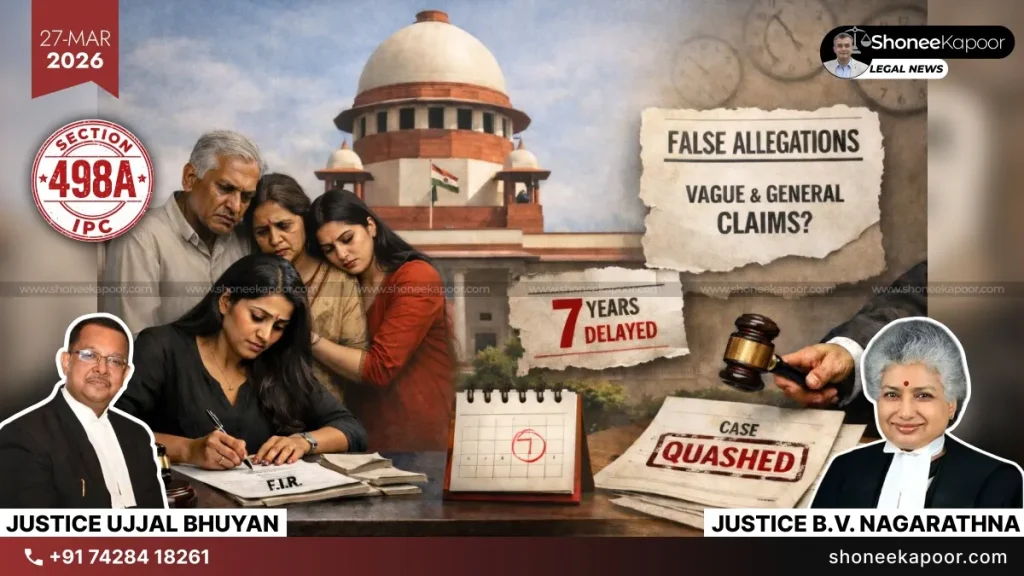
Serious criminal charges can destroy reputations and families, but the law still demands proof and credibility.
Is mere accusation under 498A, along with claims of molestation and miscarriage, enough to prosecute without documents or witnesses?
NEW DELHI: In an important judgment dated 25 March 2026, Justices B.V. Nagarathna and Ujjal Bhuyan of the Supreme Court exposed how criminal law is being misused in matrimonial disputes and gave major relief to a man’s family by quashing all proceedings against his sister and elderly parents.
The case started from an FIR filed by a wife in 2023, almost 7 years after her marriage, where she accused her husband’s family of dowry demand, harassment, assault, forced miscarriage, and even molestation. However, the Court carefully examined the record and found that most allegations were general, exaggerated, and not supported by any real evidence.
The Court clearly stated that just making statements without proof is not enough to start criminal action. It observed that a simple claim that dowry was demanded or harassment happened cannot be accepted unless there is material to support it. The long delay of more than six years in filing the complaint also raised serious doubts about the truth of the allegations.
The Court reminded that people must act on time and said, “law protects those who are vigilant about their rights”. It further highlighted that such long delays can destroy evidence and make cases unreliable.
On the serious allegation of miscarriage caused by assault, the Court noted that even medical records did not support the claim, and the police themselves dropped the charge under Section 313 IPC. This clearly showed gaps in the story presented by the complainant.
Similarly, the allegation of molestation against the father-in-law was found to be vague. The Court noted that no clear act or detail was explained, and such bald claims cannot be accepted in law without proof.
The Supreme Court strongly warned against a growing trend where entire families of husbands are dragged into criminal cases without specific roles. It quoted its earlier judgment and stated:
“A mere reference to the names of family members in a criminal case arising out of a matrimonial dispute, without specific allegations indicating their active involvement should be nipped in the bud.”
The Court went further and acknowledged misuse of law, observing:
“There has been a growing tendency to misuse provisions like Section 498A of the IPC as a tool for unleashing personal vendetta against the husband and his family”.
It made it clear that while genuine victims must be protected, false and exaggerated cases cannot be allowed to continue, especially when used as pressure tactics in marital disputes.
Applying the well-known Bhajan Lal principles, the Court concluded that the case was weak, improbable, and appeared to be filed with ulterior motives. It found that continuing such proceedings would be an abuse of the legal system.
Finally, the Supreme Court quashed the FIR, chargesheet, and entire criminal case against the sister-in-law and elderly parents-in-law, holding that forcing them to face trial would be unjust and against the interest of justice.
Explanatory Table: Laws And Provisions Involved
| Law / Provision | Purpose | How Applied in This Case |
| IPC Section 498A | Protects women from cruelty and dowry harassment by husband or his relatives | Court held allegations were vague, general, and unsupported by evidence |
| IPC Section 323 | Punishes causing hurt (physical injury) | No clear or specific proof of physical assault was shown |
| IPC Section 354 | Protects women from assault outraging modesty | Allegation against father-in-law lacked details and evidence, hence not sustained |
| IPC Section 313 | Punishes causing miscarriage without consent | Dropped due to no medical proof supporting miscarriage claim |
| Dowry Prohibition Act Section 3 | Punishes giving or taking dowry | No evidence of dowry exchange was presented |
| Dowry Prohibition Act Section 4 | Punishes demand for dowry | Court found no material proof of demand |
| State of Haryana vs Bhajan Lal (1992) | Lays guidelines for quashing FIR when case is false or abuse of law | Applied to hold case as malicious, improbable, and abuse of process |
| Dara Lakshmi Narayana vs State of Telangana (2025) | Warns against false implication of husband’s family in matrimonial disputes | Used to stress that vague allegations against relatives must not continue |
Case Details
- Case Title: Charul Shukla vs State of U.P. & Others
- Case No.: Criminal Appeal arising out of SLP (Crl.) No.555 of 2024
- Court: Supreme Court of India
- Neutral Citation: 2026 INSC 297
- Bench: Justice B.V. Nagarathna & Justice Ujjal Bhuyan
- FIR Details:
- FIR No.: 758/2023
- Police Station: Mohammadi, District Khiri, Uttar Pradesh
Key Takeaways
- False 498A cases are increasingly being used to drag entire husband’s family into criminal litigation without proof
- Vague, general and delayed allegations without evidence cannot be allowed to ruin lives of innocent family members
- Long unexplained delay in filing FIR seriously weakens credibility and indicates possible misuse of law
- Serious charges like miscarriage or molestation must be backed by medical or concrete evidence, not mere statements
- Criminal law cannot be used as a pressure tool in matrimonial disputes; misuse will lead to quashing of proceedings
This Could Change Your Case-Get FREE Legal Advice-Click Here!
Disclaimer: The views and opinions expressed in this article are those of the Indian courts and do not necessarily reflect the official policy or position of “ShoneeKapoor.com” or its affiliates. This article is intended for informational and educational purposes only. The content provided is not legal advice, and viewers should not act upon this information without seeking professional counsel. Viewer discretion is advised.