
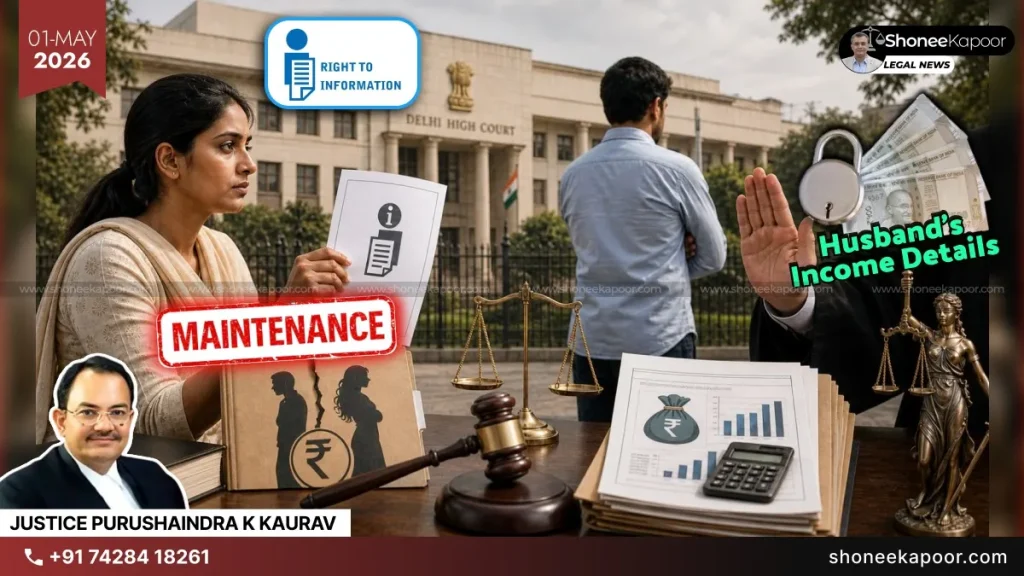
Can RTI be used as a tool in maintenance cases to access a man’s personal financial data?
The Delhi High Court held that such information cannot be accessed through RTI and must be disclosed only through the proper legal process before the concerned court.
NEW DELHI: The Delhi High Court, through Justice Purushaindra Kumar Kaurav, delivered an important judgment reinforcing that personal financial information cannot be accessed through RTI in matrimonial disputes.
The dispute arose from a matrimonial maintenance proceeding where the wife attempted to obtain the husband’s income tax details by invoking the RTI mechanism. The issue before the Court was not merely about access to information, but whether such personal financial data could be compelled to be disclosed under the RTI framework in a private dispute.
While examining the statutory position, the Court analysed Section 8(1)(j) of the RTI Act and reproduced the provision as follows:
“8(1)(j) information which relates to personal information the disclosure of which has no relationship to any public activity or interest, or which would cause unwarranted invasion of the privacy of the individual unless the Central Public Information Officer or the State Public Information Officer or the appellate authority, as the case may be, is satisfied that the larger public interest justifies the disclosure of such information.”
Applying this provision to the facts, the Court found that income tax details of an individual clearly fall within the scope of “personal information” and are ordinarily protected from disclosure. It further held that a private maintenance dispute does not satisfy the threshold of “larger public interest” so as to override the statutory protection of privacy under the RTI Act.
The Court made it clear that personal information enjoys strong protection and cannot be casually disclosed. Relying on the principle laid down in Girish Ramchandra Deshpande v. Central Information Commissioner, the Court reaffirmed that income tax details fall within the category of personal information and are ordinarily exempt from disclosure.
It observed that the general rule under the law is that such information remains private unless there is a genuine public interest involved, and matrimonial disputes cannot be treated as such.
The Court further clarified the scope of “larger public interest” and cautioned against its misuse, noting that RTI was designed to ensure transparency in public authorities and not to expose personal data of individuals. It held that expanding this concept to private disputes would defeat the purpose of the law.
Addressing the contention that income details are required for deciding maintenance, the Court relied on the established legal framework laid down in Rajnesh v. Neha and observed that:
“Both parties in a maintenance claim are required to file affidavits of their income, assets, and liabilities, in order to enable proper adjudication of such claim.”
The Court emphasized that the wife is not without remedy and that the appropriate course to obtain financial details is through affidavits filed before the court dealing with the maintenance proceedings, and not by invoking the RTI mechanism.
Concluding the matter, the High Court held that directing disclosure of income tax details through RTI in such circumstances is legally unsustainable. The ruling firmly establishes that personal financial data remains protected, and matrimonial litigation cannot be used as a tool to bypass privacy safeguards under the RTI Act.
Explanatory Table: Laws & Provisions Involved
| Law / Provision | Purpose | How Applied in This Case |
| Section 8(1)(j), Right to Information Act, 2005 | Protects personal information from disclosure unless larger public interest exists | Court held income tax details are personal information and cannot be disclosed in absence of public interest |
| Right to Information Act, 2005 (RTI Act) | Ensures transparency in functioning of public authorities | Court clarified RTI cannot be misused to access private data in matrimonial disputes |
| Supreme Court Judgment in Girish Ramchandra Deshpande v. Central Information Commissioner | Declares income tax returns as personal information exempt from RTI disclosure | Relied upon to reinforce that income details are protected under privacy exemption |
| Supreme Court Judgment in Rajnesh v. Neha | Mandates disclosure of financial details through affidavits in maintenance cases | Court held proper remedy is filing affidavits in maintenance proceedings, not RTI |
Case Details
- Case Title: Kapil Agarwal v. CPIO Income Tax Officer Moradabad & Anr.
- Court: Delhi High Court
- Case Number: W.P.(C) 8481/2021 & CM APPL. 26235/2021
- Bench: Justice Purushaindra Kumar Kaurav
- Date of Decision: 28 April 2026
- Neutral Citation: 2026:DHC:3705
- Counsels:
- For Petitioner: Mr. Vineet Sinha, Ms. Ankita Gupta, Advocates
- For Respondents: Mr. Manish Raghav, Mr. Prakash Srivastava, Mr. Rajan Thakur, Ms. Smriti Dubey, Advocates
Key Takeaways
- RTI cannot be misused to extract a man’s personal financial data in matrimonial disputes—privacy protection is upheld.
- Income tax details are clearly classified as personal information and cannot be disclosed without genuine public interest.
- Maintenance claims cannot override a man’s right to privacy by using indirect legal tools like RTI.
- Proper legal route is financial affidavits in court, ensuring both parties disclose equally—not one-sided exposure.
- Legal processes must remain balanced and cannot be weaponised to pressure men through misuse of transparency laws.
This Could Change Your Case-Get FREE Legal Advice-Click Here!
Disclaimer: The views and opinions expressed in this article are those of the Indian courts and do not necessarily reflect the official policy or position of “ShoneeKapoor.com” or its affiliates. This article is intended for informational and educational purposes only. The content provided is not legal advice, and viewers should not act upon this information without seeking professional counsel. Viewer discretion is advised.