
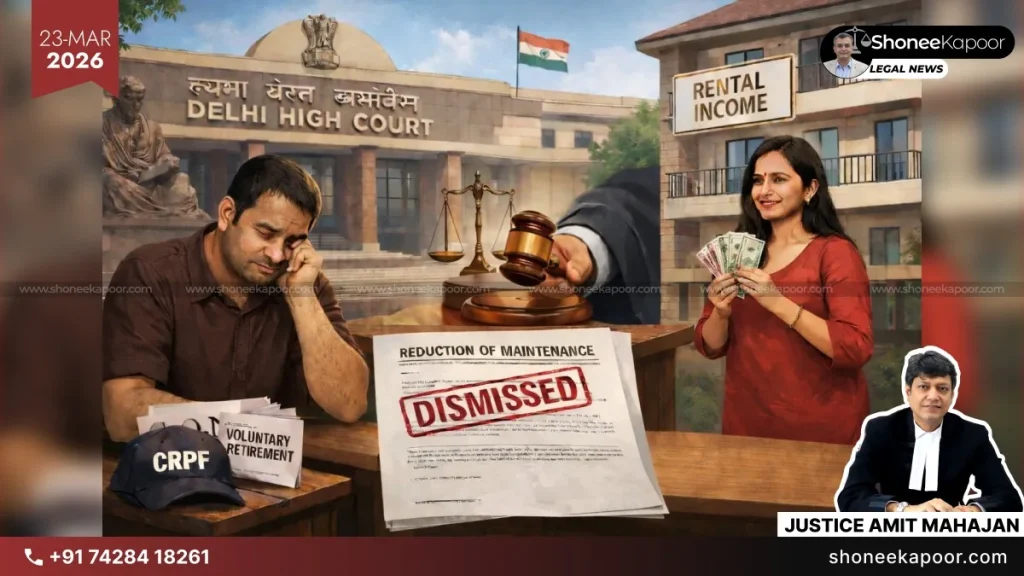
Despite retirement and reduced income, husband remains financially liable, as highlighted by the Delhi High Court.
Do the Courts prioritize declared income or earning ability while deciding maintenance?
NEW DELHI: The Delhi High Court, in a judgment delivered by Justice Amit Mahajan, dismissed a husband’s plea seeking reduction of maintenance payable to his wife and children, reinforcing that financial responsibility cannot be avoided by voluntary retirement or underreporting income.
The husband, a former CRPF employee, argued that he had limited income after retirement and that his wife was earning rental income and had chosen to live separately. However, the Court found no sufficient proof of substantial income on the wife’s part and held that small rental earnings do not make a woman self-sufficient.
The Court reiterated the legal position under Section 125 CrPC, referring to judgments such as Chaturbhuj v. Sita Bai and Anju Garg v. Deepak Kumar Garg, emphasizing that maintenance is meant to prevent destitution and that an able-bodied man cannot escape his duty to maintain his family.
On the issue of income, the Court rejected the husband’s attempt to show reduced earnings after voluntary retirement. It observed that quitting a stable job without valid justification cannot be used as a ground to reduce maintenance and noted a pattern where parties may suppress true income in matrimonial disputes.
The Court clearly stated:
“Just as employed wives allegedly leave their jobs to gain an upper hand in maintenance disputes, quitting of jobs is similarly a common strategy adopted by well-qualified husbands to avoid paying proper amount of maintenance as well.”
Further, the Court held:
“It appears to be implausible that the petitioner would have taken retirement from his stable well-paying job without securing any other mode of income.”
Rejecting the claim of financial incapacity, the Court observed:
“Any assertion of the petitioner having no source of income apart from his pension pursuant to retirement cannot be accepted.”
The Court also emphasized the obligation to earn and maintain family, stating: “The petitioner is thus obliged to earn and maintain his family.”
Based on overall assessment, including past salary, pension, and earning potential, the Court upheld the income estimation of around ₹50,000 per month and found the maintenance awarded to be reasonable.
The petition was dismissed, and the maintenance order remained unchanged.
Explanatory Table: Laws & Provisions Involved
| Law / Section | Purpose | How Applied In This Case |
| Section 125 CrPC | Law for maintenance to wife, children, parents | Court said it ensures financial support and prevents dependency |
| Conditions under Section 125 CrPC | Wife may not get maintenance if adultery, refusal to live without reason, or mutual separation | Court examined but found wife’s case valid due to allegations of cruelty |
| Article 15(3) Constitution | Allows special laws for women and children | Used to justify protective nature of maintenance law |
| Article 39 Constitution | State should ensure livelihood and support | Reinforces purpose of maintenance provisions |
| Chaturbhuj v. Sita Bai | Maintenance is for survival, not punishment | Court relied on this to justify continuation of maintenance |
| Anju Garg v. Deepak Kumar Garg | Husband must earn even by labour if able-bodied | Used to reject husband’s claim of no income |
| Bharat Hegde v. Saroj Hegde | Court can estimate income if not disclosed properly | Court used this to justify income “guess work” |
| Annurita Vohra v. Sandeep Vohra | Income division principles in maintenance | Court corrected wrong allocation to mother |
Case Details
- Case Title: Vinod Kumar vs Seema Devi & Anr.
- Case Number: CRL.REV.P. 452/2023 with CRL.M.A. 10546/2023, 10548/2023, 23663/2025
- Court: High Court of Delhi at New Delhi
- Bench: Hon’ble Mr. Justice Amit Mahajan
- Neutral Citation: 2026:DHC:2170
- Dates:
- Judgment Reserved On: 19.12.2025
- Judgment Pronounced On: 16.03.2026
- Counsels:
- For Petitioner (Husband): Mr. Gurpreet Singh, and Ms. Vaishnavi Vashishta
- For Respondents (Wife & Others): Mr. Deepak Garg, Mr. Mohan Singh, Mr. Sachin Kumar, Ms. Vishakha Deswal, and Mr. Robin Singh
Key Takeaways
- Court ignored actual income and focused on “earning capacity”, putting burden on husband even after retirement.
- Voluntary retirement treated negatively, assuming men reduce income deliberately to avoid maintenance.
- Wife’s independent income (rent, separate residence) not given real weight while deciding entitlement.
- Even without proof of higher income, Court used “guess work” to increase financial liability on husband.
- Long-term financial obligation imposed on husband, with little consideration of changing financial realities.
This Could Change Your Case-Get FREE Legal Advice-Click Here!
Disclaimer: The views and opinions expressed in this article are those of the Indian courts and do not necessarily reflect the official policy or position of “ShoneeKapoor.com” or its affiliates. This article is intended for informational and educational purposes only. The content provided is not legal advice, and viewers should not act upon this information without seeking professional counsel. Viewer discretion is advised.