
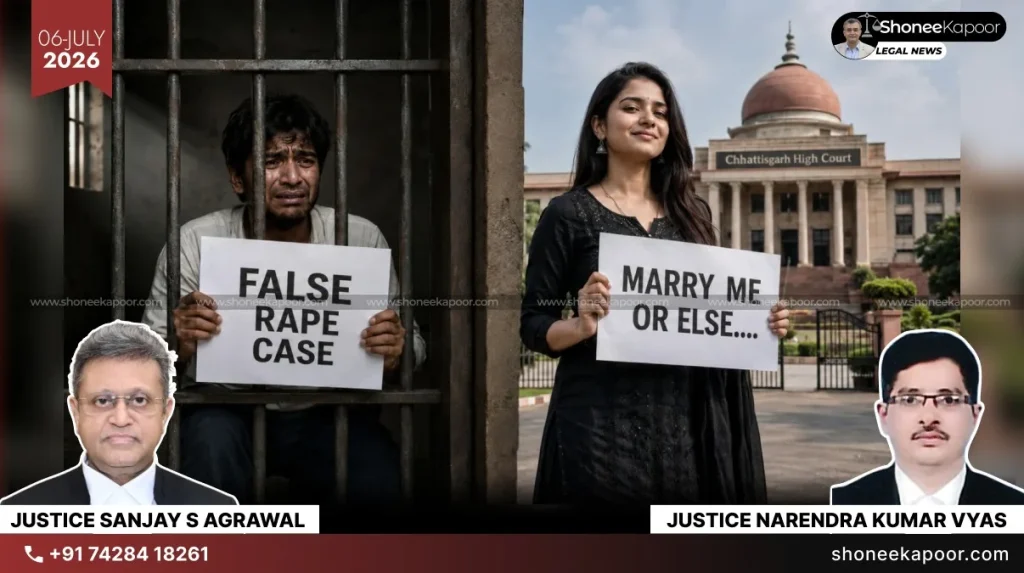
Can a long live-in relationship later become a rape case only because marriage did not happen? Chhattisgarh High Court explains why adult consent, conduct and long relationship history matter.
BILASPUR: The Chhattisgarh High Court has held that when two adults are in a long live-in relationship, a later refusal by the man to marry the woman will not automatically amount to rape.
The Court said that in such relationships, both parties usually understand the nature and consequences of their decision. A desire or discussion about marriage during a live-in relationship does not by itself prove that the physical relationship happened only because of a promise of marriage.
A Division Bench of Justice Sanjay S Agrawal and Justice Narendra Kumar Vyas passed the ruling on June 29 while dismissing an appeal filed by a woman against the acquittal of a man accused of rape and unnatural sex.
The Bench observed, “In a long-drawn live-in relationship… a presumption would arise that they voluntarily chose that kind of a relationship fully aware of its consequences,”
The Court also said that while examining such cases, courts should not take a “pedantic approach”. Instead, they must look at the full facts, including the length of the relationship, the conduct of both parties and whether consent can be reasonably presumed.
The case involved a 40-year-old woman who was working as a Project Manager with the Bhilai Municipal Corporation. She alleged that she met the accused while studying for an MBA at the Indian Institute of Management, Raipur in 2019.
According to her, the accused had assured her that he would marry her. She claimed that because of this assurance, they entered into a physical relationship and lived together for around two years.
She further alleged that after completion of the MBA course, the accused started avoiding the topic of marriage. Later, he allegedly told her that his parents were not ready for the marriage because she was older than him, divorced and Christian.
She also claimed that on November 28, 2021, when she went to his residence and again asked him to marry her, he subjected her to unnatural sexual intercourse against her wishes.
On the basis of her complaint, an FIR was registered in December 2022 under Sections 376 and 377 of the Indian Penal Code.
However, the trial court acquitted the accused after finding that the prosecution failed to prove the case beyond reasonable doubt. The woman then challenged the acquittal before the Chhattisgarh High Court.
The High Court examined the evidence and noted several important facts. During cross-examination, the woman admitted that she was ready to settle the dispute before the Women’s Commission for ₹30 lakh. The Court also noted that the accused had given a cheque of ₹15 lakh as part of the proposed settlement, but later stopped payment after the settlement did not take place.
The Court further noted that the woman herself admitted that both parties had agreed to marry only if their respective families consented. This became important because it showed that marriage was not an unconditional promise made only by the accused.
The Bench also considered the statement of the woman’s brother. He stated that the woman had told him that the physical relationship developed because both of them were in a love affair, even though they belonged to different communities.
The medical evidence also did not support the allegations of force. The doctor who examined the woman stated that she had not complained of forced sexual intercourse or unnatural sex during the medical examination. The doctor also found no injuries suggesting unnatural sexual intercourse.
After considering the full evidence, the High Court held that the trial court was right in treating the relationship as consensual. The Court found that this was not a case where consent was obtained only on a false promise of marriage.
The Bench observed, “The finding recorded by the learned trial Court that the victim and the accused were living in long drawn relationship as such, the physical relationship is consensual relationship. As such, the accused cannot be punished for commission of offence of rape is in conformity with the law laid down by the Hon’ble Supreme Court,”
The High Court finally upheld the acquittal of the accused and dismissed the woman’s appeal.
EXPLANATORY TABLE OF ALL LAWS/SECTIONS MENTIONED
| LAW / SECTION / CASE LAW | WHAT IT MEANS | HOW IT WAS RELEVANT IN THIS CASE |
| Section 376 IPC | Punishes the offence of rape. | FIR was registered alleging that the accused had physical relations with the woman on promise of marriage. The Court found the relationship was consensual and upheld acquittal. |
| Section 376(2)(n) IPC | Covers repeated rape on the same woman. | The prosecution alleged repeated physical relations from 2019 to 2021, but the Court noted long live-in relationship and lack of proof of non-consent. |
| Section 376(2)(k) IPC | Deals with rape by a person in a position of control or dominance over a woman. | The trial court had acquitted the accused of charges including Section 376(2)(k)(n), and the High Court found no perversity in the acquittal. |
| Section 377 IPC | Earlier dealt with unnatural sex under IPC. | The woman alleged unnatural sexual intercourse, but the doctor stated there was no complaint of unnatural sex and no injury suggesting the same. |
| Acquittal Appeal | Appeal filed against an order acquitting an accused. | The woman filed an acquittal appeal against the trial court judgment dated 24.06.2025, but the High Court dismissed it at admission stage. |
| Ravish Singh Rana vs State of Uttarakhand and Another, 2025 SCC OnLine SC 1055 | Supreme Court case on long live-in relationship, consent and refusal to marry. | The High Court relied on this case to hold that a long live-in relationship gives rise to a presumption of valid consent. |
| Ballu @ Balram @ Balmukund and Another vs State of Madhya Pradesh, (2024) 12 SCC 202 | Supreme Court judgment cited by the defence. | Cited by the respondent accused to support the acquittal and oppose interference by the High Court. |
| Rajnish Singh @ Soni vs State of Uttar Pradesh And Another, (2025) 4 SCC 197 | Supreme Court judgment cited by the defence. | Cited to support the proposition that criminal liability cannot be mechanically imposed in such relationship disputes. |
| Biswajyoti Chatterjee vs State of West Bengal and Another, (2025) 5 SCC 749 | Supreme Court judgment cited by the defence. | Relied upon by respondent No. 1 while arguing that the acquittal should not be disturbed. |
CASE DETAILS
| DETAIL | INFORMATION |
| Case Title | XYZ vs Siddharth Sarangi & State of Chhattisgarh |
| Court | High Court of Chhattisgarh at Bilaspur |
| Case Number | ACQA No. 380 of 2025 |
| Neutral Citation | 2026:CGHC:26186-DB |
| Reserved On | 17.06.2026 |
| Delivered On | 29.06.2026 |
| Coram / Bench | Hon’ble Shri Sanjay S. Agrawal, Judge and Hon’ble Shri Justice Narendra Kumar Vyas, Judge |
| Judgment Authored By | Justice Narendra Kumar Vyas |
| For Appellant | Mrs. Shriya Jaiswal (Marhas), Advocate |
| For Respondent No. 1 | Mr. B.P. Sharma with Mr. Sanjeev Pandey, Advocates |
| For State | Mr. Sanjeev Pandey, Deputy Advocate General |
| Trial Court Order Challenged | Judgment dated 24.06.2025 passed by Additional Sessions Judge, F.T.C., Raipur in Sessions Trial No. 61/2023 |
| Final Result | Acquittal affirmed. Appeal dismissed at admission stage. |
KEY TAKEAWAYS
- Refusal to marry is not rape
A man cannot be criminally punished only because a relationship did not end in marriage. - Long live-in means consent matters
When two adults live together for years courts must examine conduct not just later allegations. - Broken relationship is not criminal liability
Every failed love affair cannot become a criminal case against the man. - Evidence must defeat emotion
Medical evidence conduct settlement talks and contradictions matter more than one-sided accusations. - Men need protection from relationship revenge cases
Serious laws like rape cannot be used as pressure tools after marriage talks fail.
This Could Change Your Case-Get FREE Legal Advice-Click Here!
Disclaimer: The views and opinions expressed in this article are those of the Indian courts and do not necessarily reflect the official policy or position of “ShoneeKapoor.com” or its affiliates. This article is intended for informational and educational purposes only. The content provided is not legal advice, and viewers should not act upon this information without seeking professional counsel. Viewer discretion is advised.