
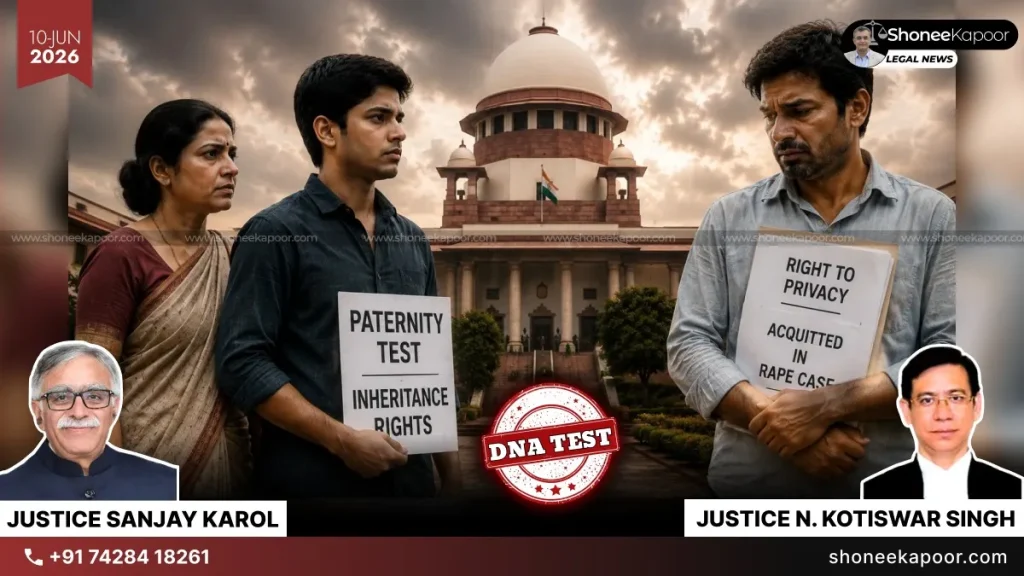
Can a rape acquittal be treated as final proof that no further claims can arise from the same relationship? The Supreme Court says No, holding that paternity disputes must be decided independently on available evidence, including DNA testing where required.
NEW DELHI: In a judgment dated May 29, 2026, Justice Sanjay Karol and Justice N. Kotiswar Singh of the Supreme Court upheld an order directing a DNA test in a dispute involving paternity and inheritance rights.
The case arose from a claim that a man was the biological father of an individual who was seeking legal recognition of that relationship and a share in his property. The claimant asserted that he was born from a relationship between his mother and the alleged father in 1999. However, the alleged father consistently denied paternity and relied, among other things, on his acquittal in a rape case that had been filed against him by the claimant’s mother in the same year.
The dispute continued for several years through maintenance proceedings and other litigation between the parties. During one of those proceedings, a court had observed that the claimant and his mother had failed to establish any relationship with the alleged father. However, the question of paternity was never conclusively determined through a full-fledged civil trial.
After attaining majority, the claimant filed a civil suit seeking a declaration that he was the biological son of the alleged father and was therefore entitled to inheritance rights in his property. The trial court directed a DNA test to determine the issue. The High Court later upheld that order, observing that no other evidence could conclusively establish the truth.
Before the Supreme Court, it was argued that a person cannot be compelled to undergo a DNA test and that such a direction would violate his right to privacy. The opposing side contended that since paternity had always been denied and no other evidence could provide a definitive answer, a DNA test had become necessary to resolve the dispute.
At the same time, the Court noted that later judgments have recognised that DNA testing may be required in exceptional situations where the truth cannot be discovered through any other evidence. Referring to its earlier rulings, the Court observed:
“There can be no dispute, that if the direction to hold such a test can be avoided, it should be so avoided.”
The Court explained that DNA testing should be directed only when it becomes indispensable for resolving the dispute and when the issue of paternity is directly involved. In the present case, the Court found that paternity was the central issue in the civil suit and that there was no other evidence capable of providing a categorical answer.
The Supreme Court further observed that the earlier findings against the claimant and his mother were not the result of a full trial on the issue of paternity. Therefore, those findings could not conclusively settle the question.
Balancing the competing interests, the Court considered the alleged father’s privacy rights on one hand and the claimant’s lifelong quest to know his biological parentage on the other. The Court noted that if the issue remained unresolved, the claimant could permanently lose rights that he may otherwise be entitled to if he was indeed the biological son of the alleged father.
Holding that the balance of interests clearly favoured determining the truth through scientific evidence, the Supreme Court dismissed the appeal and upheld the orders of the trial court and the High Court. The Court directed that the DNA test be conducted and that the civil suit proceed further on the basis of the result received thereafter.
EXPLANATORY TABLE: LAWS & SECTIONS INVOLVED
| Law / Section | Purpose | Relevance in This Case |
| Section 376, Indian Penal Code, 1860 | Punishes the offence of rape | The claimant’s mother had earlier filed a rape case against the alleged father, who was later acquitted. |
| Section 125, Code of Criminal Procedure | Provides maintenance to wives, children and parents in certain circumstances | Earlier maintenance proceedings took place between the parties. |
| Section 112, Indian Evidence Act, 1872 | Presumption regarding legitimacy of a child born during a valid marriage | The Supreme Court discussed principles governing DNA testing and paternity disputes under this provision. |
| Section 114, Indian Evidence Act, 1872 | Allows courts to draw certain presumptions from conduct and circumstances | The appellant argued that no adverse inference should be drawn against him at this stage. |
| Principle of Res Judicata | Prevents re-litigation of issues already finally decided | The appellant argued the civil suit was barred, but the Supreme Court rejected the contention. |
CASE DETAILS
- Case Title: Chaturbhuj Pradhan v. Amar Pradhan & Anr.
- Court: Supreme Court of India
- Bench:Justice Sanjay Karol | Justice N. Kotiswar Singh
- Neutral Citation: 2026 INSC 600
- Case Number: Civil Appeal arising out of Special Leave Petition (Civil) No. 4016 of 2026
- Date of Judgment: May 29, 2026
KEY TAKEAWAYS
- Courts cannot order DNA tests casually, but when paternity is the core issue and inheritance rights depend on it, scientific evidence may become unavoidable.
- A man’s right to privacy remains important, yet it is not absolute when another person’s legal status and property rights cannot be determined without a DNA test.
- Earlier maintenance proceedings or acquittals in criminal cases do not automatically settle a later civil dispute regarding paternity.
- DNA testing should remain an exceptional remedy and must be used only when ordinary evidence cannot conclusively establish the truth.
- Paternity claims affecting family property rights must be decided on evidence and facts, not assumptions, emotions, or decades-old allegations.
This Could Change Your Case-Get FREE Legal Advice-Click Here!
Disclaimer: The views and opinions expressed in this article are those of the Indian courts and do not necessarily reflect the official policy or position of “ShoneeKapoor.com” or its affiliates. This article is intended for informational and educational purposes only. The content provided is not legal advice, and viewers should not act upon this information without seeking professional counsel. Viewer discretion is advised.