
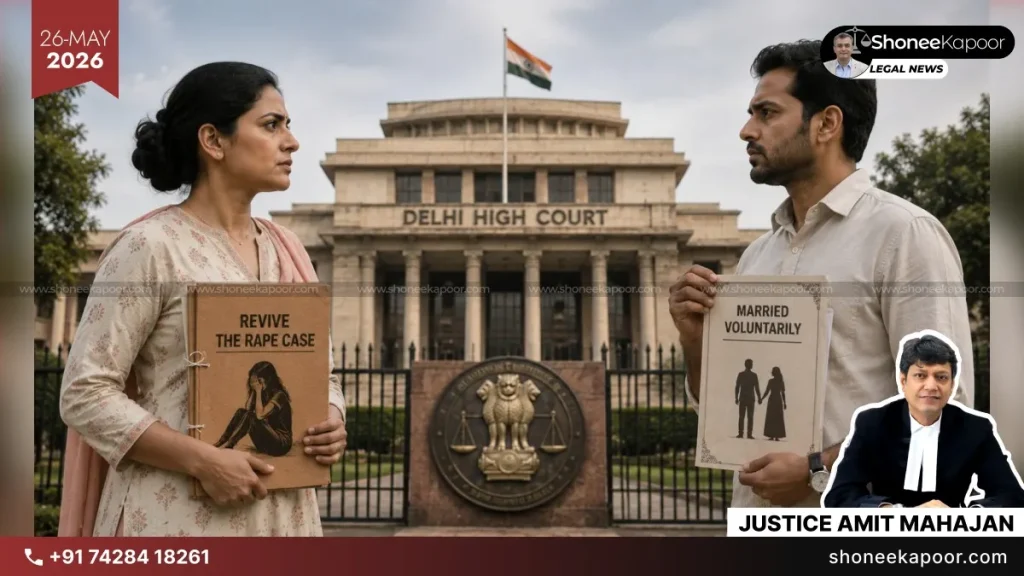
If couples settle and marry, can old criminal cases return after separation?
Delhi High Court held that later matrimonial disputes alone cannot reopen settled criminal proceedings.
NEW DELHI: The Delhi High Court recently refused to restore a rape FIR against a husband after the marriage between the parties later turned bitter. Justice Amit Mahajan made it clear that once a criminal case is quashed by the Court after a voluntary settlement, later matrimonial disputes alone cannot reopen the case.
The case started after a woman lodged an FIR at PS Laxmi Nagar under Sections 376(2)(n), 313 and 506 IPC. She alleged that the man had physical relations with her on the promise of marriage and also forced her to terminate her pregnancy by giving abortion pills.
However, after the FIR was registered, both parties got married on 31.05.2024 according to Hindu rites and ceremonies. Later, the husband approached the Delhi High Court seeking quashing of the FIR on the ground that the dispute had been settled and the parties were now married.
While quashing the FIR earlier, the Court had recorded the woman’s statement where she admitted that:
“She was in a consensual relationship with the Respondent. The complaint had been lodged, due to certain misunderstandings between the parties and when the Respondent had refused to marry her.”
and that after marriage-
“She was happily residing with the Respondent and did not wish to pursue the proceedings arising out of the FIR.”
Around six months later, the woman again approached the Court and sought recall of the quashing order. She claimed that the husband and his family had allegedly cheated her and only agreed to marriage to escape criminal prosecution. She further alleged physical violence, emotional abuse, financial exploitation and threats after the FIR was quashed.
The husband opposed the plea and argued that once the FIR was quashed by a final judicial order, the High Court had no power to review or reopen the matter under Section 362 CrPC and Section 403 BNSS. He also argued that any later matrimonial disputes could at best give rise to fresh legal remedies but could not revive the already quashed FIR.
The High Court agreed with the husband and observed that criminal courts become functus officio after passing a final order and cannot review or alter such orders except for clerical mistakes. The Court relied on several Supreme Court judgments and held that inherent powers under Section 482 CrPC or Section 528 BNSS cannot be used to indirectly review final orders.
Justice Amit Mahajan further noted that the FIR was not quashed merely because of a future promise of a happy marriage. The Court had already considered that the parties had voluntarily married before the quashing order and that the woman herself had supported quashing before the Court through her statement and affidavit.
The Court also explained that every failed relationship or broken promise to marry does not automatically amount to rape. Referring to Supreme Court rulings, the Court observed that to attract rape charges on false promise of marriage, it must be shown that the promise itself was false from the beginning and made without any intention to marry.
Rejecting the woman’s plea, the Court held that later matrimonial fights, cruelty allegations or breakdown of marriage cannot by themselves prove that the earlier quashing order was obtained by fraud. The Court observed that if every later dispute was allowed to reopen settled criminal cases, no settlement or quashing order would ever attain finality.
Finally, the Delhi High Court dismissed the recall application but clarified that if the woman believes any fresh offences were committed after marriage, she is free to take separate legal remedies available under law.
Explanatory Table: Laws & Sections Involved
| Law / Section | Purpose | How Applied In This Case |
| Section 376(2)(n) IPC | Deals with repeated sexual intercourse treated as rape under law | The woman alleged that physical relations happened on a false promise of marriage |
| Section 313 IPC | Punishes causing miscarriage without the woman’s consent | The FIR alleged that abortion pills were given forcibly |
| Section 506 IPC | Punishment for criminal intimidation or threats | Threat allegations were also part of the FIR |
| Section 482 CrPC | Gives High Courts inherent powers to prevent misuse of legal process and secure justice | Earlier, the Delhi High Court used this power to quash the FIR after settlement |
| Section 528 BNSS | New equivalent provision under BNSS replacing Section 482 CrPC | Court referred to this while discussing quashing powers |
| Section 362 CrPC | Criminal courts cannot review or change final judgments except clerical mistakes | Main legal bar against reopening the already quashed FIR |
| Section 403 BNSS | BNSS equivalent of Section 362 CrPC | Court relied on this to hold that recall of final order is not permissible |
| Functus Officio Principle | Once a Court passes a final order, it loses authority to reopen the same matter | Court said it became functus officio after quashing the FIR |
Case Details
- Case Title: Ashwini Pal v. State NCT of Delhi and Anr.
- Case Number: CRL.M.C. 5219/2024
- Court: Delhi High Court
- Bench: Justice Amit Mahajan
- Date Of Judgment: 22 May 2026
- Neutral Citation: 2026:DHC:4598
- Police Station: PS Laxmi Nagar, Delhi
- FIR Number: FIR No. 152/2024
- Counsels:
- For Petitioner: Mr. Nandan Kumar Rai and Mr. Gajendra Mohan Thakur
- For State: SI Prashant Malik, PS Laxmi Nagar
Key Takeaways
- A failed relationship or broken marriage does not automatically turn every past consensual relationship into a criminal offence.
- Criminal cases settled voluntarily before courts cannot be endlessly reopened because relations later turned bitter.
- Courts must protect the finality of judicial orders, otherwise settlements and reconciliations will lose all legal value.
- Allegations made after settlement may create fresh legal remedies, but cannot automatically revive old criminal proceedings.
- Misuse of serious criminal provisions in personal relationship disputes remains a growing concern requiring balanced judicial scrutiny.
This Could Change Your Case-Get FREE Legal Advice-Click Here!
Disclaimer: The views and opinions expressed in this article are those of the Indian courts and do not necessarily reflect the official policy or position of “ShoneeKapoor.com” or its affiliates. This article is intended for informational and educational purposes only. The content provided is not legal advice, and viewers should not act upon this information without seeking professional counsel. Viewer discretion is advised.